


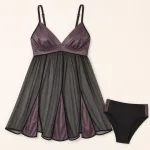
Three-Gore Adjustable Mesh Babydoll Set
August 14, 2026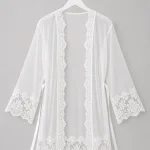
White Sheer-Mesh Kimono Robe with Scalloped Floral Lace Trim
August 14, 2026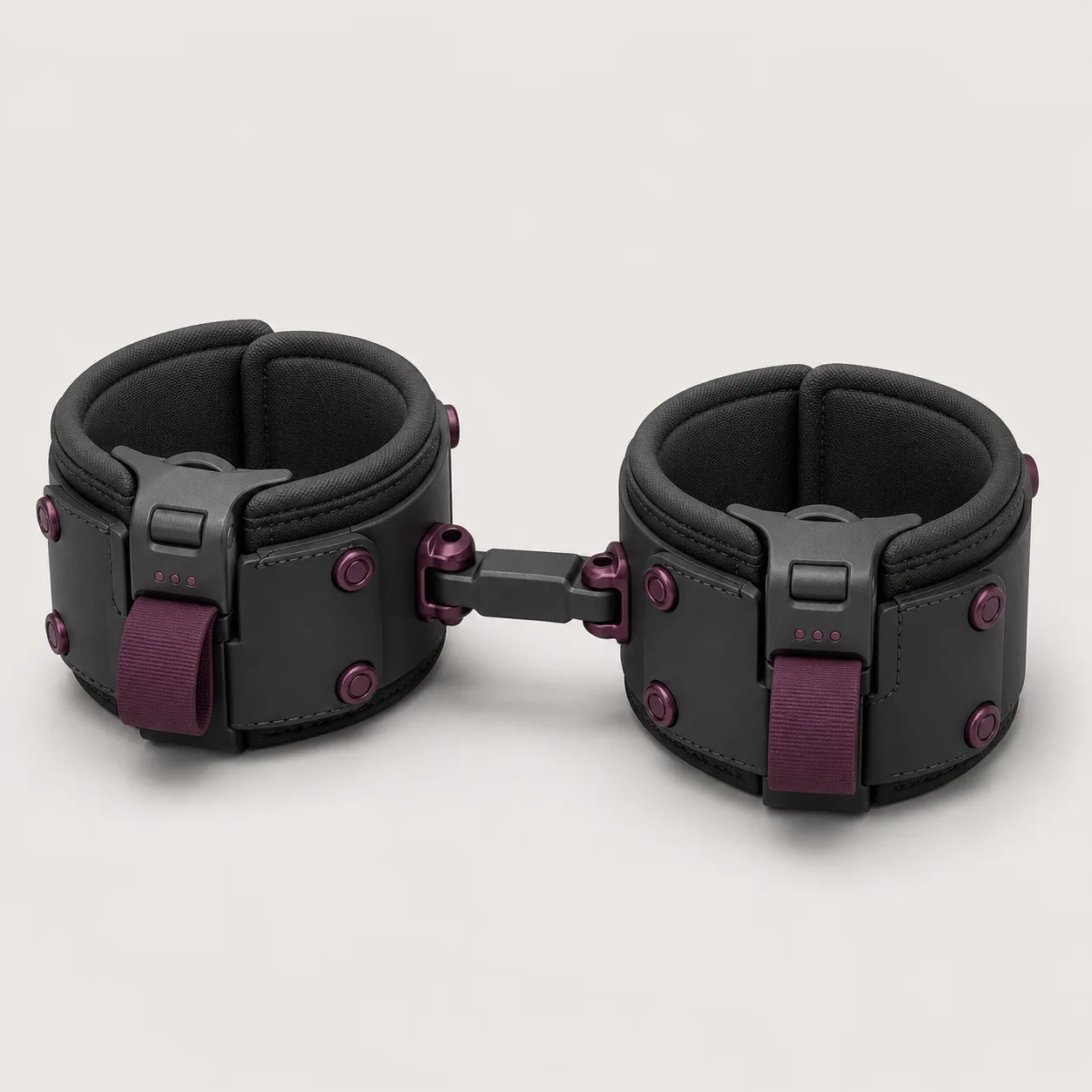
Four-Sector Load-Balancing Ankle Cuffs with Captive Swivel Link
A matched ankle restraint concept with four articulated padded sectors per cuff, independent quick-release tabs and a short captive dual-joint swivel link.
44,99 $
200 in stock
Distribute restraint load across four padded sectors
These four-sector load-balancing ankle cuffs form each oval cuff from four broad overlapping charcoal sectors rather than one uninterrupted strap. Guarded plum pivots let adjacent sectors settle around a measured fixture, while a short captive center link gives the matched cuffs independent angular movement without a loose chain.

The image does not prove fit range, load sharing, release force, joint capture, padding performance, material composition, hardware rating, cleanability or production availability.
Inventory every sector joint and closure part
Request an exploded bill of materials for cuff A and cuff B: sectors S1 through S4, inner pads, border rolls, hinge leaves, pivot pins, bushings, guard caps, front bridge, buckle tongue, latch, quick-release webbing, three alignment indicators, stitching, backing, link-end eyes, two universal-joint collars, central swivel body, retainers, pigments, lubricants, coatings, adhesives and concealed reinforcement.
Each item needs a drawing revision, tolerance, batch record and approved sample reference.
Establish cuff and link dimensions
Measure relaxed inner major and minor axes, usable circumference range, cuff height, sector thickness, overlap length, pivot spacing, bridge width, release-tab length, link eye separation, center-body length, joint offsets, mass and center of gravity. Record both cuffs independently.
Compare clockwise and counterclockwise measurements so mirrored assembly errors are visible.
Characterize the four inner pads
At each sector, measure pad thickness, compression force at several depths, recovery time, hardness, density, seam prominence and moisture uptake. Map transitions where one padded edge meets the next and check for an uncovered hard ledge.
Compression should remain consistent after conditioning; a soft visual surface does not establish load-spreading performance.
Verify overlap between neighboring sectors
Measure overlap and edge coverage at every joint across the declared fit range. Flex the cuff on calibrated oval mandrels and inspect whether backing, pin bosses or stiff corners become accessible as sectors articulate.
No overlap should reverse, buckle inward or create a narrow pressure ridge under conservative fixture load.
Measure all guarded pivot clearances
For eight pivots in total, log radial play, axial play, breakaway torque, running torque, guard overlap and accessible gaps while relaxed, fitted and gently twisted. Use articulated gauges and record each joint by cuff and clock position.
Pin migration, cap lift, scraping, binding or growing clearance requires quarantine and root-cause review.
Calibrate both front buckle bridges
Measure closure travel, engagement depth, latch force, false-latch behavior, webbing retention and resistance to accidental contact. Confirm that the three indicator dots correspond to documented positions rather than decoration.
The bridge must sit clear of neighboring pivots and keep its edges covered through the whole approved range.
Map fit on oval sizing mandrels
Use rigid and compliant oval mandrels spanning the proposed range. At each setting, record inner contour, pad compression, bridge angle, sector angles, gap accessibility and the force needed to close and open each cuff.
Publish a fit chart only after both cuffs meet the same measured limits; visual symmetry alone is insufficient.
Measure load sharing around each cuff
Apply conservative axial and off-axis fixture tension through the captive link while pressure sensors map all four sectors. Compare peak pressure, average pressure, sector contribution, bridge loading and left-right symmetry at multiple cuff settings.
A single overloaded sector indicates poor articulation, mismatched padding or a binding pivot.
Characterize the captive swivel link
Measure rotation around the center body, angular travel at both plum collars, end play, radial play, breakaway torque and hard-stop contact. Challenge combined yaw, pitch and roll without exceeding the approved fixture load.
Document whether a joint can fold against a cuff edge, trap a release tab or expose a retainer.
Time both emergency quick releases
Measure pull direction, required force, travel, release time and hardware retention for each broad plum tab while unloaded and under several conservative fixture loads. Repeat with gloves, low light, dust and approved cleaning residue.
A release must remain easy to identify and must not detach into a loose small part.
Inspect stitching backing and edge rolls
Count stitch density, inspect lock formation and measure seam allowance at every sector, bridge and pull-tab anchor. Abrade representative edge rolls and backing samples, then check for fraying, exposed reinforcement, dye transfer and sharp cut ends.
Confirm cleaner compatibility and measured drying time for all absorbent layers and hidden overlaps.
Challenge asymmetry and single-joint faults
Introduce bounded drag at one pivot, reduced pad compression at another sector and a controlled amount of link play in separate test specimens. Monitor contour, pressure, closure force, swivel path, release time and hardware movement.
Stop before permanent damage; do not rely on a neighboring sector to conceal a failing component.
Cycle fitting loading cleaning and storage
Run repeated closure, adjustment, conservative axial loading, joint articulation, quick release, cleaning, measured drying and flat storage. At checkpoints repeat dimensions, pad recovery, overlap, pivot play, load sharing, bridge engagement, swivel range, stitching and corrosion inspection.
Retire samples with torn padding, inward folds, loose pins, lifted caps, unreliable latches, stretched release anchors, seized swivel collars, exposed reinforcement, persistent residue or permanent distortion.
Build landed price after restraint testing
An Alibaba bondage wrist-and-ankle cuff page currently shows a PU leather adjustable cuff category example at USD 0.67-0.69 with MOQ one. It is a price benchmark only and does not confirm this four-sector construction, captive swivel link, padded overlap system or an approved supplier.
The procurement reference supports an EUR 44.99 planning price after allowing for China-origin freight, exact-model sourcing, paired-cuff inspection, sector and padding metrology, pivot-gap checks, fit mapping, load-distribution testing, swivel characterization, release timing, textile review, cycle life, protective packing and discreet fulfillment. Exact quotation, MOQ, materials, hardware ratings, packed size, weight, freight, duty, tax, insurance, payment fees, certifications and delivery terms remain pending.
Frequently asked questions
Why are there four sectors per cuff?
The concept uses articulated padded sectors to distribute fixture load; measured pressure mapping is still required.
Can the cuffs rotate independently?
The short captive link includes two joint collars, but angular range and stop clearances remain pending.
Do the plum tabs release both cuffs?
Each cuff has its own visible pull tab and must be timed separately under controlled loads.
How is fit determined?
Use measured oval mandrels, inner contour, pad compression and closure force rather than a visual estimate.
Can the pivots pinch?
All eight guarded joints need articulated-gap tests at every approved fit setting and under gentle twist.
Which faults require retirement?
Torn pads, inward folds, pin migration, lifted guards, false latching, stretched anchors, seized joints, exposed reinforcement, persistent residue or permanent distortion.

Reviews
There are no reviews yet.