



Extended-Size Lace-Trim Satin-Look Slip and Robe Set – 4 Colours
August 14, 2026
Twin-Wheel Three-Stop Depth Sensory Pinwheel with Triple Rolling Guards
August 14, 2026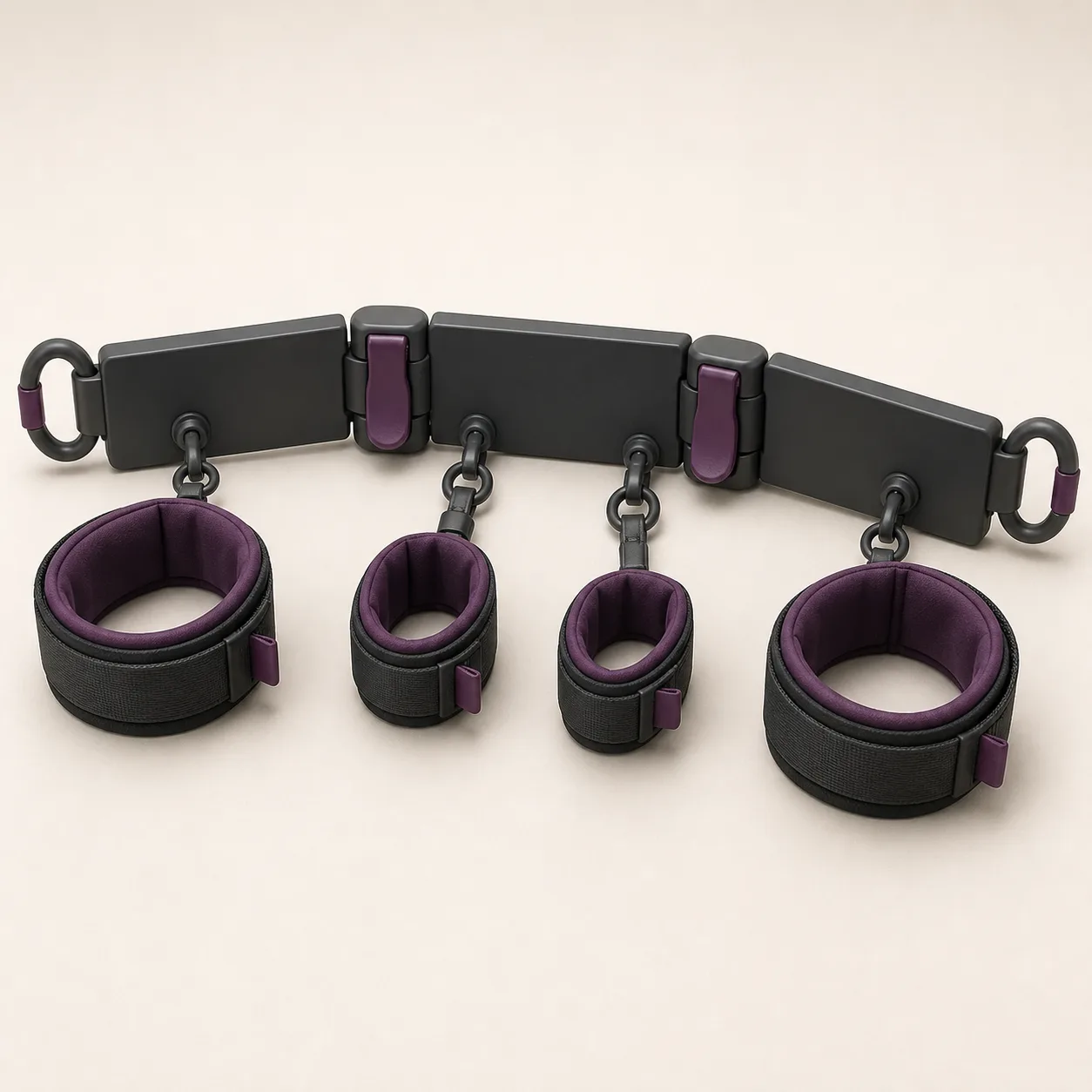
Three-Panel Folding Spreader Bar with Guarded Locks and Four Padded Cuffs
A folding bondage spreader-bar concept with three low-profile panels, two guarded over-center locks, four padded cuffs and two gated end eyes; not for suspension.
54,99 $
200 in stock
Fold three panels into a compact restraint bar
This three-panel folding spreader bar concept replaces a telescoping tube with three low-profile panels and two guarded over-center lock stations. Four padded cuffs attach at separated underside anchors, while rotating gated eyes at both ends provide visible handling points rather than hidden sockets.

The image does not establish panel material, unfolded span, hinge angles, lock capacity, cuff sizes, anchor strength, release performance or suitability for any specific load. This design is not proposed for suspension.
Inventory every part in the complete set
Obtain a bill of materials for three panel shells and cores, two hinge bodies, pivot pins, retainers, over-center links, lock levers, guards, hard stops, four cuff anchors, two end-eye pivots, two gated eyes, four connectors, two wider cuffs, two narrower cuffs, padding, liners, adjustment straps, quick-release tabs, stitching, edge binding, coatings, pigments, lubricants and adhesives.
Confirm that all four cuff assemblies and every connector are included in each packed unit.
Confirm component geometry before loading
Record each panel length, width, thickness, edge radius, hinge-center spacing, folded envelope, open span, cuff-anchor coordinates, end-eye axes, connector reach, cuff internal circumference range, pad width and thickness, strap overlap and total mass.
Measure the set in folded, partially open and intended open states without forcing either hinge beyond its stop.
Inspect panel alignment and flatness
Map bow, twist, face flatness, edge mismatch and centerline offset for all three panels. Inspect every panel-to-hinge joint for cracks, loose fasteners, coating damage and local deformation before and after conditioning.
A central panel that sits out of plane can change cuff spacing and concentrate load at one hinge.
Characterize both hinges through their full arc
Measure free angle, working angle, hard-stop angle, pivot friction, axial play, radial play, side clearance and repeatability at each hinge. Compare movement in both directions and after controlled contamination and cleaning.
Hinge geometry must not depend on a cuff connector acting as a travel limiter.
Prove the locks cross a stable center
Track lever force, linkage angle, over-center margin, latch engagement, rebound, false closure and unlock force at both stations. Add clear witness marks so a nearly closed lever cannot be mistaken for a secured state.
Test one lock at a time and both together under conservative fixtures before any wear cycling.
Map guard and folding gaps
Probe lever edges, pivot cheeks, over-center links, panel ends, hard stops, anchor eyes, end-eye gates and all folded-panel interfaces throughout opening, locking, loading and release. Use articulated gauges rather than fingers.
Guards should limit access while leaving enough visibility to identify debris, damage and incomplete engagement.
Map the four cuff anchors separately
Measure each anchor eye diameter, section, rotation, connector articulation, fastener capture, pull direction and interference with adjacent panels. Apply conservative axial, transverse and angled fixture loads to one anchor at a time.
Do not infer the capacity of the center pair from the outer pair or from visual symmetry.
Evaluate the rotating gated end eyes
Record rotation range, gate opening, closure force, captured clearance, side play and access in folded and open states. Check whether an end eye can contact a hinge lever, cuff connector or panel edge during movement.
The end eyes are not suspension points unless independently engineered, documented and approved for that use; no such approval is claimed.
Inspect every padded cuff individually
For both wider and both narrower cuffs, measure usable circumference range, pad width, thickness, compression, seam position, liner continuity, strap width, overlap, tab size and connector alignment. Inspect for hard points, rough edges, color transfer and uneven padding.
Fit evaluation should allow circulation monitoring and immediate access to every tab.
Measure quick-release access under tension
Verify adjustment, closure, release-tab force, one-handed access and disengagement under conservative direct and angled fixture tension. Repeat with dry, damp and gloved fixtures and with the bar in each intended orientation.
Establish a second release method that does not rely on the same tab, connector or hinge path.
Perform conservative static-load screening
Use an instrumented fixture and a written low-load protocol to measure panel deflection, hinge rotation, lock creep, anchor displacement and cuff-connector movement. Stop before permanent set, coating damage, rising noise or visible deformation.
Published use limits require engineering evidence and a safety factor; supplier marketing or visual thickness is not evidence.
Challenge asymmetric and unintended loads
Load one outer cuff, one center cuff and diagonal pairs separately while observing panel twist, hinge bias, lever movement, anchor alignment and end-eye interference. Add small cyclic reversals to reveal loose retainers or progressive latch walk.
Quarantine any sample with a bent panel, growing play, partial lock opening, frayed connector, torn cuff or inaccessible release.
Cycle folding locks cuffs and cleaning
Run repeated open, lock, conservative load, release, fold, cuff adjustment, quick release, cleaning, measured drying and storage cycles. At checkpoints repeat panel geometry, hinge play, over-center margin, anchor alignment, cuff fit and release force.
Validate cleaning at guards, hinge cheeks, panel seams, anchor eyes, gates, connectors, strap overlaps, padding edges and release tabs without trapping moisture.
Build landed cost after lock verification
An Alibaba bondage-bar results page currently shows a stainless-steel spreader-bar category example with cuffs at USD 3.80-6.80 and MOQ one. It is only a category benchmark and does not confirm this three-panel folding architecture, guarded over-center locks, four-cuff layout or approved supplier.
The procurement reference supports an EUR 54.99 planning price after allowing for China-origin freight, exact-model sourcing, complete-set inspection, panel and hinge metrology, over-center lock calibration, gap mapping, four-anchor and end-eye tests, individual cuff and release analysis, conservative asymmetric load screening, full fold-and-care cycling, material evidence, protective packing and discreet fulfillment. Exact quotation, MOQ, materials, load limits, packed size, weight, freight, duty, tax, insurance, payment fees and delivery terms remain pending.
Frequently asked questions
Is this bar designed for suspension?
No. No suspension rating is claimed, and the sourcing plan treats it only as a floor- or surface-level restraint concept.
How do the two hinges lock?
The proposal uses guarded over-center levers, but margin, false closure, creep and unlock force require physical testing.
Are all four cuffs the same size?
The visualization proposes two wider and two narrower cuffs; each circumference range and pad profile must be measured individually.
Can either hinge fold unexpectedly?
Lock engagement, witness marks, asymmetric loading and cycle tests must establish the risk and retirement criteria.
How are releases kept accessible?
Every quick tab should remain reachable in intended orientations, with a separate backup release method prepared.
Which faults require retirement?
A bent panel, cracked hinge, missing retainer, rising pivot play, lever creep, deformed anchor, damaged gate, torn cuff, frayed connector or unreliable release.
Reviews
There are no reviews yet.