


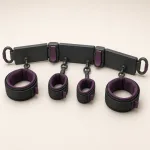
Three-Panel Folding Spreader Bar with Guarded Locks and Four Padded Cuffs
August 14, 2026
Floor-Length Satin Duster Robe with Floral-Lace Shoulder Yoke and Twin Side Slits
August 14, 2026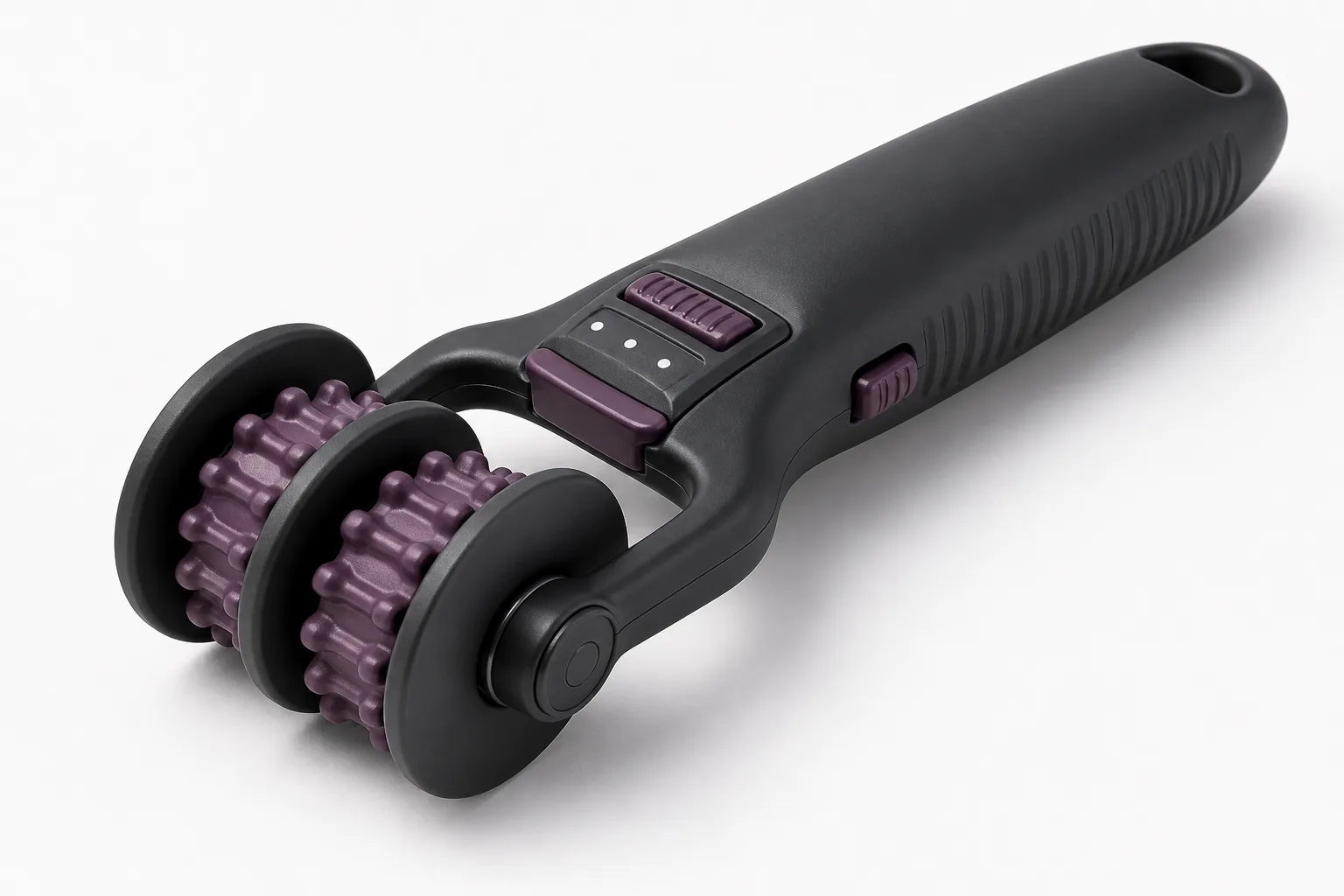
Twin-Wheel Three-Stop Depth Sensory Pinwheel with Triple Rolling Guards
A guarded BDSM sensory roller concept with two rounded-tooth tracks, three smooth rolling guides, three indexed projection states and a broad lift-release tab.
39,99 $
200 in stock
Compare two rounded-tooth wheels through three rolling guards
This twin-wheel guarded sensory pinwheel concept places exactly two smoky-plum rolling wheels in one charcoal fork. Larger smooth guide discs flank the pair and divide the tracks, while a three-stop depth slider and broad lift-release tab define the verification path.

The render does not prove tooth dimensions, projection, guard motion, pressure, rolling quality, materials or manufacturing availability.
Inventory the complete rolling head and handle
Require a bill of materials for toothed wheels W1 and W2, outer guards G1 and G3, center guard G2, axle, bushings or bearings, washers, spacers, fork arms, caps, depth carrier, slider, three detents, travel stops, release tab, lift linkage, storage lock, handle shell, grip ribs, lanyard insert, coatings, pigments, lubricants and adhesives.
Confirm whether guards and toothed wheels rotate independently or share axle drag.
Measure wheel guard fork and handle geometry
Record wheel diameters, widths, pitch circles, tooth count, tooth height and radius, guard diameters and widths, W1-W2 track spacing, guard overlap, axle span, fork clearance, head angle, slider travel, handle length and circumference, lanyard-eye dimensions, mass and balance.
Repeat after rolling, adjustment, cleaning, drop and storage cycles.
Profile every rounded tooth on both wheels
Scan each tooth for tip radius, height, width, pitch, flank angle, molding seam, flash, voids, runout and local hardness. Compare W1 and W2 without averaging defects across the two tracks.
Reject sharp points, burrs, chips, thin roots, exposed reinforcement, edge flash or irregular pitch that creates isolated peaks.
Calibrate guard diameter and exposed projection
Measure the radial difference between each tooth tip and adjacent guard rims at every slider stop. Record left, center and right guard runout and their alignment with both toothed tracks.
A larger visible guard does not prove a safe projection; loaded guard deflection and tooth compression must be included.
Measure rolling torque and axle behavior
Record breakaway torque, running torque, directionality, coast, wobble, axial play, radial play and sound for W1, W2 and G1-G3. Test clean, after approved lubrication and after drying.
Reject seizing, chatter, reverse drag, cap migration, washer contact, guard-wheel rubbing or torque drift that changes the sensory pattern.
Verify all three depth-slider stops
Measure slider force, travel, detent depth, indication, carrier position and actual tooth projection at all three states approached from both directions. Repeat under light standardized rolling load.
Reject false seating, spontaneous movement, stop compression or a state that produces inconsistent left-right projection.
Test the broad lift-release tab
Measure tab force, travel, guard lift, residual tooth exposure and reset from each indexed stop while stationary and rolling on fixtures. Confirm that release remains reachable without touching the wheels.
The release path must be mechanical, immediate and independent of sliding through a deeper setting.
Map dual-track spacing and trace consistency
Measure W1-W2 center spacing, parallelism, phase relationship and trace separation through straight, curved and diagonal passes. Record whether the center guard contacts and how it influences steering.
Reject converging tracks, fork twist, wheel overlap, center-guard scuffing or phase lock that creates repetitive local loading.
Quantify rolling force and local pressure
Use instrumented compliant sheets to record handle force, guard load, tooth contact area, peak pressure, trace uniformity and slip at each depth stop, direction and speed. State fixture compliance and pass length.
Do not translate bench pressure into a body-use limit without a validated protocol and exact material evidence.
Review grip angle control and accidental adjustment
Measure grip pressure, wrist angle, slip, head visibility, slider reach, tab reach, storage-lock force and accidental contact during straight and curved fixture passes. Test dry and approved damp-hand conditions.
Reject a handle balance that increases uncontrolled tip load or allows the slider to move during ordinary grip changes.
Screen gaps pinch points and cleaning access
Probe tooth roots, W1-W2 gap, all guard-wheel interfaces, axle caps, fork slots, depth carrier, slider, release linkage, shell seam, grip ribs and lanyard eye for pinch, hair entrapment, residue and moisture traps.
Define washing, brushing, rinsing, measured drying, inspection and any approved disassembly without removing captive hardware.
Verify materials coatings and corrosion resistance
Require exact substrate, tooth and guard materials, restricted-substance evidence, coating chemistry, pigment, lubricant and adhesive declarations. Test colorfastness, abrasion, swelling, stress cracking and cleaner compatibility.
Expose axle, caps, washers and fork hardware to the verified cleaning cycle and inspect for corrosion, staining, pitting and lubricant loss.
Cycle rolling adjustment release and storage lock
Cycle W1, W2 and G1-G3 rotation, all depth states, lift release, lock changes, fork loading, approved cleaning, drying and storage. Track torque, play, projection, detent force, release travel and cap position.
Retire for damaged teeth, guard cracks, seized wheels, rising wobble, axle migration, fork distortion, slider drift, delayed lift, shell cracks, corrosion or persistent residue.
Build landed price after projection proof
An Alibaba BDSM pinwheel page showed a sensory roller category example at USD 6.20-6.60 with MOQ one. It is a benchmark only and does not confirm this twin-wheel triple-guard mechanism or an approved supplier.
The procurement reference supports an EUR 39.99 planning price after allowing for China-origin freight, exact-sample sourcing, part inventory, tooth and guard metrology, projection calibration, wheel and guard torque, release testing, dual-track analysis, force and pressure mapping, grip review, gap screening, material and corrosion evidence, cleaning and cycle durability, protective packing and discreet fulfillment. Exact quotation, MOQ, materials, packed size, weight, freight, duty, tax, insurance, payment fees, certifications and delivery terms remain pending.
Frequently asked questions
Are the wheel teeth sharp?
The concept shows rounded scallops, but every tip radius, seam and defect requires sample inspection.
What changes at the three slider stops?
Actual tooth projection and guard position at each state remain pending.
Do all five discs rotate independently?
Axle, bushing, spacer and drag allocation require teardown and torque tests.
What does the lift-release tab do?
Guard lift, residual exposure and response time must be measured at each setting.
Can the head be washed?
The approved cleaning, brushing, rinsing and drying method depends on verified materials and captive hardware.
Which defects require retirement?
Damaged teeth, cracked guards, seizure, wobble, axle migration, slider drift, corrosion or residue.
Reviews
There are no reviews yet.