


Four-Panel Padded Posture Collar
August 14, 2026
Purple Double-End Flex-Neck Wand with Bulb Head and Tapered Tip
August 14, 2026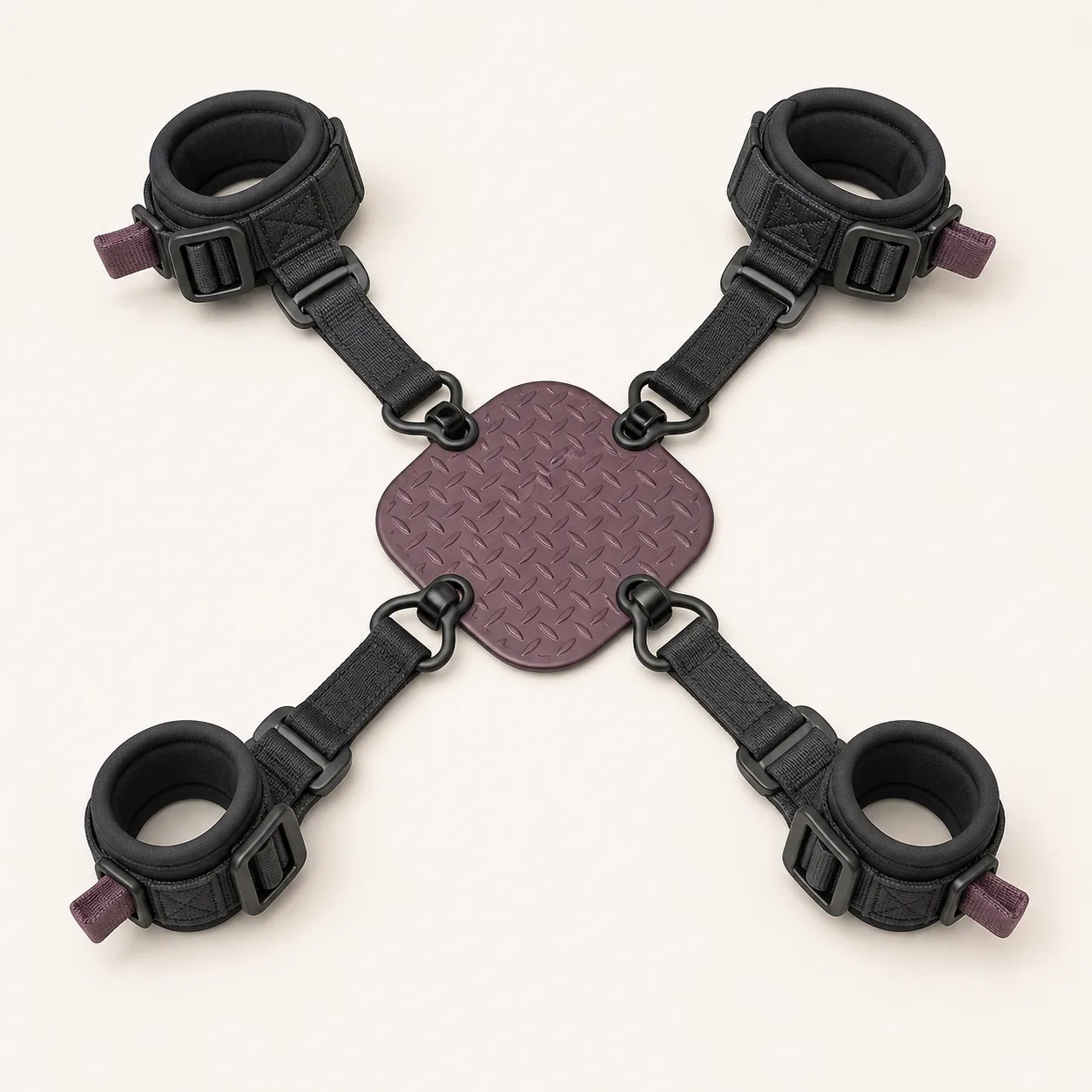
Four-Cuff Diamond Equalizer Restraint Set
A four-cuff restraint concept with adjustable webbing, individual release tabs and one central diamond plate with four rotating attachment eyes.
59,99 $
200 in stock
Distribute four restraint lines through one plate
This four-cuff diamond equalizer restraint set concept connects exactly four padded cuffs to one central smoky-plum plate. Four adjustable webbing straps terminate at four rotating eyes, while each cuff includes one ladder buckle and one high-contrast release tab.

The image defines a validation layout and does not confirm load sharing, cuff fit, hardware materials, release performance or production status.
Identify every load-bearing component
Label plate Q0; eyes E1-E4; straps S1-S4; cuffs C1-C4; buckles B1-B4; release tabs R1-R4; padding, edge binding, reinforcement panels, thread, guards, swivels and connectors.
Require exact-sample drawings, assembly sequence and a traceable bill of materials.
Measure the central diamond plate
Record width, height, thickness, corner radius, eye spacing, flatness, mass and surface texture. Inspect every eye aperture and plate edge for burrs, cracks and coating damage.
Reject sharp transitions, visible deformation, loose inserts or exposed fastener ends.
Calibrate eye E1 through E4
Measure rotation range, axial play, radial clearance, pull alignment, friction and retention for every attachment eye. Cycle motion under no load and bounded multi-axis load.
Four visible eyes are not freely equalizing until measured travel remains smooth and guarded.
Compare four adjustable strap paths
Record S1-S4 minimum and maximum working length, width, thickness, weave, stiffness, slider travel and creep. Mark reference lengths and repeat after cyclic loading.
Reject fraying, twisting, edge cutting, skipped webbing layers or adjustment that slips under documented force.
Map load sharing across the plate
Apply bounded loads to one, two, three and four lines while recording tension at every strap and displacement at Q0. Repeat symmetric and deliberately asymmetric patterns.
Do not describe the plate as self-balancing without force evidence across the intended configurations.
Fit cuff C1 through C4 independently
Measure internal circumference range, padding width, closure overlap, edge pressure, buckle location and release-tab access for each cuff. Use calibrated limb-form fixtures rather than human endurance trials.
Reject exposed hardware, hard pressure ridges, padding gaps, buckle contact or uncontrolled closure tightening.
Verify buckle retention and controlled release
Measure B1-B4 holding force, adjustment steps and slip under steady and cyclic loads. Time R1-R4 release with dry, damp and gloved fixture handling.
Every cuff requires direct individual release access; a central component must not become the only exit path.
Probe swivels gaps and pinch paths
Gauge clearances around eyes, connectors, ladder buckles, cuff loops and release tabs throughout rotation and load. Use compliant probes to identify trapping, snag and abrasion hazards.
Reject closing gaps, unguarded metal edges, connector inversion or webbing captured between moving parts.
Define bounded positioning configurations
Document intended strap routing, maximum span, plate orientation and prohibited loading directions using instrumented fixtures. Keep loads away from the neck and any condition that affects breathing or circulation.
This product is not suspension, climbing, fall-arrest or load-lifting equipment.
Write communication and stop procedures
Require informed adult consent, agreed limits, a clear stop signal, continuous monitoring, accessible releases and immediate cessation for numbness, discoloration, pain, breathing change or distress.
Never leave a restrained person unattended and keep suitable safety shears available for soft goods.
Inspect stitching padding and edge binding
Check stitch density, bar tacks, reinforcement area, padding compression, binding overlap and thread finish at every cuff and strap junction. Run seam and pull tests in principal directions.
Reject skipped stitches, loose thread loops, padding migration, delamination or abrasive edges.
Clean and dry all contact surfaces
Apply visible test soil to cuff lining, binding, tabs, webbing, buckles, connectors, eyes and plate texture. Record cleaning access, residue, drying time, odor, corrosion and coating transfer.
No machine-wash, immersion or disinfectant compatibility claim is made without exact material evidence.
Cycle load release and storage
Cycle adjustment, bounded loading, eye rotation, buckle release, cleaning, drying, folding and temperature-conditioned storage. Remeasure strap creep, eye play, cuff geometry, seam strength and plate flatness.
Retire samples for cracks, bent hardware, webbing cuts, stitch failure, release faults, padding damage or corrosion.
Build landed price after equalizer validation
An Alibaba adjustable-cuff category page showed one padded cuff example at USD 0.67 to 0.69 with a one-piece minimum. It is a broad benchmark only and does not identify this four-cuff equalizer set or an approved supplier.
The public procurement benchmark supports an EUR 59.99 planning price after provisional allowance for China-origin freight, exact samples, cuff, strap and plate metrology, eye calibration, multi-line load mapping, buckle and release tests, pinch probing, cleaning, fatigue work, protective packing and discreet fulfilment. Exact supplier, quote, MOQ, dimensions, materials, load limits, packed weight, freight, duty, tax, certification, payment terms and lead time remain pending.
Frequently asked questions
How many cuffs are included?
The concept shows exactly four padded adjustable cuffs.
Does the plate equalize tension automatically?
That behavior is unconfirmed until multi-line force and displacement data are available.
Can each cuff be released separately?
The concept provides one tab per cuff; holding and release performance require testing.
Is this suitable for suspension?
No. It is not specified for suspension, climbing, fall arrest or load lifting.
Which safety practices are essential?
Adult consent, monitoring, clear stop signals, accessible releases and circulation checks.
Which faults require retirement?
Cracks, bent hardware, webbing cuts, seam failure, release faults or corrosion.
Reviews
There are no reviews yet.