


T-Bar Twin-Dome and Center-Roller Wand with Hinged Crosshead and Three-Stop Angle Collar
August 14, 2026
Four-Cuff Diamond Equalizer Restraint Set
August 14, 2026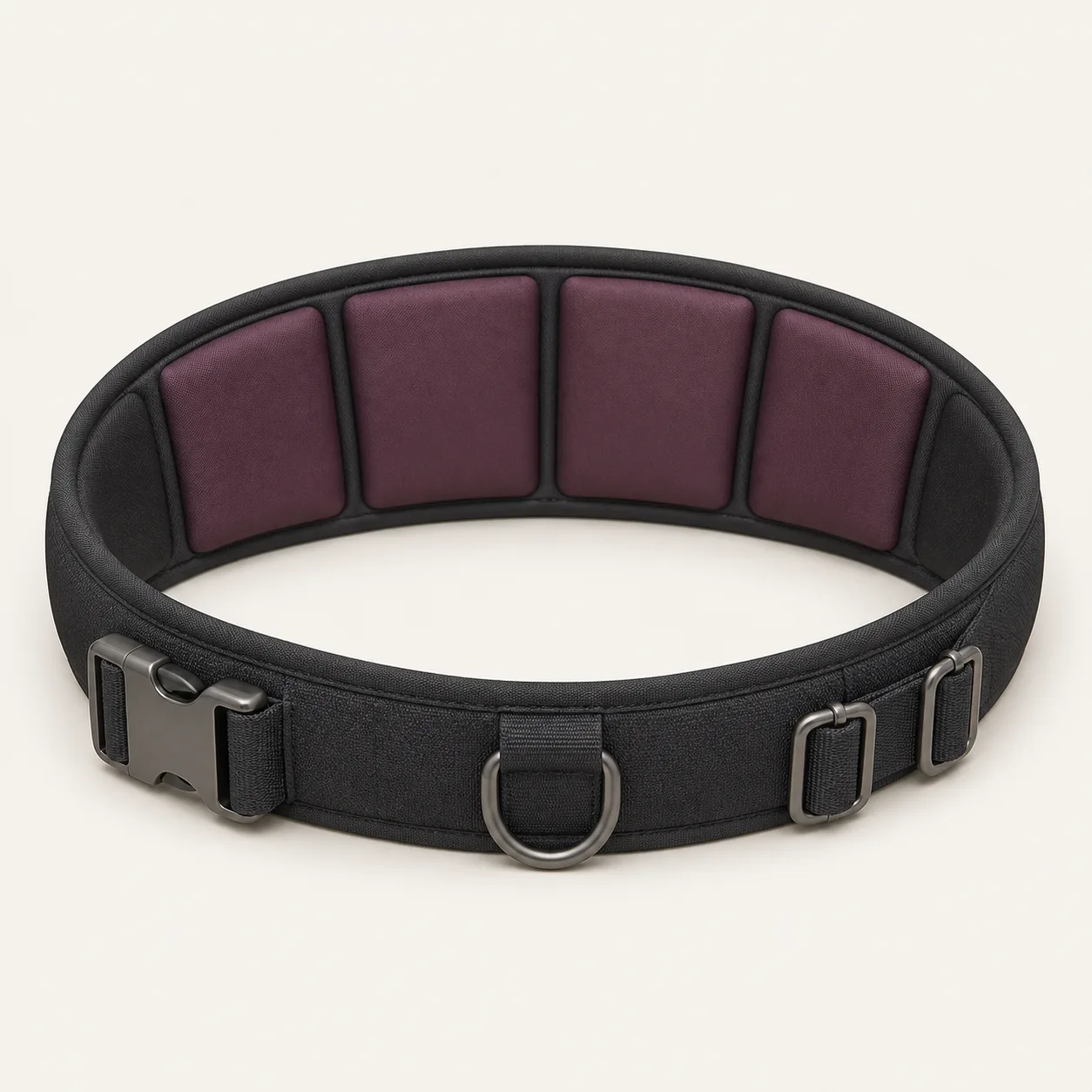
Four-Panel Padded Posture Collar
A matte-charcoal posture-collar concept with exactly four separate inner padding panels, one centred D-ring, one quick-release buckle and two adjustment sliders.
52,99 $
200 in stock
Compare exactly four separated inner padding panels
This four-panel padded posture collar concept uses exactly four separate smoky-plum inner padding panels inside one matte-charcoal band, with one centred gunmetal D-ring, one side-release buckle and two adjustment sliders.

The rendering defines visible architecture only. It does not confirm dimensions, neck-fit range, fibre content, foam structure, hardware alloy, coating, stitch strength, buckle release force, D-ring working load, colourfastness or production readiness.
Confirm one complete collar inventory
The proposed set contains one collar only. No leash, chain, lock, cuffs, connector, storage pouch or spare hardware is shown or implied.
Request an approved bill of materials and destination pack list that identify every webbing layer, padded insert, edge binding, thread, buckle half, slider, D-ring and reinforcement tab.
Measure the band and closed-loop geometry
Record overall flat length, usable adjustment interval, band height, edge thickness, overlap at minimum and maximum settings, mass and buckle offset. Establish fixed measurement datums at the buckle and centre D-ring.
Rendered proportions are not a sizing chart. Sellable fit guidance remains pending measurements on approved production samples.
Inspect all four padding panels independently
Label the inner panels P1 through P4 from the buckle side. Measure each panel’s height, width, thickness, edge radius, compressibility and spacing, then compare symmetry and attachment.
Inspect every panel for wrinkles, collapsed foam, lifted corners, hard inclusions, exposed stitching and migration after bounded flexing.
Map pressure across panels, gaps and bound edges
Use graded instrumented neck forms to map contact pressure at P1 through P4, the three inter-panel gaps, upper and lower binding, buckle zone and D-ring reinforcement. Repeat at every approved size setting without exceeding a conservative test boundary.
Four soft-looking panels do not prove even pressure or suitability for any particular wearer.
Verify buckle engagement and immediate release
Measure insertion force, audible and tactile engagement, pull resistance, two-sided release force and one-handed access through repeated clean, damp and contaminated-condition cycles. Reject partial engagement, cracked prongs, sharp moulding flash or release jamming.
The buckle must remain immediately reachable. A decorative appearance is not evidence of emergency-release performance.
Audit webbing travel through both sliders
Label the sliders S1 and S2. Measure adjustment travel, holding force, tail retention and slippage under bounded cyclic load, then inspect webbing for bunching, edge abrasion and unintended loosening.
Document a safe method for setting both sliders evenly before the collar is fastened.
Define the D-ring as non-suspension hardware
Measure the ring, tab, stitch pattern and backing reinforcement, then test only within a supplier-documented conservative load programme. Inspect coating wear, deformation, thread cutting and local band distortion.
This collar must never support body weight or be used for suspension, lifting, dragging, fall restraint, forced pulling or airway restriction. No working-load claim is accepted without model-specific evidence.
Document textile, foam, thread and metal composition
Request exact fibre percentages, foam chemistry and density, thread specification, buckle polymer, metal grades, coating system, restricted-substance evidence and lot traceability. Review odour, dye transfer, corrosion and contact-surface finish.
Descriptions such as leather-look, vegan, skin-safe, hypoallergenic, nickel-free or latex-free remain unavailable until matching documentation is approved.
Set conservative fit and airway boundaries
Size on a suitable measuring form before any consenting-adult evaluation. Maintain a verified clearance, keep the buckle unobstructed and exclude any configuration that changes breathing, swallowing, speech, circulation or neck movement.
Stop immediately for pain, dizziness, panic, numbness, tingling, colour change, unusual pressure, breathing or swallowing change, buckle difficulty, panel shift or visible damage. Persistent symptoms require appropriate medical advice.
Plan consent, communication and release access
Agree boundaries, a clear stop signal and a non-verbal backup before fitting. The wearer and partner must both know the buckle location and how to release it without tension on the band.
Never leave a fastened wearer unattended, asleep, intoxicated or unable to communicate. Keep the session low intensity until fit, release and material evidence are established.
Clean seams without trapping moisture
Follow only the validated cleaner, water temperature, contact time and drying method for the approved textiles, foam, coating and hardware. Wipe every panel face, the inter-panel gaps, binding, buckle recesses, webbing tail, sliders and D-ring tab.
Immersion, boiling, bleach, solvent, machine washing, tumble drying and abrasive brushing are excluded unless the exact care specification permits them.
Dry open and store without compression
Unfasten the buckle, loosen both sliders and air-dry the collar away from heat and direct sunlight. Confirm that panel gaps, webbing folds and hardware interfaces are fully dry before storage.
Store flat or in a broad relaxed curve, separate from dye-transfer sources, corrosive materials and heavy objects that could compress the four pads.
Cycle padding, adjustment and hardware together
Define lot tests that combine buckle operation, slider adjustment, bounded pull, band flex, panel compression, cleaning and drying. Inspect stitch growth, webbing slippage, foam set, edge fray, corrosion, coating loss and buckle damage.
Record sample size, conditioning, fixtures, acceptance thresholds and failure photographs so later lots can be compared consistently.
Build landed price from a broad collar benchmark
An Alibaba adult-collar category page displayed one padded faux-leather collar with leash at USD 2.71 to 2.99 and MOQ 1. It is a broad procurement benchmark only and does not identify this four-panel collar or an approved supplier.
The public procurement benchmark supports an EUR 52.99 planning price after provisional allowance for China-origin freight, sample measurement, pressure mapping, buckle and slider cycling, D-ring verification, material documentation, cleanability checks, discreet fulfilment and expected textile-hardware handling loss. Exact supplier, quote, MOQ, dimensions, materials, packed weight, freight, duty, tax, certification, payment terms and lead time remain pending.
Frequently asked questions
How many inner padding panels are shown?
Exactly four separate smoky-plum panels are shown inside the charcoal band.
Does the listing include a leash?
No. The proposed inventory is one collar only, with no leash, chain or detached accessory.
Can the D-ring support body weight?
No. Suspension, lifting and any body-weight load are excluded; an exact conservative hardware limit still requires model-specific testing.
What neck sizes does it fit?
The usable fit interval remains pending measurements on approved samples and must not be inferred from the rendering.
Which materials touch the wearer?
Exact textile fibres, foam, thread, dyes, coatings and restricted-substance evidence remain pending supplier documents.
How should the collar be cleaned?
Use only the validated method for the approved construction, then dry every panel gap and hardware interface completely before storage.
Reviews
There are no reviews yet.