


High-Neck Lace-and-Mesh Bodysuit with Inverted-V Front Cutout and Three Bridge Straps
August 14, 2026
Twin-Thigh Padded Cuff and Center Positioning Strap Set
August 14, 2026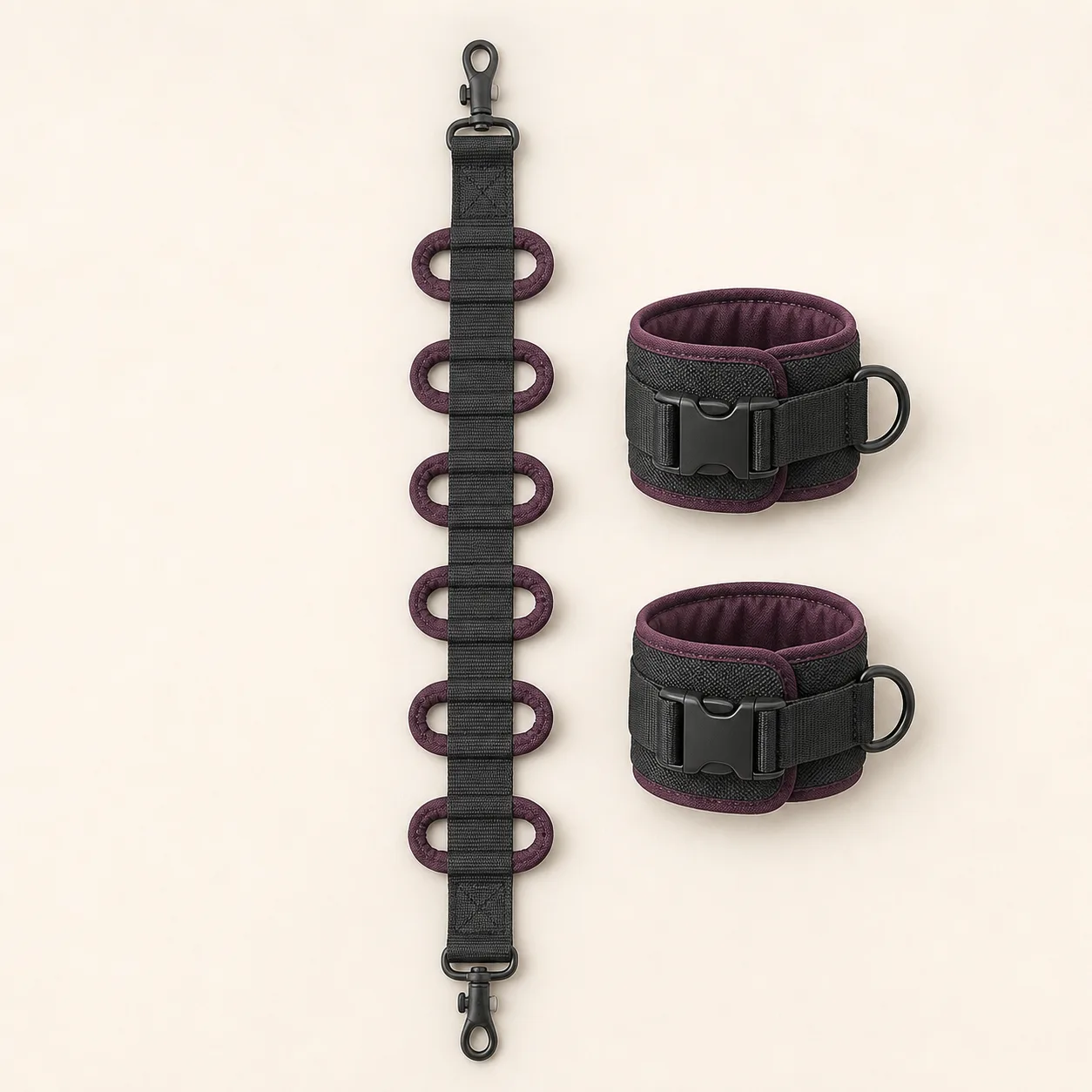
Six-Loop Ladder Positioning Strap with Twin Padded Quick-Release Cuffs
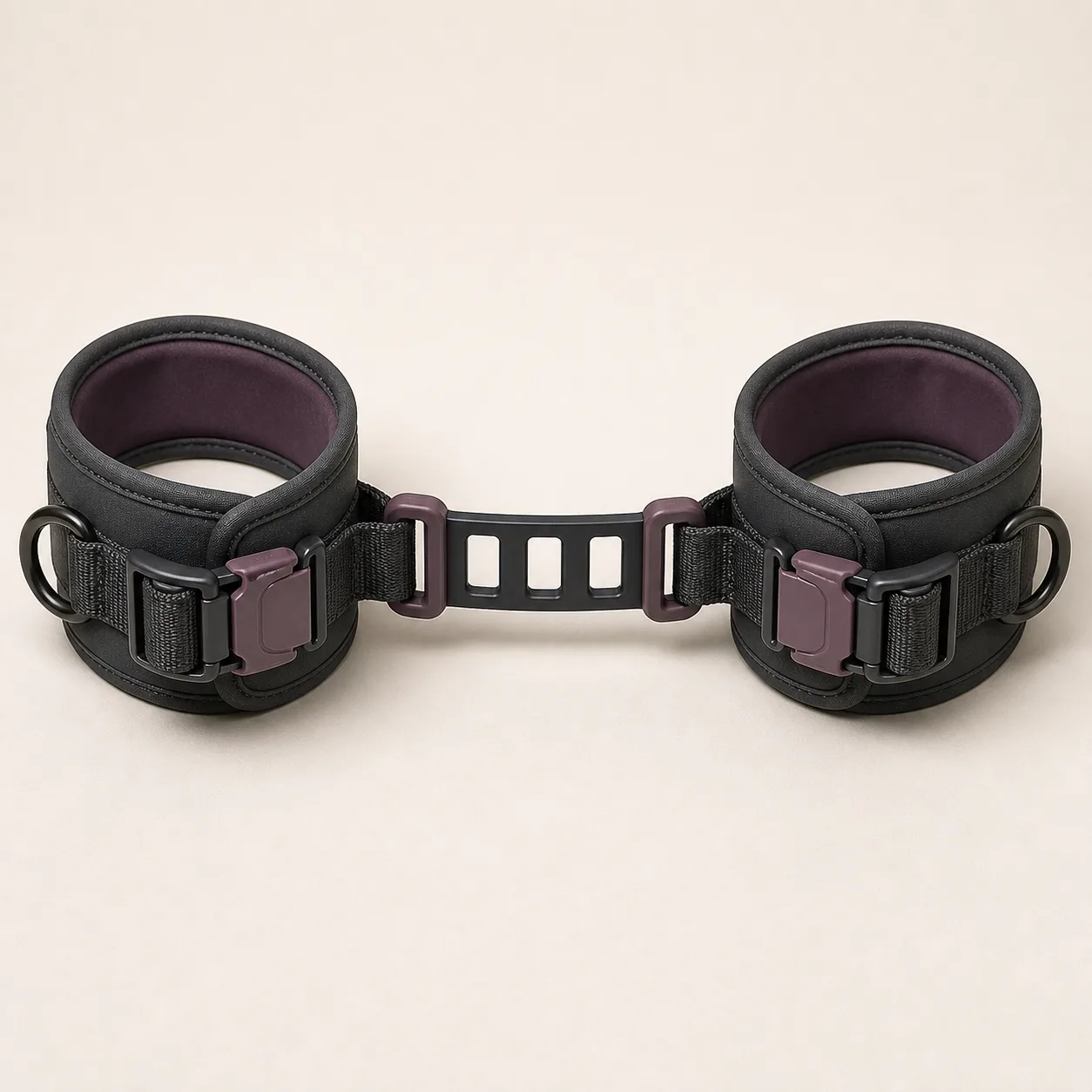
A three-piece restraint concept with one charcoal ladder strap, exactly six padded attachment loops, two swivel end hooks and two matching quick-release cuffs.
49,99 $
200 in stock
Use six fixed loop stations instead of one sliding anchor
This six-loop ladder positioning strap and twin cuff set contains one charcoal webbing ladder with exactly six smoky-plum attachment loops, one swivel snap hook at each end and two separate padded cuffs. The fixed loop sequence is intended to make chosen connection points visible and repeatable without relying on an unmarked sliding buckle.

The rendering defines the proposed component layout only. Lengths, fit, materials, load limits, hardware strength and production readiness remain pending.
Audit exactly three principal components
The proposed retail set contains one ladder strap and two matching cuffs. The two snap hooks are permanently assigned to the ladder ends in the concept and should not be counted as loose accessories unless a supplier changes the construction.
A sealed-pack audit must identify every sewn component, buckle, D-ring, hook, label and instruction sheet. No blindfold, collar, rope, chain, padlock or storage bag is included.
Measure the ladder web from hook to hook
Record overall length, usable webbing length, width, thickness, weave density, folded-end allowance and mass. Mark the centreline and the distance from each end hook to the nearest loop so an asymmetric assembly cannot pass as acceptable.
Webbing fibre, abrasion rating, stretch and breaking load are unconfirmed. Appearance alone cannot establish nylon, polyester or any performance class.
Number the six attachment loops L1 through L6
Label the loops from top to bottom and measure clear opening, outer width, projection, padding thickness, stitch box and spacing to the adjacent station. All six should accept the specified connector without crushing the padded edge or trapping the gate.
Inspect L1-L6 under the same bounded proof load and reject torn covering, skipped stitches, distorted openings or exposed reinforcement.
Inspect both swivel snap hooks as active release points
For the upper and lower hook, document gate opening, swivel travel, eye dimensions, finish, edge radius and one-handed release force before and after cycling. The gate must close fully without webbing or loop fabric entering the latch.
Metal type, coating, corrosion resistance, working-load limit and emergency suitability require traceable supplier data and sample tests.
Fit each padded cuff independently
Measure internal circumference at minimum and maximum adjustment, cuff width, padding thickness, overlap, strap tail length and the clearance around the side-release buckle. Mark the two cuffs individually during inspection so unequal padding or range is not overlooked.
Use only a size that allows ongoing sensation, colour and temperature checks. Universal-fit and comfort claims are excluded until the graded range and adult fit trials are approved.
Verify both side-release buckles under light tension
Test each buckle for insertion force, audible and tactile engagement, pull separation, tab reach and release force with dry and damp hands. A buckle should open intentionally without requiring a tool, while resisting accidental pressure from ordinary movement.
Participants must rehearse opening both cuffs before use. A second rapid-release method should be immediately accessible in case a buckle jams or a strap becomes loaded.
Keep the cuff D-rings clear of buckle paths
Measure D-ring internal span, wire diameter, seam location and free movement. Confirm that the ring cannot cover the buckle tabs, abrade the padded edge or rotate into a hard pressure point when connected to any of the six stations.
The D-rings are connection points, not lifting hardware. Suspension, body-weight support and overhead rigging are outside the proposed scope.
Map every load path before selecting a station
Draw the route from one cuff D-ring through its selected ladder loop, central webbing, end assembly and approved external anchor. Repeat for the second cuff and check whether the chosen geometry creates twisting, lever action or cross-loading at a hook.
Use only low-force consensual positioning within verified working limits. Do not attach to furniture, doors or fixtures unless their strength, stability and edge condition have been independently confirmed.
Set consent, communication and release rules first
All participants must be consenting adults who agree on boundaries, a clear stop signal and who controls each connection. The person operating the restraint should remain present, attentive and able to release every point immediately.
Never use the system on the neck, across the chest, for breath restriction, during sleep, with intoxication or where a fall, entanglement or unattended confinement could occur.
Monitor circulation and joint position continuously
Check warmth, colour, sensation and movement before connection and at short planned intervals. Keep wrists or ankles in a neutral position, avoid pressure over nerves and joints, and reposition or release at the first sign of tingling, numbness, coldness, swelling, discolouration or pain.
This equipment is not medical or protective restraint gear. Anyone with a condition affecting circulation, sensation, mobility or injury risk should seek qualified advice before considering use.
Proof-test seams without turning the set into load gear
Apply a documented low proof load separately to all six loops, two hook attachments, two cuff D-ring seams and two buckle assemblies, then inspect elongation, stitch movement, hardware distortion and padding damage. Repeat after cleaning and ageing samples.
A passed low-force inspection does not authorize lifting, suspension, impact loading, vehicle attachment or any use above the verified limit.
Verify materials, coatings and contact surfaces
Request fibre declarations for webbing, loop covers, cuff shells, padding and thread, plus alloy and coating data for D-rings and snap hooks. Inspect for burrs, sharp gate edges, dye transfer, odour, tack and exposed cut webbing.
Leather, vegan, latex-free, hypoallergenic, rustproof and skin-safe wording remains pending evidence for the finished set.
Clean textile and hardware zones by component
Supplier instructions should define cleaner, water temperature, contact time, rinsing and air-drying for the strap and both cuffs, while addressing trapped moisture beneath padding and inside loop coverings. Wipe and dry hooks, D-rings and buckle crevices as validated.
Do not machine wash, soak, bleach, heat-dry or lubricate buckles and gates unless the approved materials and test results specifically allow it.
Build landed pricing from a broad restraint benchmark
An Alibaba bondage-restraint-system category page displayed a wrist-and-ankle cuff set at USD 2.00 to 2.80 with MOQ 10 and a bed-restraint reference at USD 2.00 to 2.50 with MOQ 1. These are broad category examples, not quotations for this six-loop ladder design or approved factories.
The public procurement benchmark supports an EUR 49.99 planning price after provisional allowance for China-origin freight, six-loop sewing, twin cuff padding, buckle, D-ring and hook inspection, proof-load and release cycling, material, colourfastness and cleaning checks, discreet fulfilment and expected quality loss. Exact supplier, quote, MOQ, dimensions, materials, fit range, load limits, packed weight, freight, duty, tax, certification, payment terms and lead time remain pending.
Frequently asked questions
How many attachment loops are on the ladder?
Exactly six padded loop stations are shown in a straight sequence.
How many cuffs are included?
Two matching padded cuffs are proposed, each with one side-release buckle and one D-ring.
Can this set support body weight?
No. Suspension, lifting and body-weight support are outside the proposed low-force positioning scope.
What happens if a buckle sticks?
Stop loading the strap and use the rehearsed secondary release method kept within immediate reach.
Can the ladder attach to any furniture?
No. Any external anchor needs independently confirmed strength, stability, geometry and smooth edges.
What materials are used?
Webbing, padding, thread, buckle polymer and metal grades remain pending supplier declarations and sample testing.
Reviews
There are no reviews yet.