


Triple-Tab Padded Wrist Gauntlet Pair with Twin D-Rings and Detachable Swivel Link
August 14, 2026
Red Triple-Contact Dual-Loop Couples Vibrator
August 14, 2026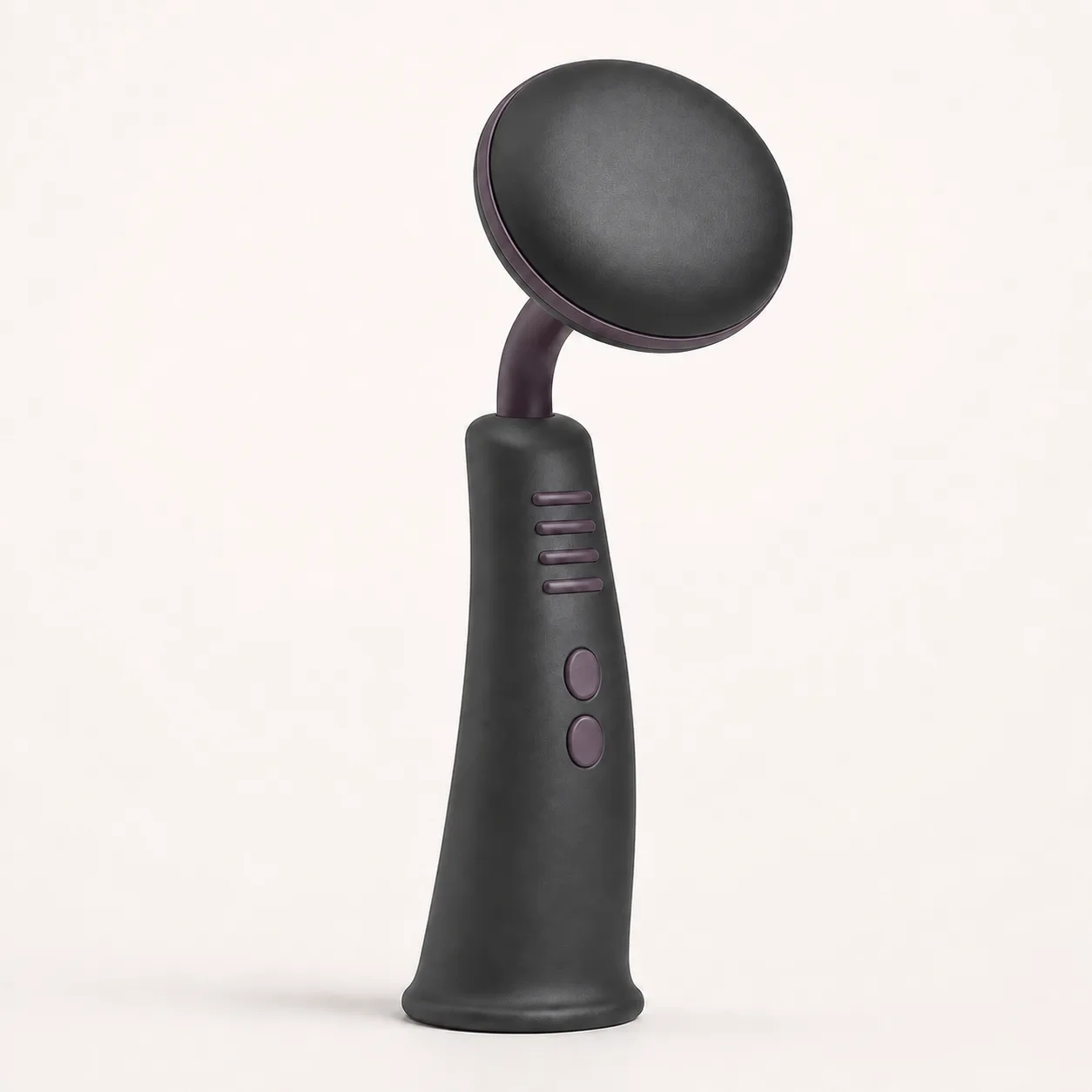
Wide-Disc-Head Mini Wand with Offset Flex Neck and Four-Ridge Thumb Grip
A compact charcoal wand massager concept with one broad circular disc head, a smoky-plum offset curved neck, exactly four horizontal thumb ridges, two oval controls and a flat standing base.
49,99 $
200 in stock
Place a wide disc head above an offset mini-wand handle
This wide-disc-head mini wand massager concept uses one broad charcoal circular head edged by a smoky-plum perimeter ring. A short curved neck offsets the disc from the tapered handle, where exactly four horizontal grip ridges sit above two oval controls.

The rendering defines visual architecture only. Dimensions, materials, flex, motor, controls, battery, ingress, sound, temperature and production readiness remain pending.
Keep the sales unit to one cordless device
The planned pack contains exactly one wand massager. A cable, charging dock, adapter, travel pouch, alternate head, remote and cleaning accessory are excluded unless an approved packing list later adds them.
Final charging interface, cable specification, packaging and instructions require supplier confirmation before sale.
Map the circular head across face rim and perimeter ring
Measure disc diameter, face crown height, face radius, edge thickness, plum-ring width and the centre of the working surface relative to the neck. Record surface flatness and left-right symmetry on a fixture.
A wide face may distribute load differently from a tall dome, but no contact-area or sensation claim is accepted without measurements.
Characterize the offset neck in three planes
Record horizontal offset, neck length, cross-section and the head angle at rest. Apply forward, backward, lateral and torsional deflection while measuring force, travel, elastic recovery and any contact between the head and handle.
Flexible, bendable and angle-holding descriptions remain pending cycle tests and defined limits.
Use the four ridges as a measurable thumb index
Label the smoky-plum horizontal ridges R1 through R4 from top to bottom. Measure length, height, spacing, edge radius and position relative to the neck and upper control.
The ridges should be tested dry and damp for pressure concentration and cleanability; their presence alone does not prove a non-slip grip.
Separate the two oval control functions
Assign one documented function to the upper button and one to the lower button. Verify short press, long press, power state, setting change, travel lock, memory, indicator feedback and shutdown across repeated starts.
Mode count, intensity steps, light behaviour and lock sequence require firmware and approved-sample agreement.
Measure handle taper and standing-base stability
Record handle length, front-back thickness, side width, taper, button reach and base footprint. Place the device upright on level surfaces and test small lateral disturbances with the head at several neck positions.
The rounded flat base is proposed for temporary standing display only; charging through the base is not claimed.
Map vibration across the disc and into the handle
Measure frequency, acceleration and displacement at the disc centre, four cardinal edge points, plum perimeter, neck, R1 through R4 and lower grip. Repeat free-air and compliant-load tests for every verified setting.
Motor type, strength labels and low-frequency claims remain withheld until instrumented ranges and unit-to-unit tolerances are available.
Compare disc loading at centre edge and shallow angle
Use a compliant instrumented surface to record contact area, peak pressure, head tilt and output damping at defined forces. Test the centre, upper edge and lateral edge without exceeding the verified neck range.
No universal pressure or positioning result is claimed; bodies, preferences and applied force vary.
Control sound temperature and operating intervals
Run the longest verified sequence at representative load and ambient conditions while logging the disc, perimeter, neck, motor zone, buttons, battery area and charging area. Measure acoustic output at a fixed distance in a controlled room.
Runtime, maximum temperature, sound level and rest interval remain pending. Stop after unusual heat, odour, swelling, rattling or intermittent output.
Validate battery protection and the charging path
Identify cell chemistry, rated capacity, protection circuit, charging voltage, current, connector and charge-complete behaviour. Test standby drain, short-circuit protection, interrupted charging, cycle retention and incorrect-cable prevention.
Rechargeable, fast-charge and exact runtime statements require battery documents and approved production tests.
Confirm every material seal and surface joint
Request traceable composition and restricted-substance evidence for the charcoal face, plum perimeter, curved neck, handle shell, four ridges, buttons, base, pigments, seals and adhesives. Inspect the disc seam, neck joints and control edges under magnification.
Silicone, medical-grade, body-safe, hypoallergenic, latex-free and waterproof claims remain unavailable without exact-model evidence.
Write cleaning instructions around the shallow disc rim
Validate a cleaner, water temperature, contact time, rinse and drying method. Wipe the disc face, perimeter groove, neck curve, all four ridge gaps, button margins, handle seam and base without flooding an unverified charging area.
Immersion, boiling, bleach, solvents and high heat remain excluded until ingress and material testing supports precise instructions.
Cycle neck controls and standing base before procurement
Combine repeated neck deflection, button presses, disc loading, grip compression, upright placement, charging, cleaning and storage conditioning. Inspect recovery, seam movement, surface wear, button response, output drift, sound and battery behaviour at defined intervals.
Lot acceptance should use measurable thresholds rather than a visual pass alone.
Build landed price from mini-wand public references
An Alibaba mini rechargeable wand page displayed a wholesale mini-wand reference at USD 1.85 to 2.35 with MOQ 101, a soft full-body mini-wand reference at USD 2.99 to 3.49 with MOQ 500 and a handheld mini massager at USD 2.43 to 2.97 with MOQ 1. Another rechargeable-wand page displayed a USB wand reference at USD 2.25 to 2.55 with MOQ 3. These are broad category examples, not quotations for this offset wide-disc design or approved suppliers.
The public procurement benchmark supports an EUR 49.99 planning price after provisional allowance for China-origin freight, disc, offset-neck, four-ridge, dual-control, vibration, load, thermal, acoustic, battery, charging, ingress, material, cleaning and cycle validation, discreet fulfilment and expected handling loss. Exact supplier, quote, MOQ, dimensions, materials, motor, modes, battery, packed weight, freight, duty, tax, certification, payment terms, lead time and production availability remain pending.
Frequently asked questions about the wide-disc mini wand
How many grip ridges are shown?
Exactly four smoky-plum horizontal ridges appear above the two oval buttons.
Does the disc head tilt?
The neck is visually curved, but deflection range, force and elastic recovery require sample testing.
How many settings are included?
The final mode count, intensity steps and control sequence require firmware confirmation.
Can it stand upright?
The base is flat in the concept, but stability depends on head position, surface level and verified sample balance.
Is it waterproof?
No ingress claim is approved. Keep the charging area dry until documented tests support another instruction.
Does it include a charging dock?
No. The planned concept contains one device only; final cable and charging components remain pending.
Reviews
There are no reviews yet.