



Twin-Spine Four-Bead Stiffness-Indexed Anal Trainer
August 14, 2026
SF564 Spiral Remote or App Anal Vibrator – 5 Colours
August 14, 2026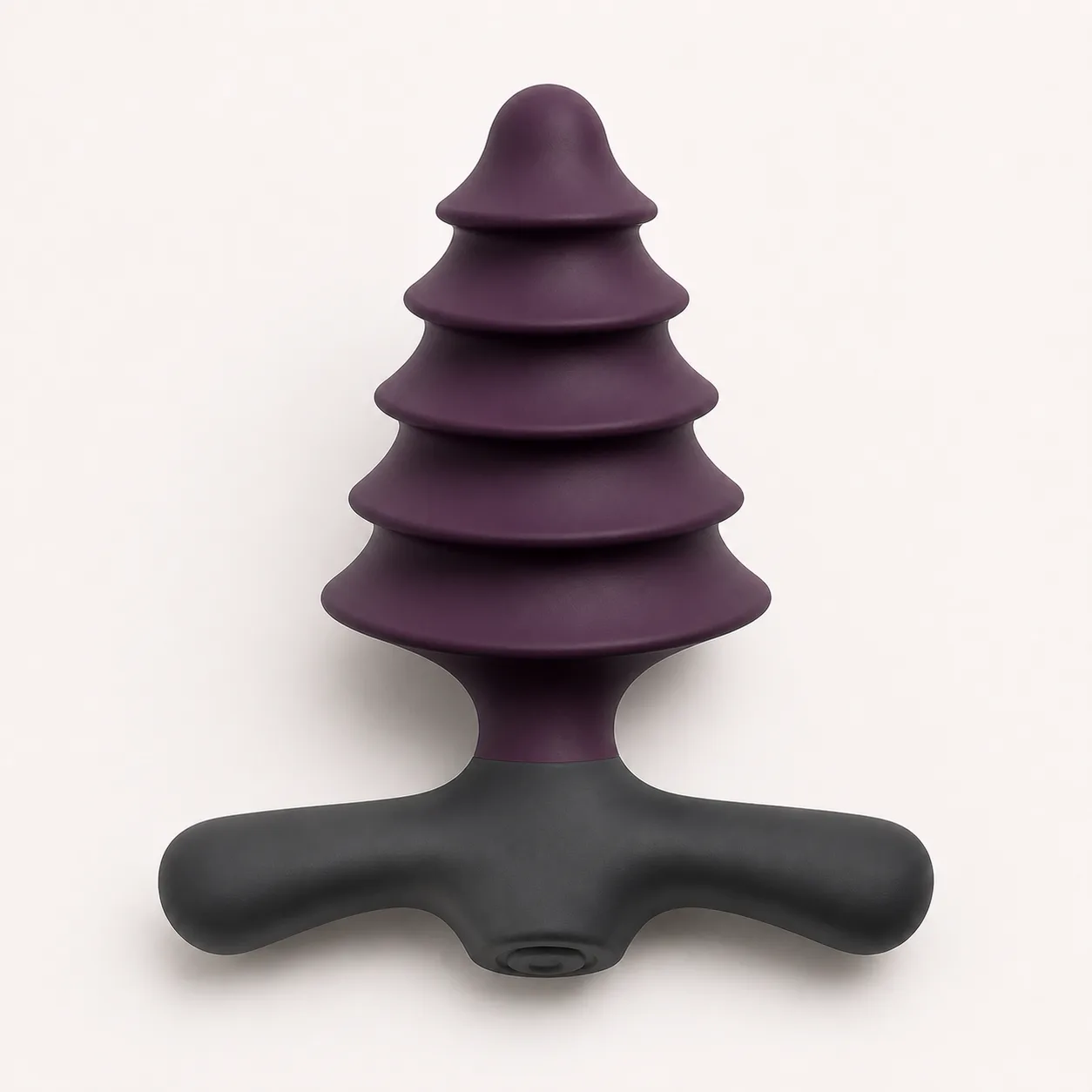
Five-Fin Tapered Anal Plug with Narrow Neck and Wide T Safety Base
A smoky-plum tapered anal plug concept with exactly five graduated circumferential fins, one narrow retention neck and a broad charcoal T-shaped safety base.
32,99 $
200 in stock
Read the five-fin tapered anal plug from tip to safety base
This five-fin tapered anal plug concept places exactly five graduated circumferential fins below one rounded tip. A smooth narrow neck separates the fifth fin from a wide charcoal T-shaped safety base with two rounded lateral wings.

The image establishes design intent only. Dimensions, material, hardness, flexibility, surface finish, fit, cleanability and production readiness remain pending.
Confirm one continuous plug rather than an assembled kit
The proposed sales unit contains exactly one non-powered object. It does not include a remote, motor, cable, storage pouch, lubricant, cleaner, insertion aid or spare base unless a final packing list states otherwise.
Supplier drawings must show whether the plum body and charcoal base are one moulded part, bonded sections or an internal core with an overmould.
Measure the rounded tip and all five fin stations
Label the fins F1 through F5 from top to bottom. Record overall insertable length, tip radius, maximum body diameter and each fin’s diameter, thickness, edge radius, root diameter, spacing and position from the tip.
Use a contour gauge and sectioned first-off sample because perspective in a catalog image cannot establish safe or usable measurements.
Check the five-step diameter progression
Calculate the diameter increase from F1 to F2, F2 to F3 and onward to F5. A predictable progression should be verified across tooling cavities and lots rather than assumed from the visual taper.
Any claimed size level, experience level or wearable profile requires measured dimensions and supervised sample evaluation; the current concept makes no universal fit claim.
Inspect valleys between adjacent fins
Measure valley radius, minimum core diameter and the angle at which every fin joins the central body. Flex and compress the fin edges to find folds, sharp transitions, trapped flash or zones that are difficult to clean.
Five clearly separated layers must remain distinguishable after conditioning without exposing a rigid internal part or permanent crease.
Validate the narrow neck as a retention zone
Record neck length, minimum diameter, wall thickness and transition radii into F5 and the base. Use controlled axial and lateral loading to measure deformation, base pull-through resistance and elastic recovery.
The neck must never be described as secure for extended wear until fit, movement and material tests define appropriate limits and stop conditions.
Prove the wide T base remains externally retrievable
Measure total wing span, wing width, thickness, corner radius, torsional stiffness and the distance from each wing tip to the centreline. Test the base against a compliant fixture in straight, angled and twisting loads.
A broad flared base is essential design intent for this product. Reject samples with wings that fold together, detach, expose an edge or can follow the neck through the fixture under the approved load protocol.
Map stiffness from tip through fins neck and wings
Measure bending force at the tip, F1 through F5, the neck and both base wings using the same span and deflection. Add compression and torsion tests so a soft exterior does not conceal an abrupt rigid core.
Soft, flexible, firm and body-safe wording remains withheld until numerical results and exact composition support it.
Request complete composition and restricted-substance evidence
Obtain a bill of materials for the smoky-plum body, charcoal base, pigments, processing aids, adhesives and any internal reinforcement. Match batch documents to approved samples and request restricted-substance, migration and odour data appropriate to the intended contact.
Silicone, medical-grade, hypoallergenic, latex-free, phthalate-free, non-toxic and waterproof claims remain pending exact-model evidence.
Audit seams flash and the recessed underside detail
Inspect the tip, all ten fin faces, five outer edges, valley roots, neck transition, base perimeter and recessed underside circle under magnification. Measure seam height and identify whether the recess is decorative, a gate mark or part of a manufacturing feature.
No charging or electronic function is associated with the recess unless verified hardware and instructions later prove otherwise.
Build a size-led selection process before public sale
Publish only verified dimensions and a clear diagram after production samples are measured. Offer a separate smaller or larger SKU when dimensions differ materially instead of treating unknown size options as the same inventory line.
Customers should choose conservatively, use a compatible lubricant verified against the final material and stop after pain, numbness, bleeding, dizziness, loss of sensation or difficulty retrieving the wide base.
Define preparation and use boundaries without performance promises
Use only between informed consenting adults, inspect every fin and the base before each session, begin slowly and keep the two T wings outside the body. Never force a fin, use on damaged skin or continue when communication or sensation is impaired.
This product is not a medical device, does not treat a condition and should not be used where a clinician has advised avoiding anal insertion.
Validate cleaning through five valleys and the base junction
Test a specific cleaner, water temperature, contact time, rinse and drying method on the confirmed material. Pay particular attention to the five valley roots, narrow neck, colour boundary, underside recess and both wing curves.
Immersion, boiling, bleach, solvents, dishwashers and high heat remain excluded until exact samples pass material, bond and dimensional checks. Dry fully before storage in a clean ventilated container away from incompatible materials.
Cycle fins neck and T wings as separate failure zones
Combine repeated fin deflection, neck bending, base twisting, axial pull, cleaning and storage conditioning. At defined intervals, measure diameter, recovery, seam change, surface tack, colour transfer, bond movement and hidden core exposure.
Reject a design if one region fails early even when the complete sample still appears visually intact.
Plan price from broad anal-plug references and pending freight
An Alibaba anal-plug page displayed a basic vibrating plug reference at USD 2.00 to 2.42 with MOQ 1 and an OEM smooth plug reference at USD 3.60 to 5.30 with MOQ 3. A separate silicon-plug category page displayed a flared expanding reference at USD 3.27 to 3.35 with MOQ 50 and a five-size trainer reference at USD 0.51 to 2.99 with MOQ 1. These are broad category examples, not quotations for this five-fin T-base design or approved suppliers.
The public procurement benchmark supports an EUR 32.99 planning price after provisional allowance for China-origin freight, five-fin dimensional mapping, neck and base retention, stiffness, composition, restricted-substance, seam, cleaning and cycle validation, discreet fulfilment and expected handling loss. Exact supplier, quote, MOQ, dimensions, materials, packed weight, freight, duty, tax, certification, payment terms, lead time and production availability remain pending.
Frequently asked questions about the five-fin design
How many fins are shown?
Exactly five graduated circumferential fins are visible between the rounded tip and narrow neck.
Why is the T base wide?
Its two lateral wings are intended to remain external and support retrieval, but span, stiffness and load behaviour still require testing.
Is the plum body silicone?
No material has been confirmed. Exact composition, pigments and any internal core require supplier documents and sample analysis.
Does the underside circle mean it vibrates?
No. The concept has no electronic function; the small recess must be identified by manufacturing documentation.
Can the plug be boiled?
Not unless the exact material, colour bond and construction pass a validated high-temperature cleaning study.
Is one size suitable for everyone?
No. Fit, experience and anatomy vary, so only verified dimensions and conservative individual selection can guide a choice.
Reviews
There are no reviews yet.