


Rounded-Tip Rechargeable Mini Bullet
August 14, 2026
Interchangeable-Head Rechargeable Mini Wand
August 14, 2026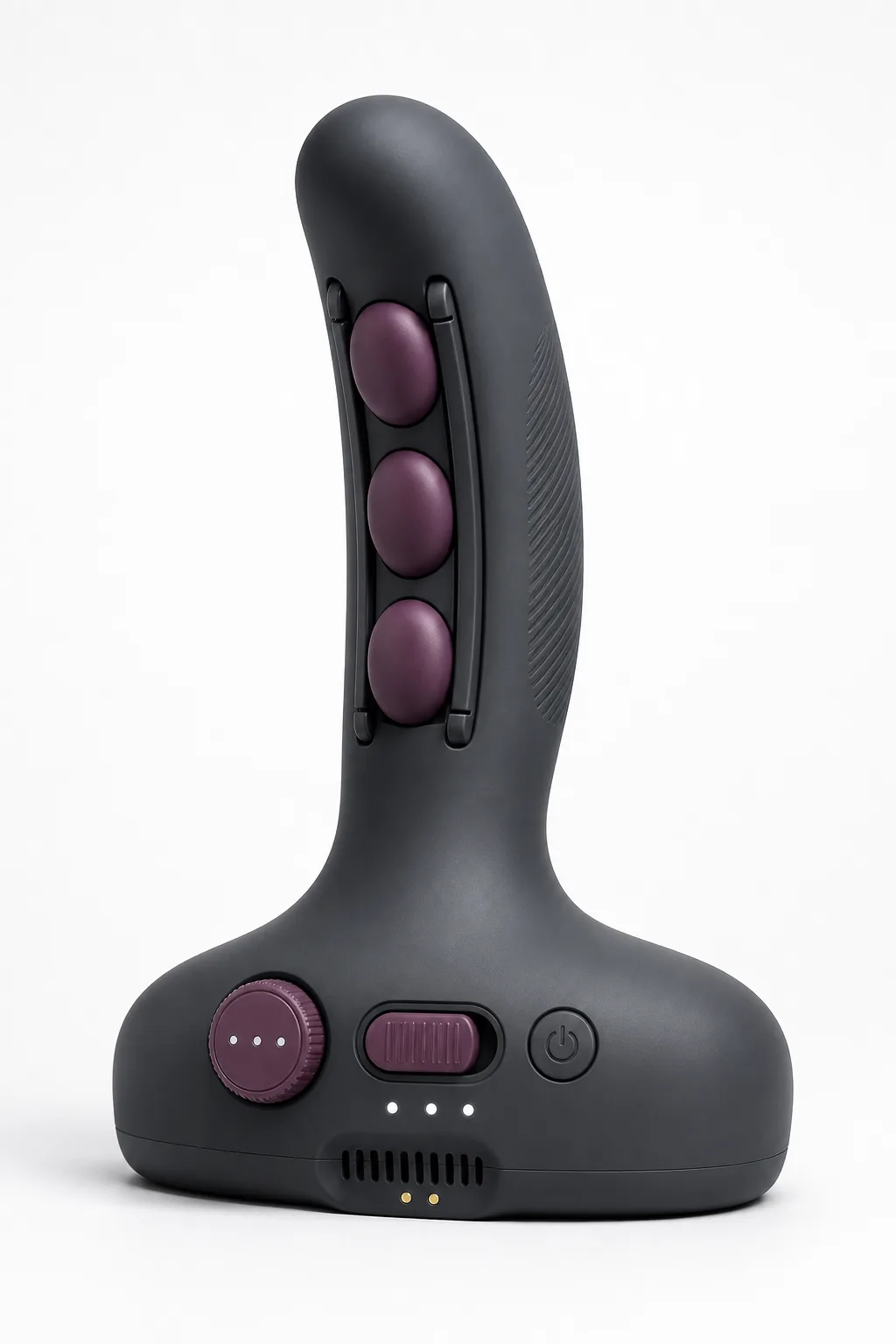
Three-Pad Twin-Rail Axial-Shift Prostate Vibrator with Wide Stop Base
A curved prostate vibrator concept with three captive oval contact pads, twin guide rails, three indexed stroke states, immediate stop and a broad retention base.
68,99 $
200 in stock
Track three contact pads between two parallel rails
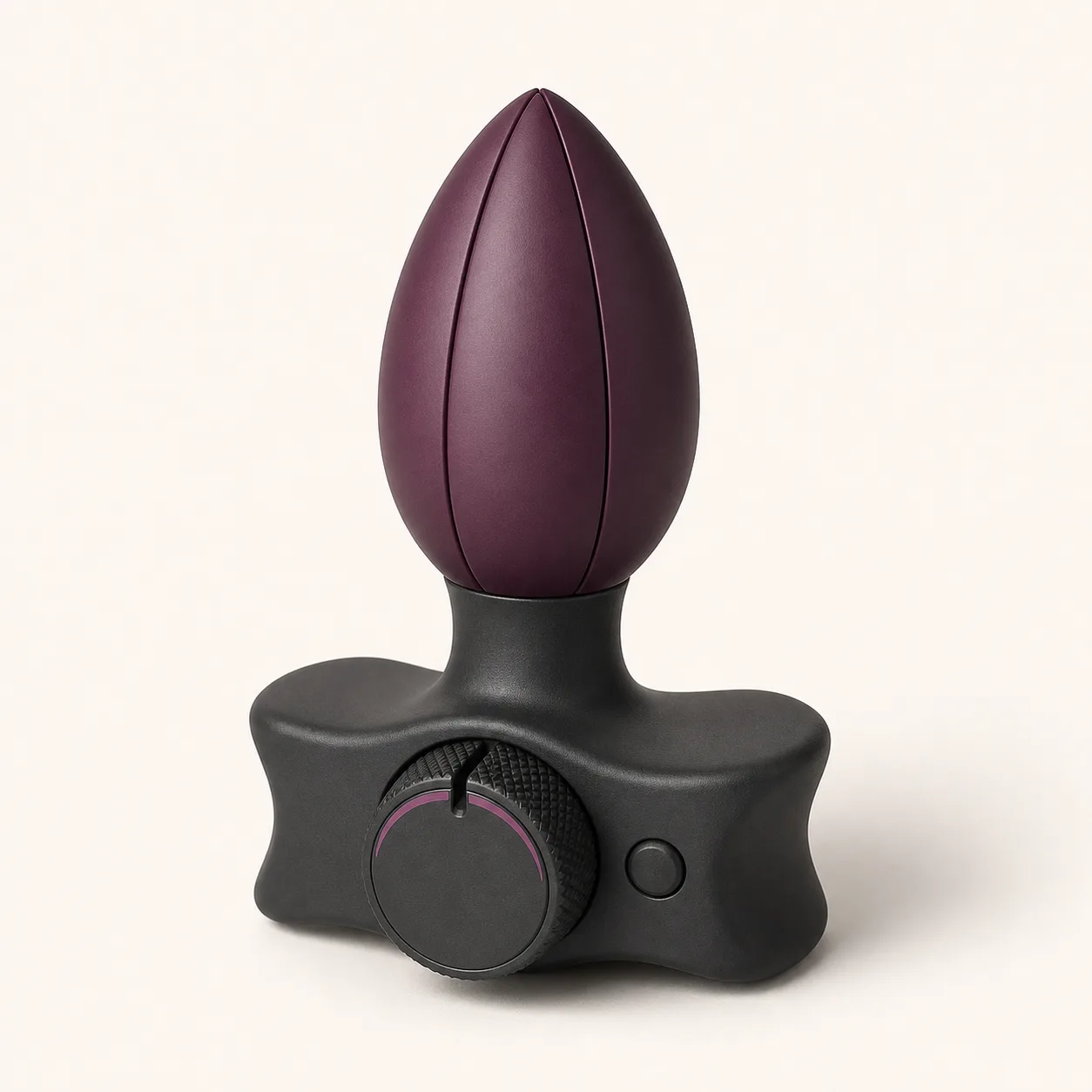
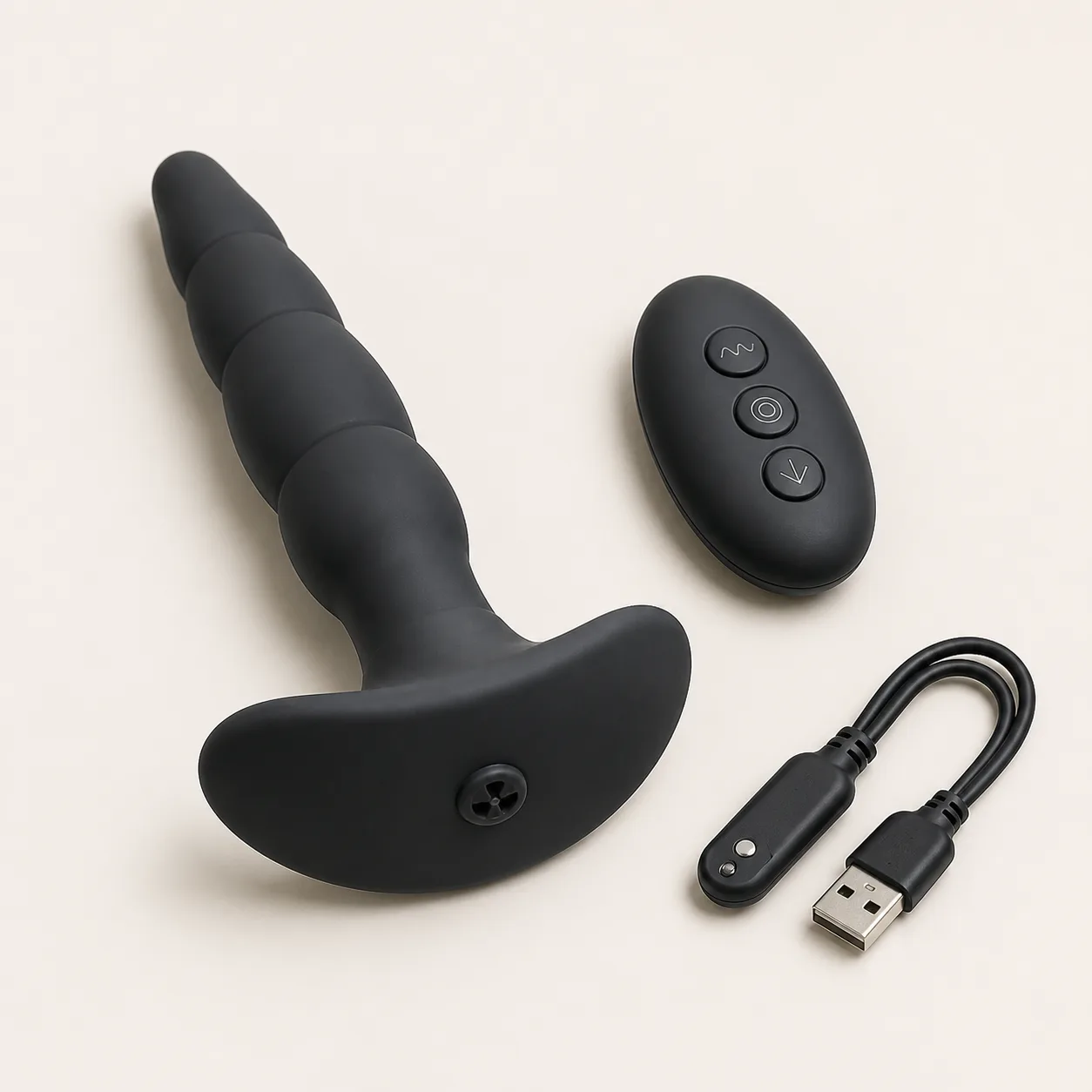
This three-pad twin-rail prostate vibrator concept places exactly three smoky-plum oval pads along the inner curve of a blunt charcoal body. Two parallel guide rails and guarded end stops frame the row, while a three-stop stroke dial and separate immediate-stop slider sit in the broad base.

The render does not prove pad movement, stroke, rail depth, actuator count, output, pressure, fit, materials, ingress or manufacturing availability.
Inventory the pad carriage drive and base
Require a bill of materials for tip skin and core, pads P1-P3, compliant layers, carriers, followers, rails A and B, guide liners, end stops, transmission, actuator, moving mass, stroke dial, detents, stop slider, controller, cell, button, indicators, conductors, strain reliefs, neck core, base shell, vent, contacts, seals, grip texture, coatings, pigments, lubricants and adhesives.
Trace load, vibration and electrical paths before assigning pad independence.
Measure tip body rail neck and base geometry
Record total and insertable length, tip radius, curve centerline, body diameters, P1-P3 centers and exposed areas, rail separation, rail length and recess, stop clearances, neck minimum dimensions, base span and thickness, control projections, mass and center of gravity.
Repeat in every stroke state and after loaded output, charging, cleaning and storage cycles.
Characterize pads P1 through P3 separately
Map each pad profile, crown radius, compliant-layer thickness, carrier edge, hardness, friction, deformation, rebound, attachment and neutral position. Preserve P1-P3 identity in every trace.
Reject delamination, hard carrier exposure, thin edges, tack, pigment transfer, twisting, tearing or a pad that sits outside its accepted rail position.
Verify both rails guides and end stops
Measure rail A/B straightness, parallelism, surface finish, guide clearance, follower engagement, stop compression, axial play, side play and load-dependent skew. Inspect all caps and hidden retainers.
Confirm the pads remain captive and cannot climb, jam, collide or expose a hard guide edge.
Identify actuator and transmission allocation
Teardown must establish actuator type, motion conversion, carrier linkage, phase mechanism, moving mass, bearings, hard stops and controller channels. Record drive current and pad position simultaneously.
Three visible pads do not prove three actuators or independently programmed axial motion.
Calibrate the three-stop stroke dial
Measure dial angle, detent force, backlash, indication and actual P1-P3 excursion at every stop approached from both directions. Repeat unloaded and under centered and offset compliant loads.
Reject false seating, stroke drift, follower impact or any state that drives a pad into a rail or end stop.
Test the wide immediate-stop slider
Measure slider force, travel, recognition, actuator shutdown, carrier position, residual pad motion and reset from every stroke stop and confirmed program. Challenge low voltage, restrained pads and one obstructed rail in protected fixtures.
The stop path must be directly accessible and must not require cycling through a longer stroke.
Capture axial trajectory timing and phase
Use synchronized optical tracking to record P1-P3 position, stroke, velocity, acceleration, dwell, reversal, phase and repeatability. Compare empty, centered-load and offset-load traces.
Quantify skew, lost motion, follower slip, rail friction, phase drift and any collision or stop strike.
Map vibration output and transmission
Record acceleration, dominant frequency, harmonics, startup and decay at the tip, P1-P3, rails, body, neck and base across all confirmed output programs and stroke states.
Measure cross-coupling, cancellation, rail resonance, output loss under load and current changes caused by restrained motion.
Measure pressure base retention and stability
Use instrumented compliant fixtures to record contact area, local pressure, pad-edge peaks, body contact, base movement, neck bending and residual position under centered, angled and side loads.
A broad visible base is not proof of retention; exact geometry, stiffness, load direction and operating motion all require controlled verification.
Screen gaps pinch points and cleaning access
Probe tip transition, pad rims, rail channels, follower gaps, end stops, neck fillets, base seams, dial, stop slider, button, indicators, vent and contacts while stationary and moving.
Define wiping, washing, rinsing and measured drying for the exact sample without flooding unverified rails, drive parts or electronics.
Verify controls battery charging and ingress
Document startup, output programs, stroke rules, stop priority, pause, memory, indicators and travel lock. Confirm cell chemistry, capacity, specified input, polarity, charge time, runtime, protection circuits, contact spacing and charging interlock.
Map pad rims, rails, stops, body seams, neck, base controls, vent and contacts. No ingress rating is accepted without exact-model evidence.
Log current sound heat faults and cycle wear
Measure current, A-weighted sound and temperatures at P1-P3, rails, transmission, actuator, controller, battery, neck, base, vent and contacts. Challenge restrained pads, jammed follower, obstructed rail, blocked vent, low voltage and power loss in protected fixtures.
Cycle stroke, vibration, loading, stop actions, charging, cleaning, drying and storage. Retire for torn pads, carrier lift, rising guide play, rail cracks, follower escape, phase drift, delayed stop, neck damage, abnormal heat, exposed contacts, cell swelling or persistent residue.
Build landed price after three-pad proof
An Alibaba prostate-vibrator page showed a rechargeable category example at USD 7.32-7.62 with MOQ one. It is a benchmark only and does not confirm this three-pad twin-rail architecture or an approved supplier.
The procurement reference supports an EUR 68.99 planning price after allowing for China-origin freight, exact-sample sourcing, pad and rail teardown, geometry, guide and stop metrology, stroke and stop calibration, synchronized trajectory and output capture, pressure and retention testing, gaps, cleaning, controls, charging, current, sound, heat, faults and cycle durability, protective packing and discreet fulfillment. Exact quotation, MOQ, materials, battery, packed size, weight, freight, duty, tax, insurance, payment fees, certifications and delivery terms remain pending.
Frequently asked questions
Do all three pads slide?
Carrier, follower and transmission allocation require teardown plus synchronized tracking.
What changes at the three dial stops?
Actual P1-P3 stroke and phase under load remain pending.
Can the pads move independently?
Actuator count and controller channels are not established by the image.
How quickly does the stop slider act?
Recognition, shutdown and residual motion require tests across programs and faults.
Is the device waterproof?
No ingress rating is claimed for pad rims, rails, seams, controls, vent or contacts.
Which defects require retirement?
Tears, carrier lift, guide play, rail cracks, follower escape, phase drift, heat, swelling or residue.
Reviews
There are no reviews yet.