


Compact Dual-Opening 10-Mode Vibrating Masturbator
August 14, 2026
Soft Dual-Loop Ball Stretcher Ring
August 14, 2026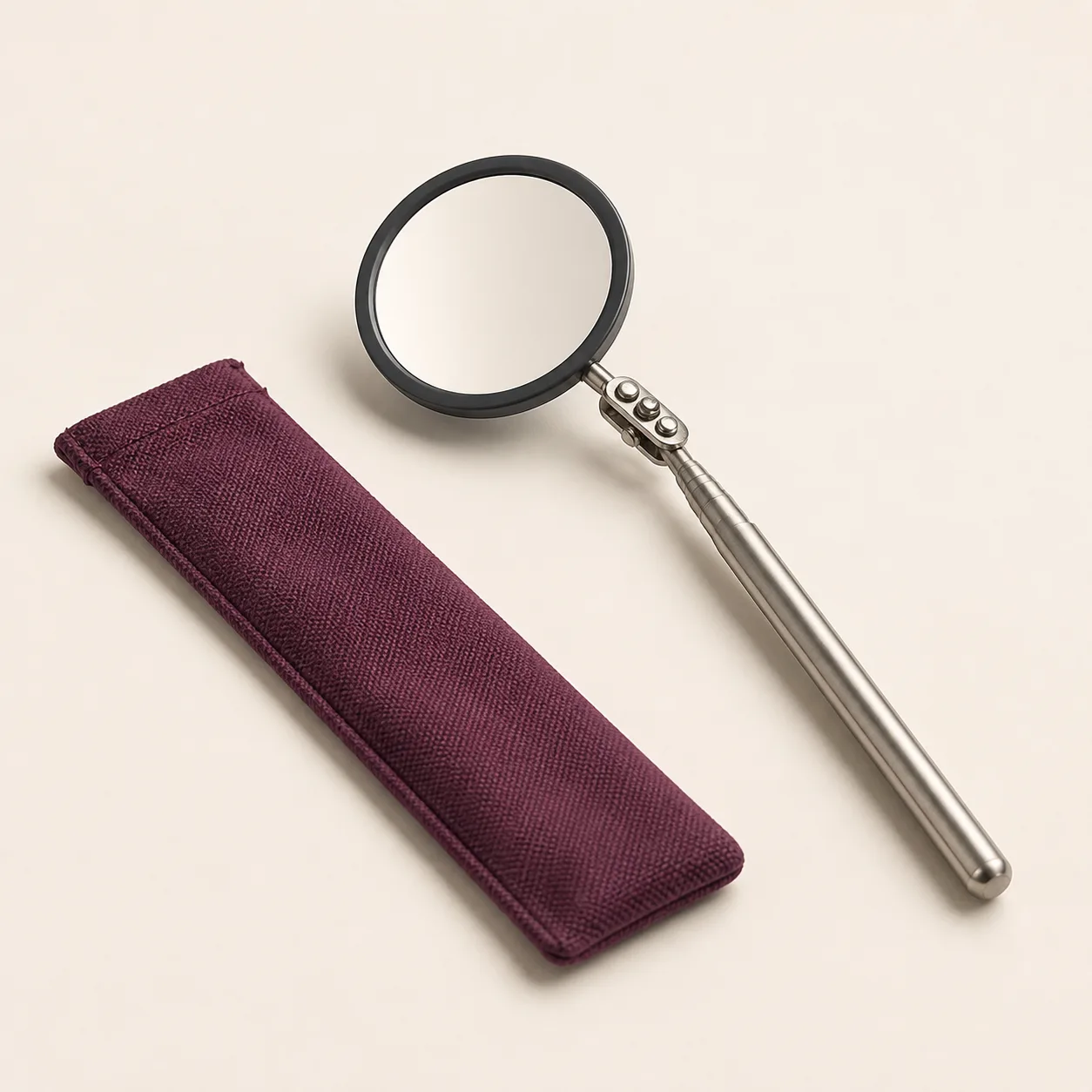
Compact Telescoping Inspection Mirror with Protective Sleeve
A compact external-inspection mirror concept with telescoping swivel handle, protective sleeve and careful guidance for viewing accessible product recesses.
14,99 $
200 in stock
Seeing a recess clearly can prevent blind wiping
The telescoping inspection mirror concept brings a small reflective head behind a storage-case hinge, beneath an exterior curve or beside an accessible charging recess. It helps the user look before deciding whether a dry particle, moisture mark or damaged edge needs attention.

Observation is its only purpose; the mirror does not clean, diagnose electronics or verify that a product is safe to use.
Limit inspection to external and plainly accessible areas
Switch the product off, disconnect every cable and place it on a stable dry surface. Use the mirror around exterior geometry that the maker allows the owner to examine, never inside a sealed housing or beyond a barrier intended for service technicians.
Stop if the manual prohibits tools near an opening.
Light the target from the side rather than into the mirror
Diffuse room light or a separate low-glare lamp can reveal film, fibers and edge damage without washing out the reflected view. Reposition the light until the target is visible while keeping the beam away from eyes and glossy surfaces.
The concept includes no lamp, battery or electrical component.
Check the mirror before it approaches the product
Inspect the reflective surface, rim, swivel and shaft. Set it aside if the mirror is cracked, chipped, loose or distorted, or if the rim has sharp flash and the telescoping sections bind, wobble or leave residue on a clean cloth.
A damaged reflection can hide the very defect being sought.
Extend each shaft section with two-handed control
Hold the thicker section while drawing out the next segment slowly. Leave enough overlap to keep the shaft stable and never snap it to full length, because an abrupt stop can loosen the swivel or send the head against the product.
Collapse the tool in the same measured sequence after use.
Set the swivel angle before entering a narrow gap
Adjust the joint in open space, then guide the mirror toward the viewing position without forcing it against a wall or hinge. If the angle slips, withdraw the tool and reset it rather than twisting the head while it is confined.
Verified swivel range and retention force remain pending.
Keep metal and glass away from charging contacts
The mirror and shaft should never bridge contacts, touch exposed conductors or enter a powered port. Maintain a visible gap, and use the reflection from outside the recess to look for debris or discoloration.
Electrical inspection belongs to the manufacturer or a qualified service provider.
A reflection can reveal clues but not material identity
Color shifts may come from lighting, viewing angle or the mirror itself. A bright fleck might be dust, coating damage or harmless texture, so record the observation and compare it with the maker’s reference images before acting.
Do not scrape a mark merely because it looks raised.
The sourcing category includes flat, convex and magnifying designs. Until the selected sample is measured, no claim is made for magnification, field of view or dimensional accuracy. Use the mirror for orientation, not for measuring a crack or clearance.
Reflections can expose private surroundings
Check what appears behind the product before taking a photograph or showing the mirror during a support call. Faces, labels, messages and room details may enter the frame even when the product itself is discreet.
Use a neutral background and crop evidence to the smallest useful area.
The mirror is not intended for examining the body
Do not use it inside or against the mouth, genitals, wounds or any body opening. It is an external product-care viewing aid, not a medical, dental or personal diagnostic instrument.
Keep the tool away from children and pets because glass and telescoping sections can cause injury.
Clean the reflective face without grinding particles into it
Blow or lift loose dry dust using the mirror maker’s approved method before wiping. Use only a confirmed compatible soft cloth and cleaner, supporting the head so pressure does not strain the swivel.
Alcohol, solvent, abrasive powder and immersion compatibility remain pending.
The protective sleeve should receive a fully dry tool
Let the rim, mirror and shaft dry in open air, collapse the sections and slide the tool into the sleeve without dragging the glass against a seam. Store it flat in a private drawer away from cleaner bottles and heavy products.
The sleeve is a scratch guard, not a shockproof or waterproof case.
Breakage requires containment rather than another inspection
If the mirror cracks or separates from its rim, stop handling the product area and keep bare hands away. Isolate the damaged tool and follow local guidance for glass or mirror disposal.
Do not use the sleeve to collect fragments unless its puncture resistance has been verified.
Incoming inspection should test optics and mechanics together
Measure collapsed and extended length, mirror diameter, joint play and rim coverage. Compare reflected grid lines for distortion, then cycle every shaft section and swivel while checking for slip, corrosion, sharp edges, adhesive squeeze-out and mirror movement.
Quarantine samples with chips, cloudy areas, double images, rough seams, loose heads or metal residue.
The sourcing reference describes a general workshop tool
An Alibaba listing from Ganzhou Pangniu Technology shows a 30 mm folding telescopic inspection mirror at USD 0.80-0.96 with MOQ 1 piece. Mirror type, shaft alloy, rim protection, sleeve inclusion and suitability for this care context remain pending.
The procurement reference supports sample inquiry only. The EUR 14.99 plan allows for China-origin freight, a protective sleeve, optical checks, edge inspection and joint cycling; packed mass, freight, duty, tax, insurance, payment fees and destination terms remain pending.
Frequently asked questions
Does the mirror magnify the image?
No magnification is confirmed; the selected sample must be checked for flatness and optical behavior.
Can the shaft touch a charging contact?
No. Keep the entire tool outside contacts and inspect only with the product disconnected.
Is the sleeve impact resistant?
No such claim is made. Treat it as a scratch guard until construction is verified.
Can I use the mirror on my body?
No. This concept is only for external product-care observation.
What if the reflection looks distorted?
Withdraw the tool, compare with a known straight grid and stop using a mirror that produces unreliable images.
When should the mirror be discarded?
Stop after a chip, crack, loose reflective head, sharp rim, slipping swivel, seized shaft, corrosion or persistent cloudy film.
Reviews
There are no reviews yet.