


Audio-Reactive Dual-Grip Automatic Stroker with Removable Liner
August 14, 2026
Dual-Channel Geometric Manual Stroker
August 14, 2026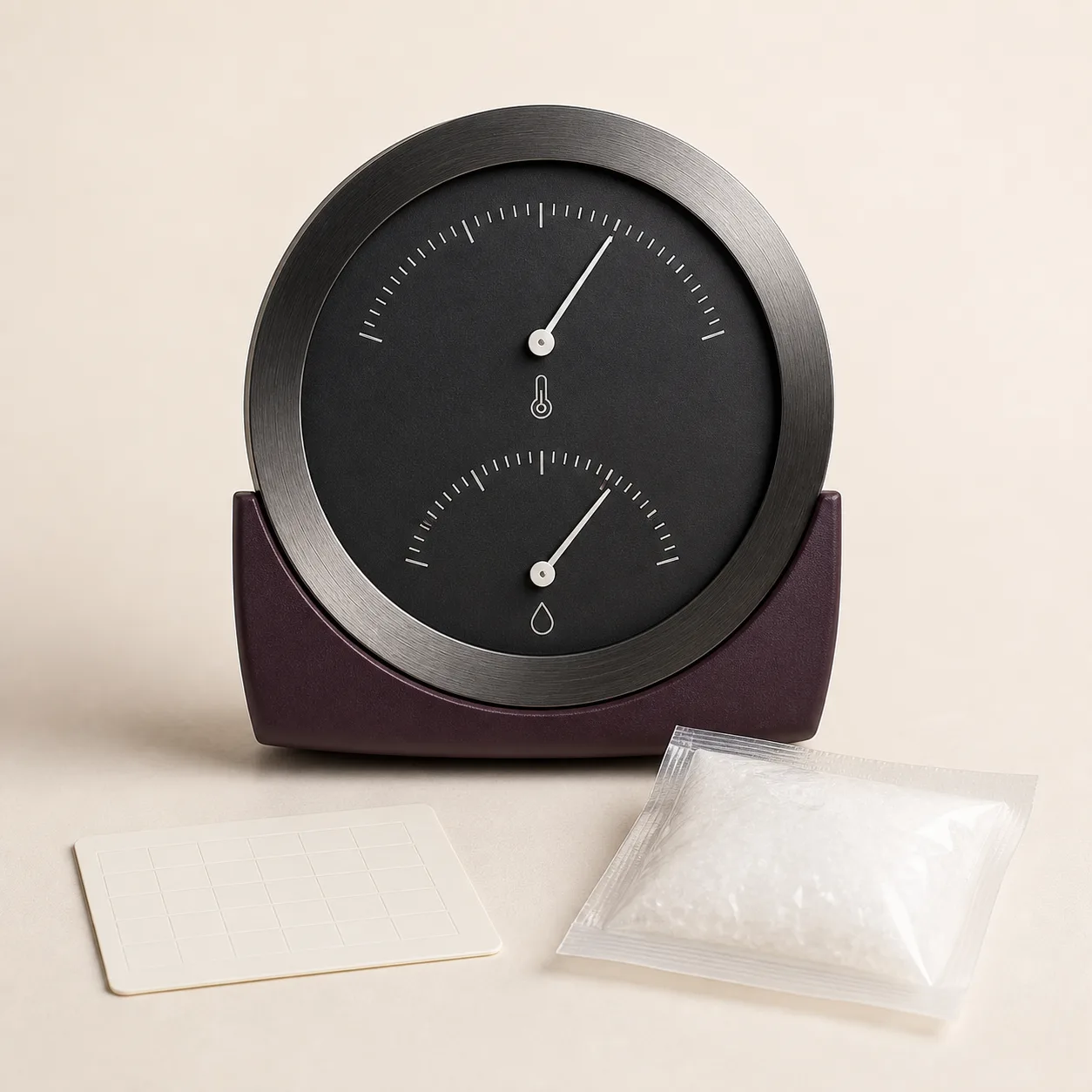
Compact Analog Storage Climate Monitor
A compact dual-pointer storage climate monitor concept with temperature and humidity arcs, removable stand, blank trend card and calibration-reference prop.
14,99 $
200 in stock
One dial observes two conditions without controlling either
The analog storage climate monitor concept combines separate temperature and relative-humidity pointer arcs in a charcoal face, brushed bezel and removable plum stand. A blank log card and sealed reference pouch frame the instrument as a measurement aid that must be checked before its readings influence storage decisions.

The device does not cool, heat, dry or humidify a space, and the reference pouch is not promised pack content.
Ranges and scale resolution must be readable on the sale unit
Confirm the minimum and maximum temperature and humidity ranges, tick spacing and units. Check pointer alignment at both ends and ensure the bezel does not hide the first or last graduations.
A decorative dial with dense marks is not useful if normal viewing distance makes the divisions ambiguous.
Accuracy needs comparison at more than one climate point
Compare production samples with traceable references at low, middle and high points across the intended range. Record temperature error, humidity error, repeatability and hysteresis after conditions move upward and downward.
No accuracy figure is approved until the method, stabilization time and uncertainty are documented.
Response time determines when a moved gauge can be trusted
Measure how long each pointer takes to settle after transfer between controlled environments. A fast-looking pointer can still lag behind the air inside a closed drawer, especially when the enclosure or sensor is slow to exchange moisture.
Read only after the instrument and storage space have reached a stable condition.
Placement should represent the stored items, not the room doorway
Position the monitor near the storage volume without touching a cold wall, heater, wet cloth or direct sun. Leave sensor openings clear and avoid placing it beneath objects that block airflow.
A reading outside the container cannot establish conditions inside a tightly closed case.
Closed drawers can develop their own small climate
Air exchange, damp textiles, recently cleaned items and temperature changes can shift humidity inside storage. Measure the actual drawer or cabinet over time rather than assuming it matches the room.
Store only fully dry items and follow each manufacturer’s ventilation guidance.
There is no universal target for every material and battery
Acceptable conditions depend on polymer, adhesive, metal finish, lubricant, cleaner, textile, packaging and cell chemistry. Use the monitor to compare readings with the documented storage range for each product.
Do not invent a single ideal zone for a mixed collection.
Battery products add temperature and inspection limits
Follow the device maker’s charge level, storage temperature and inspection instructions. The gauge cannot detect internal cell damage or make a swollen, leaking or unusually warm battery safe.
Isolate damaged electronics promptly and keep them away from combustible storage materials.
Condensation is a visible warning even before the pointer settles
Moving cold items into warm humid air can create moisture on surfaces and inside seams. Allow temperature equalization in an appropriate dry setting and inspect ports, joints and cases before storage.
Do not close visibly damp items into a drawer simply because the current room reading looks moderate.
A small trend log is more useful than one isolated reading
Record date, time, location, temperature, humidity and any event such as cleaning, heating or weather change. Repeated measurements reveal drift and daily swings that a single glance can miss.
Use the same placement and stabilization routine so entries remain comparable.
Reference-salt checks require a defined method and safe handling
The pictured sealed pouch is a visual calibration prop only. Any real reference material needs identity, concentration, container volume, test temperature, equilibration time and disposal instructions.
Keep chemicals sealed, labeled and away from children, pets and stored personal items.
Cleaning must not wet the sensor or move the pointers
Dust the exterior gently and use only the supplier-approved method for the lens, bezel and stand. Do not spray cleaner into vents or immerse an instrument whose ingress resistance is unknown.
Avoid pressing the lens or knocking the adjustment mechanism while wiping.
Shock and vibration can create a false but plausible reading
After a drop or hard impact, compare both channels with known references before using the monitor again. Inspect the pointer pivots, face alignment, bezel and stand for displacement or rubbing.
A stuck pointer may still point to a believable value, so movement alone is not proof of accuracy.
Incoming inspection should include a three-point comparison
Sample dimensions, finish, pointer zero, scale print, stand fit and sensor openings. Stabilize units at documented temperature and humidity points, then record error, hysteresis and response time.
Quarantine monitors with bent pointers, hidden ticks, cracked lenses, corrosion, excessive error or inconsistent adjustment.
The source price does not include calibration evidence
An Alibaba listing from Yueqing Taixin Electric Co., Ltd. displays a mini analog indoor thermometer-hygrometer at USD 1.20 with MOQ 10 pieces. Exact model, ranges, sensor mechanisms, accuracy, response and calibration access remain pending.
The procurement reference supports sample inquiry only. The EUR 14.99 plan includes a provisional China-origin freight allowance plus three-point comparison, response, hysteresis, enclosure and documentation review; packed weight, freight, duty, tax, insurance, payment fees and destination terms remain pending.
Frequently asked questions
Does the monitor control humidity?
No. It only displays temperature and relative humidity and cannot change either condition.
How accurate is it?
Accuracy remains pending until production samples complete documented multi-point comparison against traceable references.
Can it be placed inside a closed drawer?
Yes if the final dimensions, sensor openings and manufacturer instructions allow it, with enough airflow and stabilization time.
What humidity is ideal for every toy?
There is no universal target; follow the documented storage conditions for each material, formula and battery.
Is the reference pouch included?
No inclusion is promised. It is a display prop, and any calibration material requires its own controlled instructions.
When should the gauge be removed from service?
Stop relying on it after impact, corrosion, cracked lens, stuck pointers, scale displacement or failed reference comparison.
Reviews
There are no reviews yet.