



Compact Analog Storage Climate Monitor
August 14, 2026
Warm-Start Rotating and Thrusting Automatic Stroker
August 14, 2026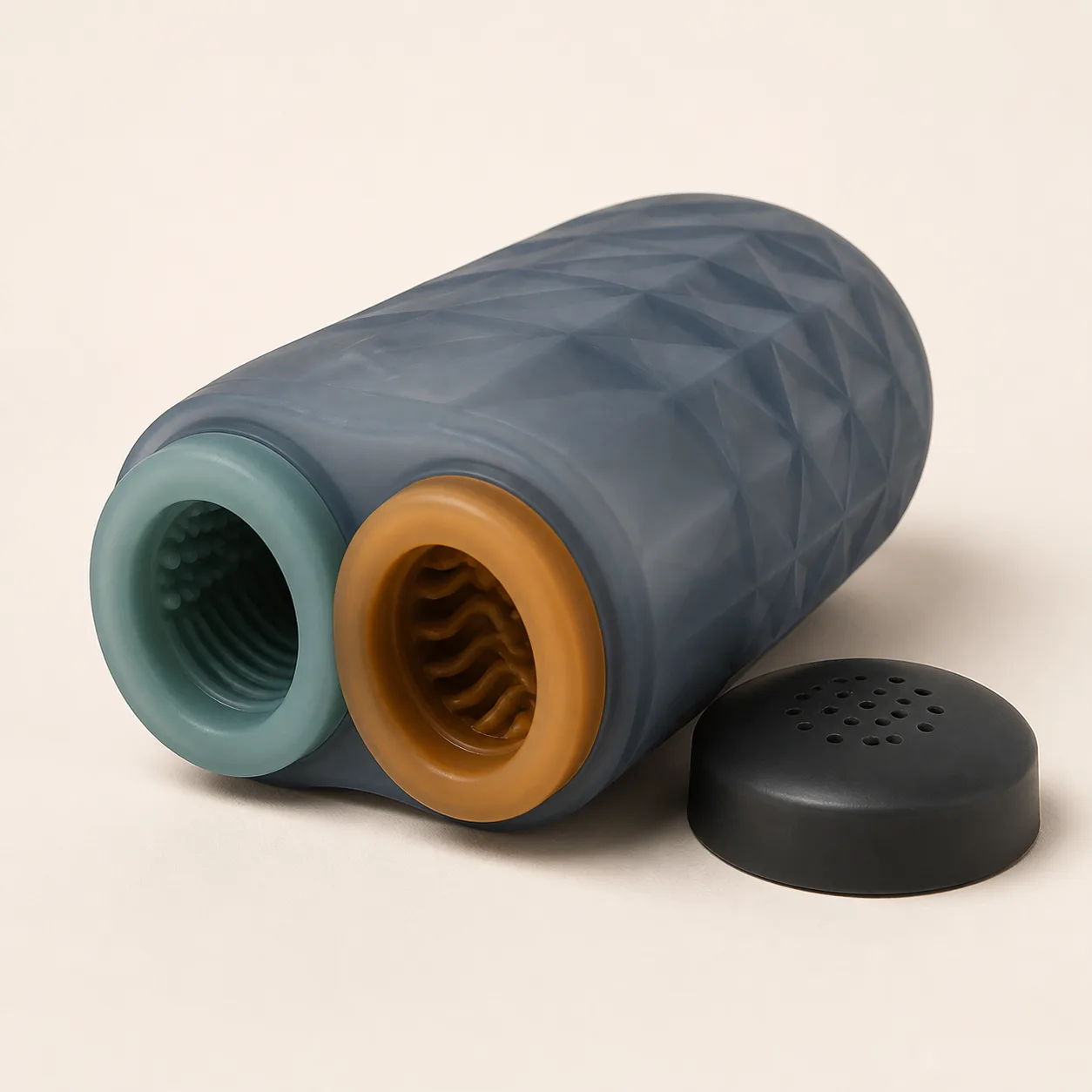
Dual-Channel Geometric Manual Stroker
A compact manual stroker concept with two color-coded texture channels, faceted squeeze grip and a removable vent cap.
34,99 $
200 in stock
Two channels should offer documented differences
This dual channel manual stroker concept uses a faceted smoky grip with two color-coded circular entrances. The teal and amber paths are intended to represent different internal textures, but useful comparison depends on measured depth, diameter, taper and texture maps rather than color alone.

No enlargement, endurance, training, prostate or therapeutic outcome is claimed.
Color coding needs a permanent orientation key
Confirm that the teal and amber rims stay bonded, resist dye transfer and correspond consistently to the same channel texture across production lots. Packaging and the cleaning guide should identify each channel without relying on color vision alone.
Raised symbols may help only if they do not create hard or abrasive rim features.
Entrance dimensions set the initial fit
Measure relaxed inner diameter, outer diameter, rim thickness, edge radius and stretch under controlled loads for both openings. Photograph every measurement point so a soft rim is not described by a single ambiguous width.
Stop for pain, numbness, pinching or persistent discoloration.
The separation wall must remain intact under squeezing
Map wall thickness between the channels from entrance to end, then compress the faceted shell in several grip positions. The two paths should not collapse into each other, tear at the divider or expose a hard structural layer.
Reject a sample with thin spots, internal bonding gaps or cross-channel leakage.
Usable depth may differ between the two paths
Record the route, taper and closed-end position for each channel with a flexible measuring fixture. If the paths curve or converge, publish that geometry rather than assuming they are straight and identical.
Never force deeper contact than the measured channel allows.
Texture maps belong in the product specification
Document ridge height, spacing, orientation and transition zones along both channels. The visible entrance pattern shows only the first section and cannot establish what continues through the sleeve.
Check molded peaks for flash, tears and hard inclusions before use.
A faceted exterior should improve grip without thin corners
Measure shell thickness beneath the raised geometric panels and inspect their valleys after repeated hand compression. Decorative facets should not create stress points, sharp outer edges or permanent creases.
Squeeze pressure should remain manually controllable and easy to release.
The vent cap needs a verified air path
Determine whether the charcoal cap covers one channel, both channels or a separate chamber. Measure its holes, retention and effect on resistance with the cap fully seated, partly seated only if permitted, and removed.
Never block a closed channel beyond the manufacturer’s approved configuration.
Cap security matters during handling and storage
Apply repeatable pull, twist and drop tests to the cap, then check whether it can detach unnoticed or trap residue against the sleeve end. Any small removable part should be kept away from children and pets.
A loose, cracked or distorted cap is a rejection condition.
Compound identity cannot be inferred from softness
The source uses silicone language without traceable evidence for the exact two-channel model. Request lot-linked records for the sleeve body, both colored rims, pigments, internal texture material, bonding layers and charcoal cap.
Check odor, tack, oil bleed, dye transfer, swelling, tearing and incompatibility after conditioning.
Each channel needs its own cleaning validation
Flush the teal and amber paths separately using the supplier-approved method, then inspect the full route with a borescope or validated visual fixture. Confirm that ridges, the divider and closed ends release residue without overstretching.
Do not turn the sleeve inside out unless the manufacturer explicitly permits it.
Drying is harder when two tunnels share one body
Establish a drying position that keeps both entrances open and allows the deepest sections to drain. Measure residual moisture after the stated drying time rather than relying on the outside surface.
Store only when both channels, rims and cap are fully dry.
Lubricant compatibility must cover every colored component
Test the approved lubricant types on the smoky body, teal rim, amber rim, internal textures, divider and cap. Look for swelling, softening, tack, color transfer and loss of bond strength.
Use only products listed as compatible with the verified production compounds.
The planned price includes dual-path inspection
The Alibaba lead displays USD 14.11 for 1 to 50 pieces, USD 13.61 for 51 to 100 and USD 12.61 from 101. Its generated material, health and performance language is not accepted as specification evidence.
The procurement reference is a sourcing lead only. The EUR 34.99 plan allows for China-origin freight, a sample, dual-channel metrology, divider, rim, texture, squeeze, vent, tear, cleaning, drying and material checks; freight, duty, tax, insurance, packaging, payment fees and destination terms remain pending.
Choose two manual textures without adding a motor
This concept is for adults comparing two internal texture paths in one manually controlled sleeve. A single-channel pocket stroker is simpler to inspect and dry, while a powered cup may suit shoppers who specifically want motorized motion and accept additional cleaning complexity.
Final comparison guidance will follow the approved channel map.
Frequently asked questions
Are the teal and amber channels different?
The source claims two channels; the exact texture, taper and depth differences remain pending measurement.
Do the channels connect inside?
The route and separation wall require sample inspection and should not be assumed from the entrance view.
What does the vent cap control?
Its air path, supported positions and effect on resistance remain pending functional tests.
Can the sleeve be turned inside out?
Only if the manufacturer approves that method without tearing the divider, rims or internal textures.
What material is the sleeve?
The source uses silicone language, but every compound, pigment and bonding layer remains pending lot-linked evidence.
How should both channels be dried?
The validated method must keep both paths open, drain their deepest points and verify that no hidden moisture remains.


Reviews
There are no reviews yet.