


MTY-26 Telescopic Rotating Male Masturbator
August 14, 2026
Twelve-Fall Alternating-Width Sensory Flogger with Braided Grip and Rounded End Knob
August 14, 2026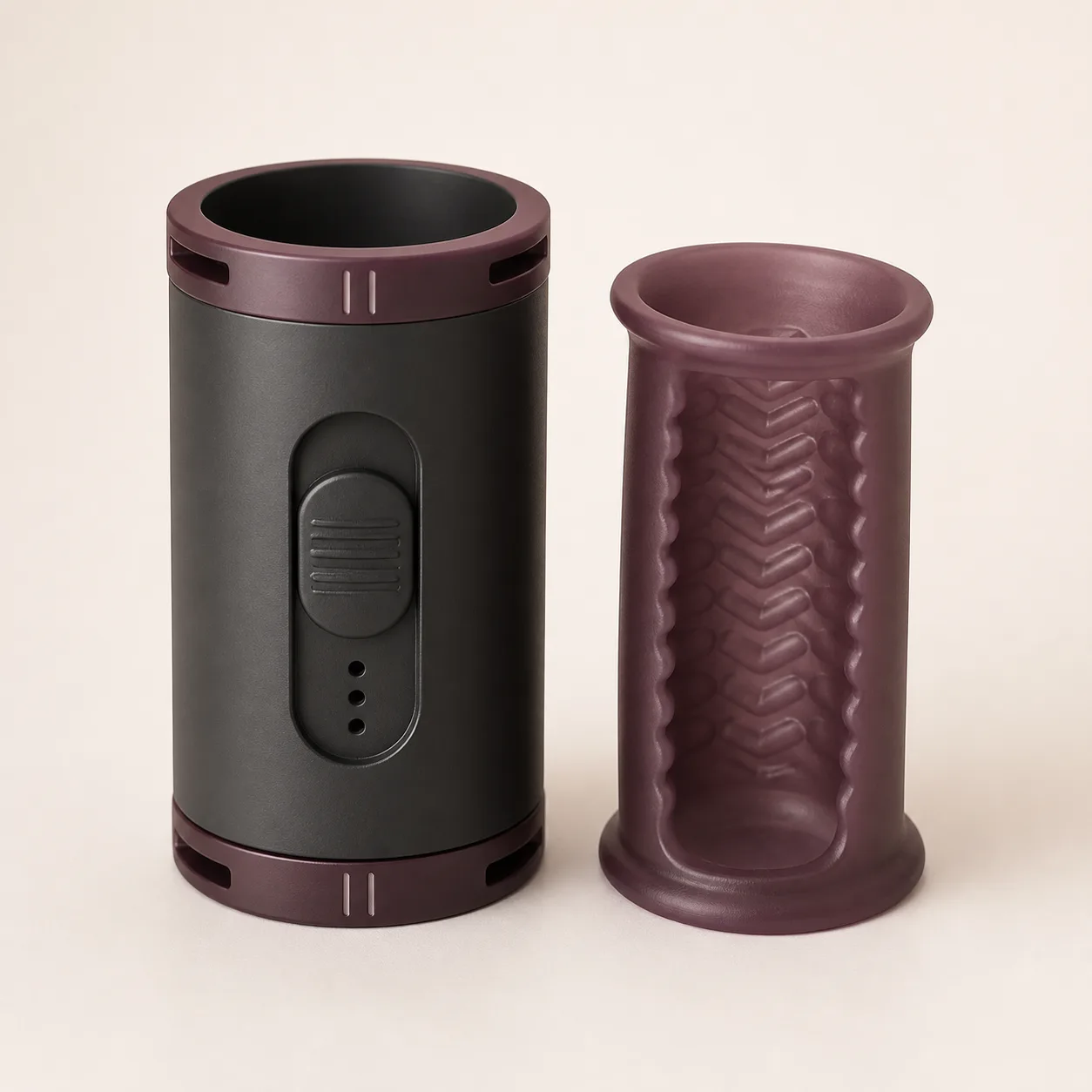
Bayonet-Lock Reversible-Liner Manual Stroker with Thumb Vent
A non-powered through-shell manual stroker concept with reversible dual-texture liner, quarter-turn bayonet collars and a three-state thumb vent.
31,99 $
200 in stock
One manual shell, one liner and two orientations
This bayonet-lock manual stroker concept pairs a short charcoal through-shell with plum quarter-turn collars, a side thumb vent and a removable smoky-plum liner. The liner is open at both ends and proposed as reversible, with chevron texture concentrated toward one side and rounded ribs along the neighboring channel.

No motor, battery, heater, charger, app or remote is included in the planned design.
Inventory the complete assembly before fitting the liner
Lay out the shell, upper collar, lower collar, liner, vent slider and any hidden seals or retaining rings. Photograph both sides of every removable component and record mass and dimensions.
A complete-set quotation must name each part; a generic sleeve listing is not evidence that the shell or collars are supplied.
Map the bayonet path at both ends
Mark the unlocked entry, rotation path and fully seated stop for each collar. Measure insertion depth, rotation angle, ramp height and clearance without stretching the liner across a sharp edge.
Alignment marks must correspond to a positive mechanical stop rather than decoration.
Test collar retention after repeated quarter turns
Fit the dry liner, engage both collars and apply a controlled axial pull and twist on a soft fixture. Repeat after a documented sequence of open-close cycles, checking for reduced torque, skipped ramps, cracks or collar lift.
A collar that releases under the qualification load disqualifies the sample.
Reverse the liner only through a verified procedure
Document which end is Orientation A and which is Orientation B before lubrication. Remove both collars, withdraw the liner without tools, turn it end for end and reseat each rim evenly before locking.
Do not flip or reorient the liner while the product is in contact with the body.
Chart the texture route from each opening
Use a flexible depth gauge and inspection light to record tunnel length, relaxed opening diameter, minimum internal diameter, chevron height, rib height, spacing and transition zones from both orientations.
Texture names do not predict pressure; the installed liner must be measured inside the production shell.
Measure airflow at every thumb-vent position
Move the recessed slider through each repeatable state and log free airflow with the empty liner, a soft calibration mandrel and light hand compression. Verify that the three visible dots correspond to documented openings.
Never assume that a partially visible hole provides a safe airflow path.
Keep a fast local pressure-release path
During fixture testing, confirm that the thumb vent can open fully with one hand and that either collar can be disengaged after load is removed. Practice the release sequence before use.
Stop after pain, numbness, discoloration, unexpected suction, trapped skin or a vent that cannot open immediately.
Inspect every hard-soft interface
Run a soft swab around collar windows, shell rims, liner lips, vent recess and internal shoulders. Look for burrs, molding flash, pinch gaps, lubricant traps and liner edges exposed by axial movement.
The installed liner must cover every approved contact boundary without twisting, bunching or creeping into the vent.
Build a fit range from dimensions and pressure data
Measure the liner relaxed, installed and stretched on graduated soft mandrels within a conservative supplier limit. Record insertion force, radial pressure, vent flow, rim movement and recovery after each step.
No universal size or tightness claim should appear until the exact sample passes the full chart.
Verify materials instead of reading them from color
Request composition for liner, shell, collars, vent slider, pigments, seals, adhesives and internal retainers. Review restricted-substance and skin-contact evidence for the exact factory revision.
Hardness, porosity, cure chemistry, odor limits and barrier compatibility remain pending.
Separate components for cleaning and lubricant review
Unlock both collars, remove the liner and follow the confirmed mild-cleaning method for each material. Flush the through-liner from both ends, work around every texture valley and wipe shell, vent channel and collar ramps separately.
Use only a lubricant confirmed compatible with the exact liner. No boiling, dishwasher, bleach, alcohol, abrasives or shell immersion is approved without exact-model instructions.
Dry the hidden paths before reassembly
Stand the open liner so both ends can drain, and dry texture valleys, flared rims, collar windows, vent holes and shell shoulders completely. Inspect against a light before installing.
Store the clean dry liner without tight folds and leave the collars disengaged enough to avoid long-term compression unless the supplier specifies otherwise.
Use lot checks that expose orientation and lock errors
For each production lot, sample both liner orientations, both collars and every vent state. Record alignment, engagement torque, axial retention, texture position, airflow, rim coverage, odor and visible defects.
Quarantine mixed revisions, incomplete sets or parts that cannot be traced to the qualified bill of materials.
Price the complete mechanism beyond a sleeve benchmark
An Alibaba showroom lists an open reusable textured stroker sleeve at USD 1.24-1.41 with a one-piece minimum. That listing is a liner benchmark only and does not establish this reversible texture plan, bayonet shell, thumb vent or legal supplier.
The procurement reference supports an EUR 31.99 planning price after allowing for China-origin freight, complete-set quotation, component measurement, collar ramp and retention testing, reversible-orientation mapping, airflow and local-release checks, interface inspection, material review, cleaning validation, protective packing and discreet fulfillment. Packed size, weight, freight, duty, tax, insurance, payment fees and destination terms require confirmation.
Frequently asked questions
Is the liner genuinely reversible?
That feature requires confirmation that both rims seat securely and both orientations keep the vent clear.
How do the bayonet collars lock?
Each collar should enter its ramps and rotate to a measured positive stop; exact angles and torque remain pending.
What do the three vent dots mean?
They indicate a proposed three-state control, but actual openings and airflow must be measured.
Can the liner be cleaned inside the shell?
Cleaning is planned with the liner removed so the tunnel, shell, collar ramps and vent path are separately accessible.
Which lubricant is suitable?
Use only a lubricant confirmed compatible with the exact liner composition after supplier verification.
Which faults require retirement?
Tears, sticky texture, swelling, odor, loose collars, worn ramps, blocked airflow, sharp edges, liner creep, trapped residue or any unexpected release.
Reviews
There are no reviews yet.