


Cloud-Glow Air-Pulse and Wired Egg Duo
August 14, 2026
Eight-Paddle Dual-Rail Travelling-Wave Automatic Stroker with Service Door
August 14, 2026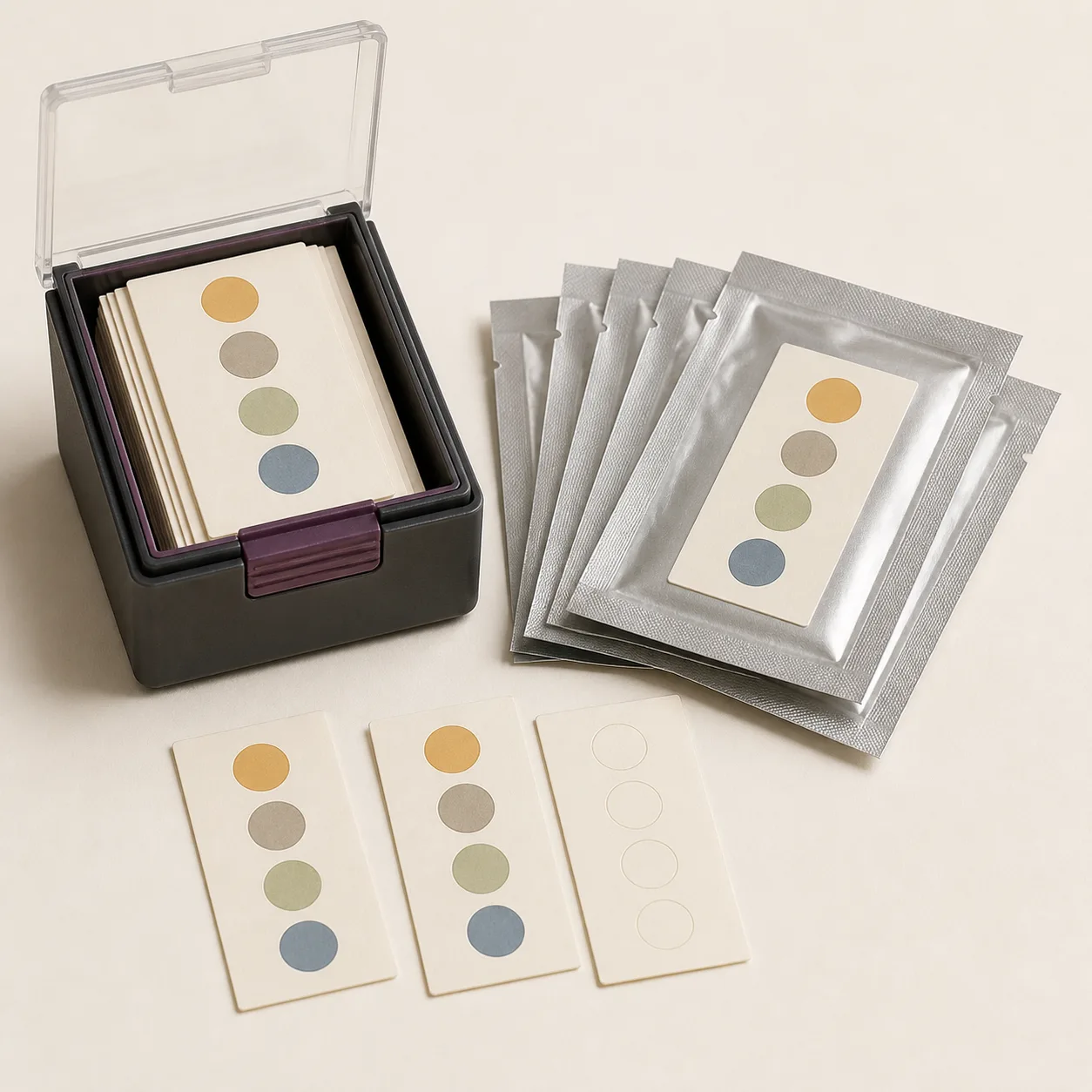
Cobalt-Free Humidity Indicator Card Kit
A multi-spot humidity indicator card concept with sealed foil sachets, a clear-lid dispenser and a threshold-based storage monitoring workflow.
14,99 $
200 in stock
A threshold card answers a narrower question than a hygrometer
The cobalt-free humidity indicator cards concept uses several color-change spots on a compact paper strip, with foil sachets and a clear-lid dispenser for organized storage. Each approved spot would indicate whether local relative humidity has crossed a defined range under specified conditions.

The card is not a calibrated continuous meter and cannot show an exact room reading between its verified thresholds.
Place the indicator in the same enclosed air as the stored item
A card inside a case, drawer or sealed pouch observes that small air volume. A reading taken outside the container may differ because ventilation, damp contents and temperature create a separate microclimate.
Do not block the sensing spots or press them directly against a stored surface.
The threshold values must come from the approved production print
Spot count, nominal relative-humidity levels, tolerance and reading temperature remain pending. Photograph each approved lot beside its supplier reference before distribution so users can interpret the specific card they receive.
The colors in the concept image are visual placeholders and not a reading chart.
Temperature affects both humidity and color interpretation
Relative humidity changes when air temperature changes, even if the moisture quantity does not. Stabilize the closed storage volume at the documented reading temperature and allow the indicator its verified response time.
A card moved between cold and warm locations should not be judged immediately.
Fresh cards need sealed barrier storage
Exposure to room air can activate an indicator before it reaches the intended container. Keep unused cards in their approved foil barrier pack, close bulk dispensers promptly and record the first-opened date.
Foil structure, reseal method and post-opening shelf life must be confirmed.
Do not touch or wet the sensing spots
Skin moisture, cleaner, lubricant and condensation can create a local reaction unrelated to the surrounding air. Handle the card by dry edges and keep it clear of liquids, powders and recently cleaned surfaces.
A directly wetted card should be isolated rather than interpreted.
The indicator observes moisture but does not remove it
These cards contain no approved drying capacity and cannot protect a damp item. Store only clean, fully dry products and use any desiccant or climate-control method solely according to its own documented instructions.
A favorable spot color is not proof that the contents themselves are dry.
Reversibility must be demonstrated, not assumed
Some humidity indicators change back as conditions fall; others are intended for one exposure cycle or can drift after prolonged humidity. Test production samples through controlled rising and falling steps before describing reuse.
Until that work is complete, treat a changed card as an inspection prompt rather than resetting it informally.
Cobalt-free is a chemical specification that needs evidence
The supplier describes cobalt-free cards, but exact indicator compounds and the analytical method remain pending. Obtain composition declarations, restricted-substance reports and lot traceability before approving that claim for the finished kit.
Cobalt-free does not mean chemical-free, edible or suitable for skin contact.
Compare color under consistent neutral lighting
Warm lamps, colored walls and phone camera processing can shift the appearance of subtle spots. Read the card under the verified neutral light source beside the approved reference swatch.
Color-vision limitations may require a second observer or an instrumented check.
Use a dated log to distinguish an event from a trend
Record card lot, location, time, temperature, observed spot state and any event such as cleaning or weather change. Paired observations from an analog or digital meter can help investigate discrepancies without pretending the card is more precise than it is.
Never alter the original observation after conditions change.
Small treated cards require controlled handling
Keep cards, foil sachets and reference swatches away from children, pets, food and drink. Do not cut, burn or place indicator paper in the mouth.
Final safety and disposal instructions must follow the verified chemistry and destination rules.
Expired or damaged packs cannot establish a baseline
Reject punctured foil, damp paper, stained spots, delamination, unreadable print or cards outside their approved shelf life. A dispenser that was left open in humid air also needs a documented disposition.
Do not mix loose cards from different lots in one unlabeled compartment.
Incoming inspection should challenge every nominal spot
Sample each lot in controlled humidity chambers at values below, near and above every threshold. Record response time, color direction, hysteresis, recovery, temperature sensitivity and agreement across cards.
Quarantine lots with uneven coating, premature activation, ambiguous colors, missing traceability or failed cobalt-free documentation.
The source price excludes verification and barrier packaging
An Alibaba listing from Dongguan Dingxing Industry Co., Ltd. displays cobalt-free humidity indicator cards at USD 0.03-0.09 per card with MOQ 1000 pieces. Thresholds, chemistry, response, reversibility, shelf life and pack configuration remain pending.
The procurement reference supports sample inquiry only. The EUR 14.99 plan provisionally includes China-origin freight, chamber checks, chemistry documentation review, foil packing and lot control; packed mass, freight, duty, tax, insurance, payment fees and destination terms remain pending.
Frequently asked questions
Does a card replace a humidity meter?
No. It provides threshold-based color information under specified conditions, not a continuous calibrated reading.
Can the card dry a storage case?
No. It indicates moisture conditions and has no approved moisture-removal function.
Are the cards reusable?
Reversibility and cycle life remain pending until controlled rising-and-falling humidity tests are complete.
What do the colors mean?
Only the verified chart supplied for the exact production lot should be used; concept-image colors are not instructions.
How should unused cards be stored?
Keep them in the approved sealed barrier packaging and follow the confirmed temperature and shelf-life limits.
When should a card be discarded?
Isolate punctured, wet, stained, delaminated, expired or previously exposed cards according to the verified disposal method.


Reviews
There are no reviews yet.