


Collapsible Care-Washing Basin with Drain Plug
August 14, 2026
Three-Carriage Eccentric Ellipse-Track Automatic Stroker with Open-End Liner
August 14, 2026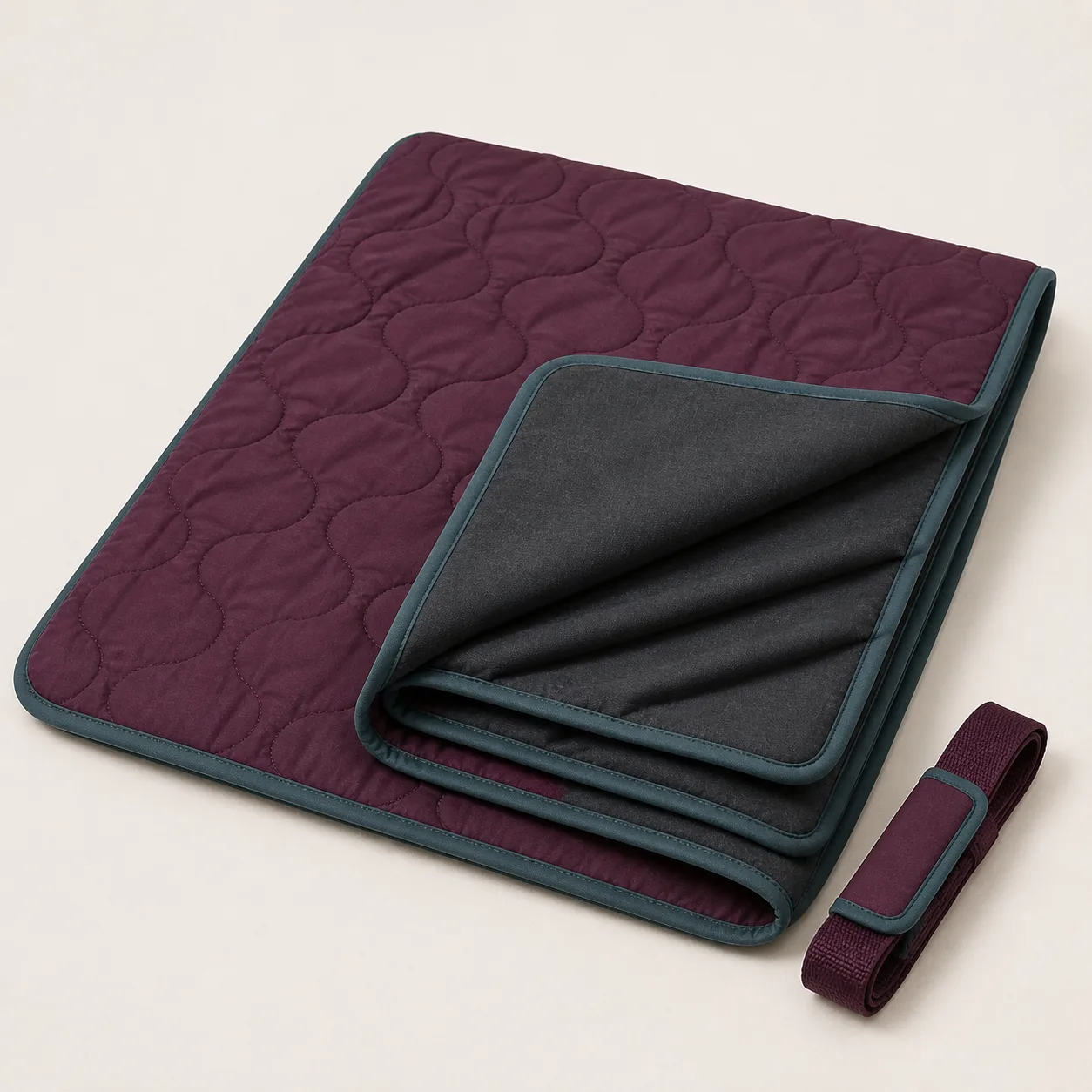
Foldable Quilted Waterproof Intimacy Blanket
A foldable quilted surface-protection blanket concept with plum face, charcoal underside, bound edge and matching carry strap.
49,99 $
200 in stock
A protective blanket should earn its place through measured construction
The foldable waterproof intimacy blanket concept pairs a deep-plum quilted face with a charcoal underside, muted-teal binding and separate carry strap. It is intended as a removable surface layer whose exact textiles and performance will be defined only after a production-matched sample is tested.

The image communicates form and color direction; it does not certify waterproofness, absorbency or laundering results.
Measured coverage matters more than a size name
Record finished length and width after conditioning, then repeat the measurements after the proposed wash cycle. Publish the actual usable area inside the binding rather than relying on throw, queen or oversized labels that vary between factories.
Corner squareness, quilting draw-in and edge curl should be included in the tolerance plan.
The quilted face needs a tactile and absorbency profile
Confirm fiber content, pile height, fabric mass, fill composition and quilting density. Test how quickly the face wets, how much it holds before transfer, and whether pressure pushes moisture sideways beyond the intended zone.
Softness is subjective, so sample evaluation should also check snagging, lint, pilling and friction against bare skin.
The hidden barrier is the critical working layer
Identify the membrane or coating chemistry, thickness and bonding method. Evaluate hydrostatic resistance on new material and after repeated washing, folding and low-temperature aging, with acceptance limits agreed before production.
A single demonstration on a flat sample cannot establish performance across seams, quilt points and worn areas.
Binding and stitching create the likely leak paths
Inspect needle holes, edge joins, binding overlaps and any label attachment. Challenge the perimeter and quilting lines separately because liquid can travel through thread or wick along a textile edge even when the central membrane stays intact.
Specify stitch density and minimum seam strength without piercing more layers than the approved construction allows.
The charcoal underside needs grip and color-transfer checks
Measure sliding behavior on dry and damp cotton sheets, smooth upholstery and other intended surfaces. A dark backing also requires rub, wash and perspiration colorfastness tests against pale fabrics.
No non-slip claim is approved until the production finish is tested on defined substrates and orientations.
Folding convenience must not fatigue the barrier
Define a repeatable fold pattern that avoids sharply creasing the same membrane line. Cycle the blanket between packed and open states, then inspect for delamination, cracking, pinholes and permanent ridges.
The removable strap needs its own seam strength, dimensional and colorfastness checks.
Set the blanket flat before the room is in use
Open it fully on a stable, dry base, smooth out ridges and keep edges away from walkways. Do not rely on the blanket to correct an unstable bed frame, damaged upholstery or a slick floor.
Keep the bound edge visible enough to notice bunching, migration or liquid approaching the perimeter.
Surface protection is not a sanitation process
A barrier may reduce contact with the furnishing beneath, but it does not disinfect either surface. Handle visible residue according to the verified care instructions and wash the blanket separately when required.
Do not place cleaned items on a used section simply because the underside appears dry.
Laundering rules must come from the complete laminate
Validate detergent type, load size, wash temperature, spin speed and whether bleach, softener or solvent is prohibited. Test the face, fill, adhesive, membrane, binding and thread together rather than borrowing care advice from one textile component.
Record shrinkage, puckering, odor, staining, delamination and waterproof performance after the claimed number of cycles.
Dry every layer before folding it away
Confirm whether line drying or a defined tumble setting is acceptable. Thick quilt channels and bound edges can remain damp after the outer face feels dry, encouraging odor or microbial growth in storage.
Store loosely folded in a ventilated, clean place away from heaters, sharp objects and direct sunlight.
Inspection turns wear into a clear stop signal
Before each setup, look for cuts, punctures, lifted laminate, cracked coating, loose stitching, stretched binding and persistent odor. Backlighting and a controlled water-column check can support periodic quality review without substituting for the supplier method.
Remove a damaged blanket from use because an invisible breach can defeat the intended barrier.
Packaged odor and chemical documents need review
Request restricted-substance declarations, coating details and destination-specific textile labeling. Evaluate odor after sealed transport and ventilation, and investigate strong or persistent emissions rather than masking them with fragrance.
Certification logos, recycled-content claims and skin-contact statements remain unapproved until documents match the exact production lot.
Incoming inspection should challenge more than appearance
Sample dimensions, weight, layer identity, binding, stitching, color, odor and strap attachment. Add controlled leak testing at the center, quilt points and edges, followed by laundering checks on retained samples.
Quarantine units with pinholes, delamination, weak seams, dye transfer, incorrect care labels or results outside the approved specification.
The sourcing price is a starting point, not a landed cost
An Alibaba waterproof-blanket-for-bed supplier page associated with Shanghai Tuoxin International Trading Co., Ltd. displays entries at USD 5.49-12.99 with MOQ 100 pieces. The exact listing-to-sample match, size, textiles, barrier, wash care and compliance file remain pending.
The procurement reference supports supplier inquiry only. The EUR 49.99 plan includes a provisional China-origin freight allowance plus textile, membrane, seam, laundering and colorfastness validation; actual packed weight, freight, duty, tax, insurance, payment fees and destination terms remain pending.
Frequently asked questions
Is the blanket proven waterproof?
Not yet. The production-matched sample must pass defined central, seam and edge tests before that claim is approved.
What size is it?
Finished dimensions and usable area remain pending because supplier size labels do not replace conditioned measurements.
Can it go in a washing machine?
The final care method depends on the complete textile and membrane construction and must be validated through repeated cycles.
Will the dark backing mark pale sheets?
Color transfer is possible until dry rub, wet rub, wash and perspiration colorfastness results are confirmed.
Does the underside prevent sliding?
No grip claim is approved; movement must be tested on each intended surface, and the blanket should be checked during setup.
When should it be removed from use?
Stop using it if there are cuts, punctures, delamination, cracked coating, loose seams, persistent odor or any failed barrier check.
Reviews
There are no reviews yet.