



Foldable Quilted Waterproof Intimacy Blanket
August 14, 2026
100ml Graduated Care-Mixing Cup with Snap Lid
August 14, 2026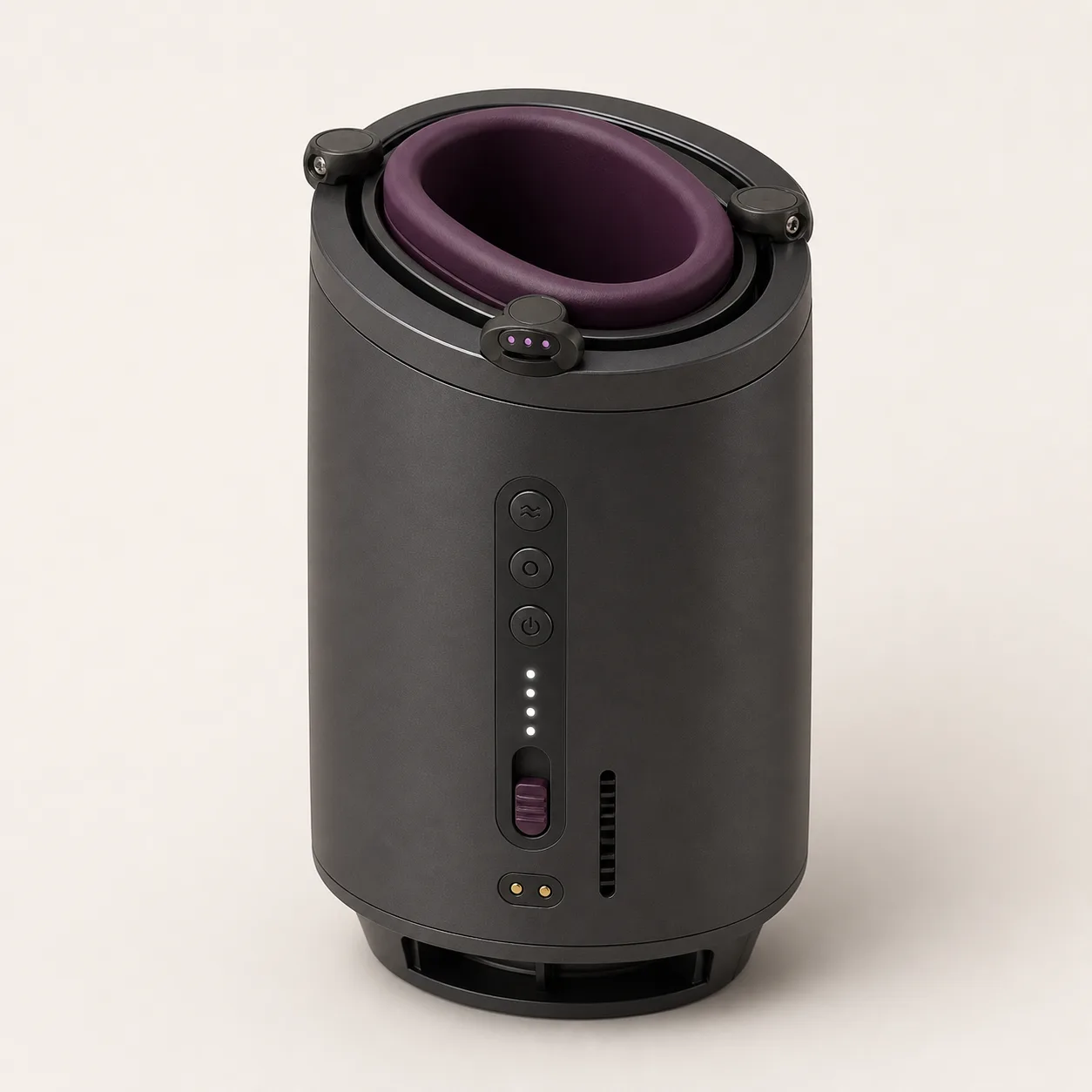
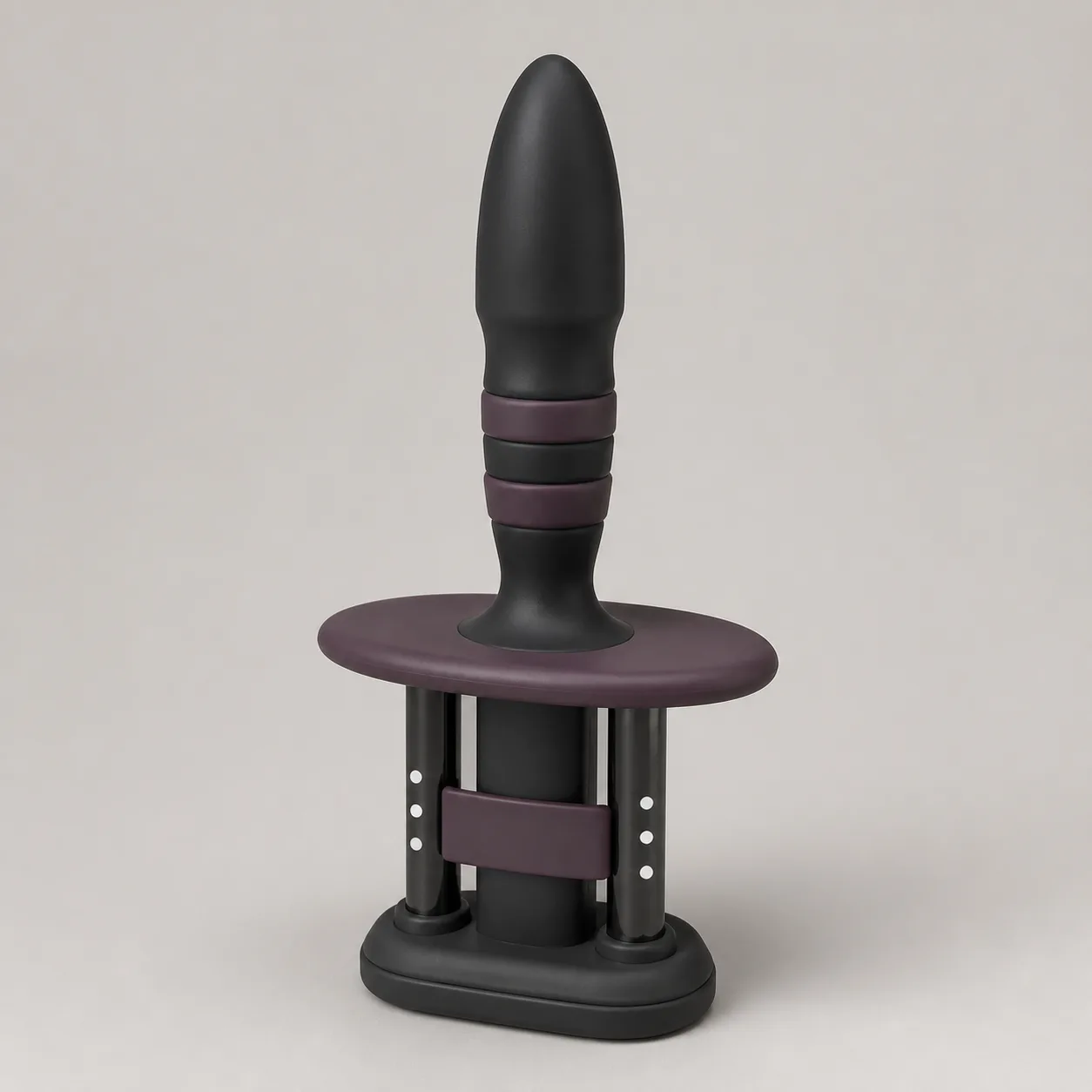
Three-Carriage Eccentric Ellipse-Track Automatic Stroker with Open-End Liner
A compact automatic stroker concept with a removable open-end liner collar captured by three carriages in an offset elliptical orbit track.
62,99 $
200 in stock
Guide an open liner collar around an eccentric ellipse
This ellipse track automatic stroker concept captures a removable open-end liner collar inside an offset elliptical guide. Three guarded carriage blocks are proposed to move the collar through a small two-axis orbital path while preventing continuous liner rotation and avoiding a telescoping thrust rail.

The image does not prove orbit amplitude, path accuracy, non-rotation, carriage count inside the shell, liner fit, programs, runtime, materials or supplier approval.
Inventory the entire orbital mechanism
Request an exploded drawing and bill of materials for the rim, liner, collar, inner and outer track rails, three carriage bodies, guide wheels, axles, bushings, preload springs, guards, stops, drive links, cam or crank, actuator, counterweight, sensors, frame, shell, controller, buttons, indicators, emergency slider, vents, cell, contacts, conductors, seals, pigments, lubricants and adhesives.
Trace loads from the collar through every carriage into the internal frame.
Measure the baseline shell and opening
Record shell height, width and depth, opening axes, liner length, collar axes, track axes, eccentric offset, rail spacing, carriage pitch, guard clearances, lower opening, control positions, vent areas, contact spacing, mass and center of gravity.
Repeat with the liner installed, removed and reinstalled in each permitted orientation.
Map the complete elliptical track
Measure major and minor axes, rail profile, flatness, runout, seam steps, surface finish, end continuity and frame alignment. Inspect the track at twelve clock positions before and after cycle testing.
Reject dents, burrs, discontinuities or rail spread that could lift a wheel or jam a carriage.
Characterize all three carriages
Record wheel diameter, axle play, bearing drag, preload, guide clearance, tilt, hard-stop margin and rolling resistance for each block. Compare leading, side and trailing positions under no load and standardized collar force.
The marked carriage must not be treated as the only driven or sensed component without teardown evidence.
Measure the orbital path in two axes
Track collar-center coordinates, velocity, acceleration, dwell and phase through every supported cycle. Separate horizontal and vertical amplitude and compare clockwise, counterclockwise or reversing paths where present.
Log path distortion, skipped sectors, carriage lag, frame flex and movement caused only by shell vibration.
Verify that the liner does not twist
Place indexed witness points on collar and liner, then measure angular drift, torsional oscillation, lock creep and orientation change through cycles and compliant loading. Repeat after liner removal and reinstallation.
Any unexpected twist requires assessment of collar retention, track friction and carriage synchronization.
Map pressure during orbital loading
Use an instrumented compliant mandrel to record local pressure, channel displacement, circumference change, shear, liner folding and migration through the full orbit. Repeat with small axial and rotational offsets.
Set limits from the highest local peak, not from average force or nominal orbit size.
Calibrate liner and collar retention
Measure insertion, collar engagement, detent force, axial play, false locking, creep, removal force and cleaning access. Test whether orbital load can unseat the liner or make release inaccessible.
Both ends must remain open and unobstructed in every approved state.
Probe track, wheel and guard gaps
Inspect rail-to-wheel, carriage-to-guard, collar-to-track, axle-end, seam, emergency-slider and lower-opening clearances throughout the orbit, liner changes and cleaning. Use articulated fixtures rather than fingers.
Guards must prevent access while permitting inspection, debris removal and complete drying.
Document controls and emergency release
Verify startup hold, orbit level, direction or program selection, pause, immediate stop, memory, lockout and indicator meanings. Measure emergency-slider force, vent opening, airflow and neutral release under no load and compliant load.
Loss of power, sensor error or carriage jam must leave a practical extraction path.
Measure current, sound and heat
Record current, sound and temperature at the liner, collar, three carriages, track sectors, drive, frame, shell, controls, vents, contacts and cell. Compare free orbit, compliant load, reverse transitions and a partly obstructed vent.
Confirm cell chemistry, capacity, protection, input, polarity, charge time, runtime method, charging interlock and transport paperwork.
Test carriage and track faults
Immobilize one carriage, increase drag on one sector and apply asymmetric collar load using protected fixtures. Measure force, current, detection time, shutdown, neutral release, cool-down and restart behavior.
Do not force a jammed collar or re-energize a derailed, cracked, rattling or hot sample.
Cycle orbit, liner changes and cleaning
Run repeated supported paths, reversals, compliant loading, immediate stops, liner removal, collar engagement, charging, cleaning, measured drying and storage. At checkpoints repeat track geometry, carriage drag, orbital coordinates, liner twist, pressure, retention, gaps, sound, current and heat.
Validate cleaning beneath the collar, along both rail faces, around every wheel and guard, at seams, controls, emergency slider, vents, contacts and the lower opening.
Price after orbital-path verification
An Alibaba automatic male-masturbator listing currently shows an open-ended telescopic category example at USD 16.18-21.56 with MOQ one set. It is a powered-category benchmark only and does not confirm this eccentric ellipse track, three-carriage collar or non-rotating open liner.
The procurement reference supports an EUR 62.99 planning price after allowing for China-origin freight, exact-model sourcing, teardown, track metrology, three-carriage characterization, two-axis path capture, liner-twist tests, pressure maps, retention and gap review, emergency venting, controls, battery, heat and fault testing, combined cycle life, material evidence, cleaning validation, protective packing and discreet fulfillment. Exact quotation, MOQ, packed size, weight, freight, duty, tax, insurance, payment fees and delivery terms remain pending.
Frequently asked questions
Does the liner collar orbit rather than thrust?
That is the concept, but two-axis coordinates must distinguish orbit from vibration or shell flex.
Are there exactly three carriages?
The visualization shows three; production count and internal links require teardown.
Does the liner stay rotationally fixed?
Angular witness testing is required across loads, reversals and reinstallations.
Can a carriage derail?
Rail profile, preload, guards and fault shutdown must be verified under asymmetric loads.
How is the track cleaned?
Only by a validated method that reaches both rails, every wheel, guard and hidden sector and confirms drying.
Which faults require retirement?
A derailed block, rising wheel play, dented rail, jammed collar, torn liner, false lock, failed vent, exposed conductor, swollen cell or abnormal heat.
Reviews
There are no reviews yet.