


Six-Petal Radial-Flex Crown Wand with Recessed Center Dome
August 14, 2026
WINGPOW SW0406 Pink Heart-Shaped Vibrating Couples Ring
August 14, 2026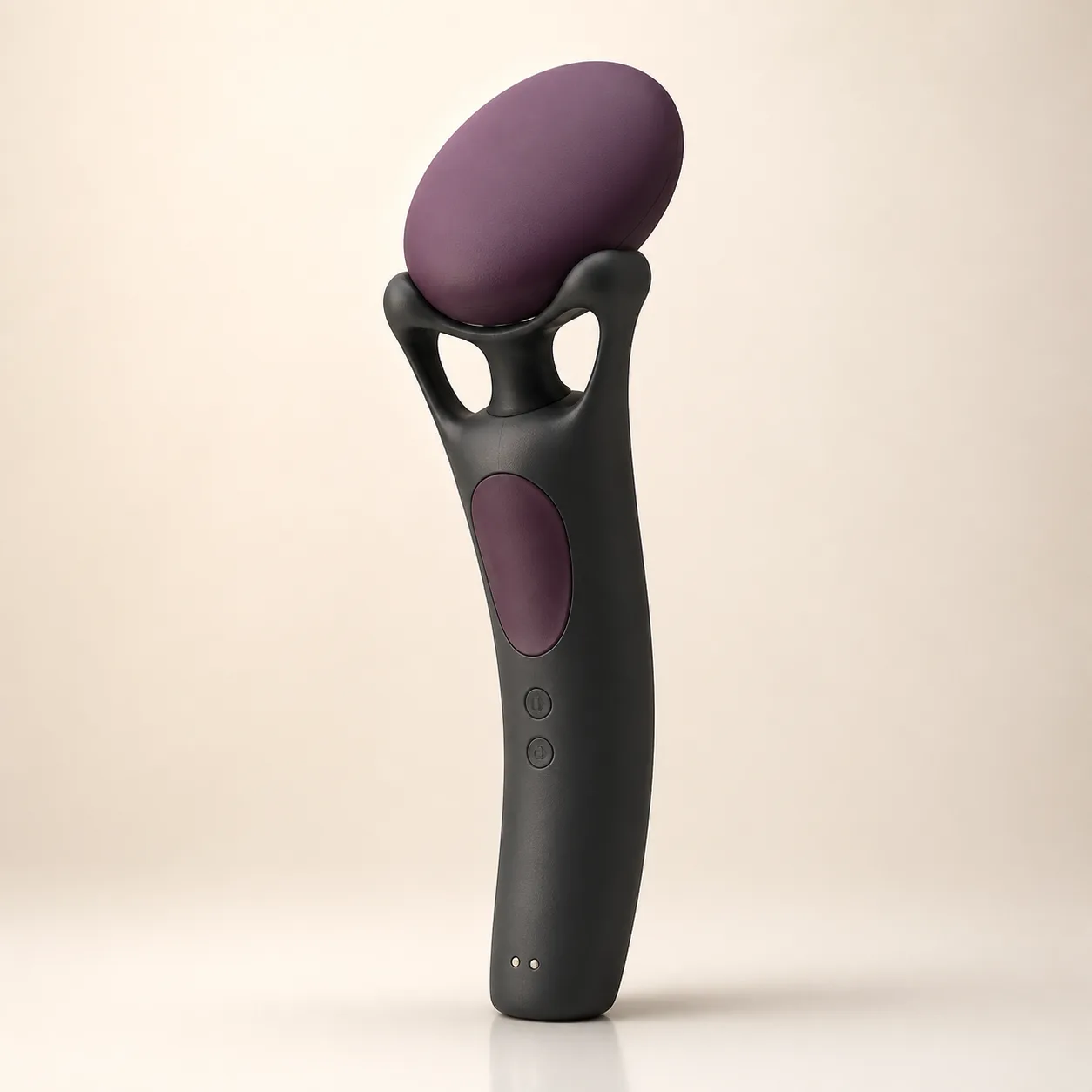
Four-Bridge Floating-Cradle Wand with Offset Oval Head
A rechargeable external wand concept with fixed offset oval head suspended in a four-bridge open cradle, two local controls and magnetic charging.
39,99 $
200 in stock
A broad oval head isolated by four visible bridges
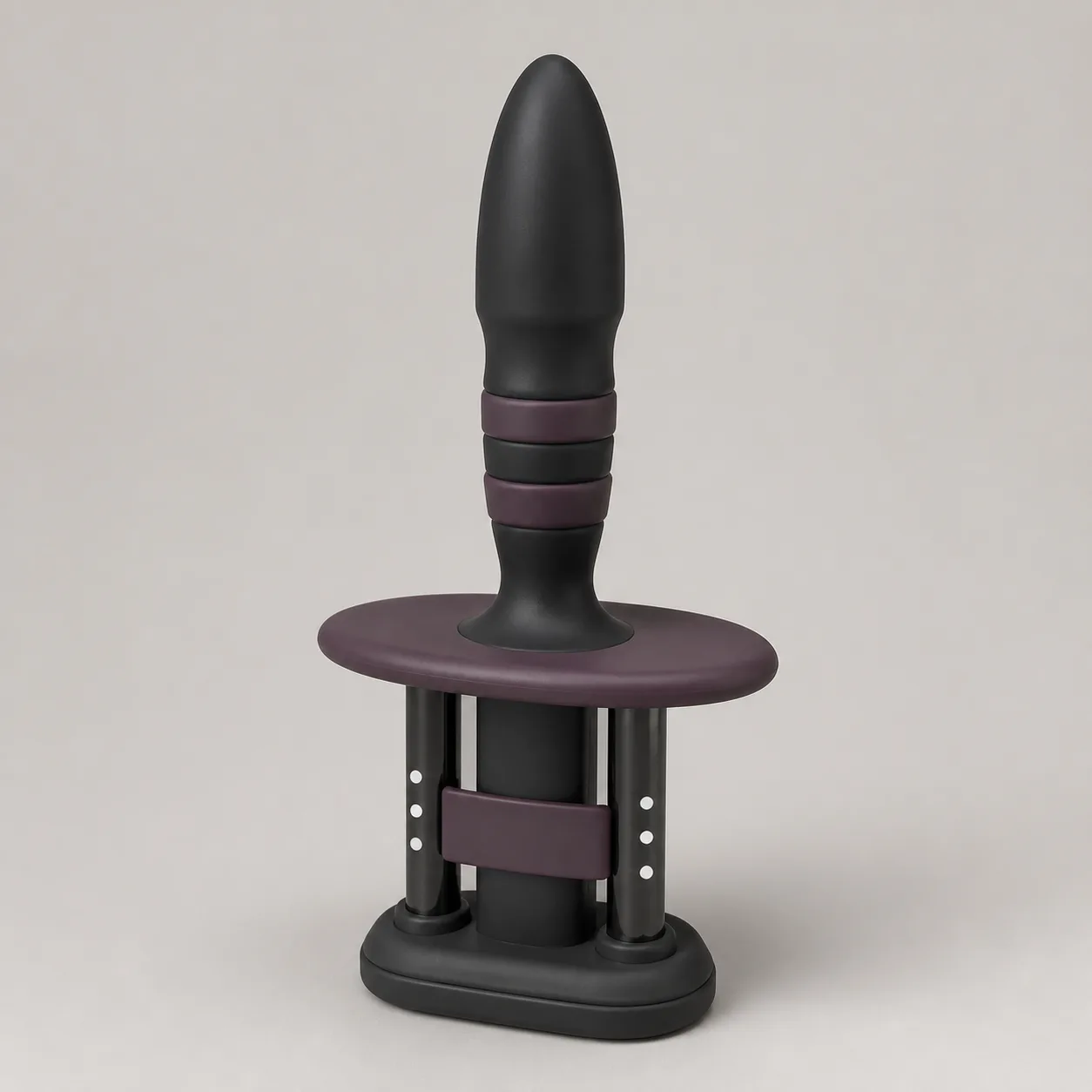
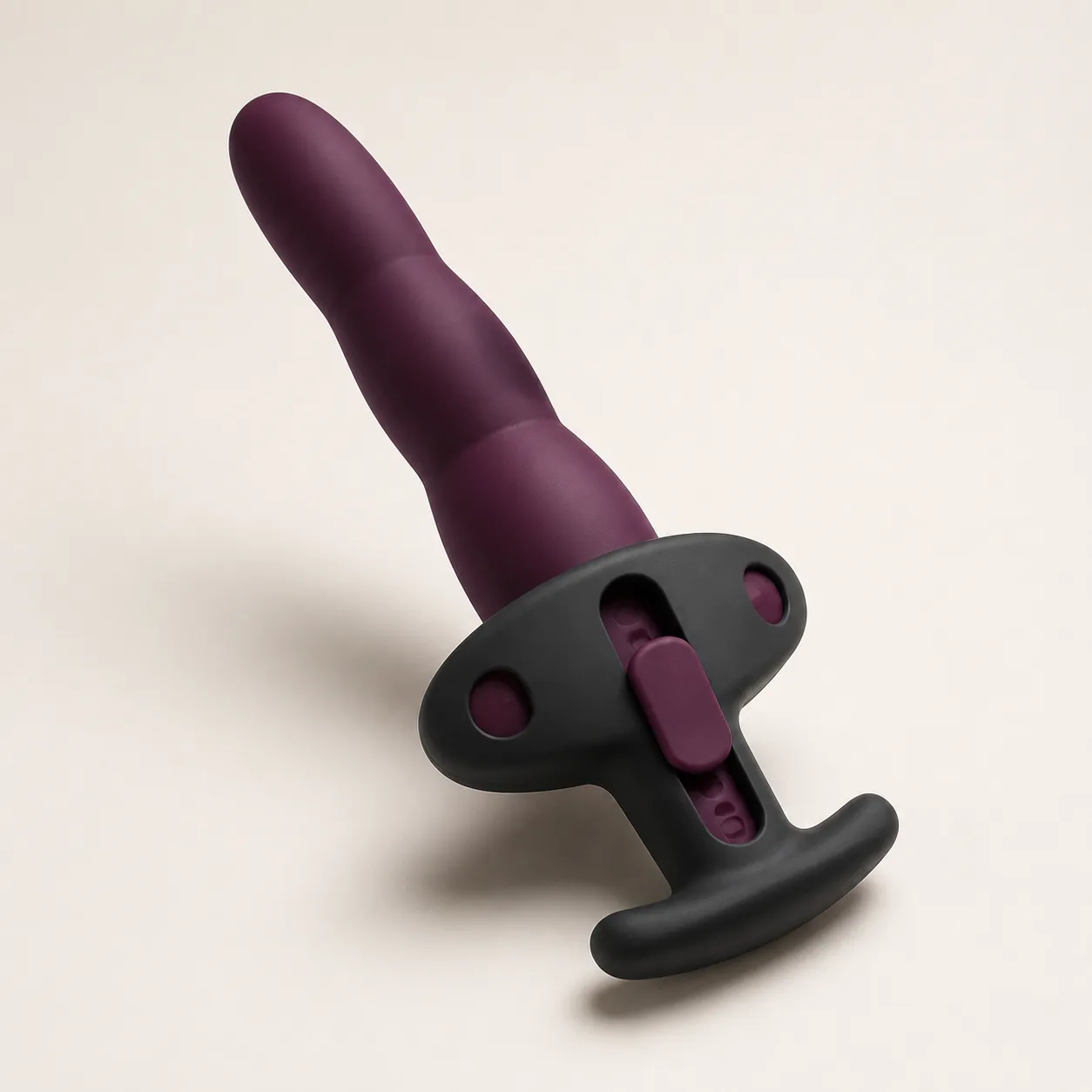
This floating cradle wand massager concept places a fixed deep-plum oval head above a tapered charcoal handle. Four short support bridges surround the neck, leaving open relief windows intended to permit controlled head movement without a conventional hinged joint.

Two local buttons, a plum thumb rest and magnetic contacts define the planned control and charging layout; no remote, app or interchangeable head is assumed.
Measure cradle travel in every direction
Clamp the handle in a soft fixture and apply small calibrated loads at the head center, both long-axis ends and both side edges. Record vertical, lateral and torsional displacement plus the recovery path after load is removed.
A floating appearance does not establish usable movement or a safe stop.
Compare all four support bridges for symmetry
Measure bridge width, thickness, free length, radius and gap on the exact sample. Repeat deflection tests after a documented number of loaded vibration cycles to identify uneven softening, whitening, cracking or permanent set.
One bridge carrying more load than the others changes both contact angle and failure risk.
Inspect the relief windows for pinch and residue zones
Move the clean dry head through its verified envelope while observing every opening around the cradle. Check for closing gaps, hard internal edges, exposed fasteners, lubricant migration and cavities a swab cannot reach.
Hair, skin, jewelry and loose fabric must remain outside all moving windows.
Map the offset oval head as two different contact faces
Record length, width, thickness, crown radius, edge radius, offset angle and distance from the handle axis. Create separate pressure maps for the broad face and narrower rim using matched soft fixtures.
The fixed head must not be twisted or pulled as if it were removable.
Measure output before and after cradle loading
Log amplitude, dominant frequency, pattern timing and noise with the head free, then repeat under controlled loads at the center and each edge. Note any rattle, mode dropout, motor stall or bridge contact with the frame.
Marketing labels such as deep or powerful cannot replace measured output.
Document every two-button control state
Test short press, long press and simultaneous actions from off, active, paused, locked and low-battery states. Confirm a simple local power-off that works while the head is lightly loaded on a fixture.
Unexpected activation, restart after charging or delayed shutdown disqualifies the sample.
Use the thumb rest to verify grip orientation
Measure handle circumference, taper, button reach, thumb-rest depth, center of mass and head offset. Compare dry and lubricated glove handling without allowing the cradle windows to become a handhold.
A secure grip must not require squeezing buttons or bending the floating head.
Separate surface comfort from mechanical pressure. Begin at the lowest verified output with light external contact and short intervals. Let the cradle move within its qualified range rather than forcing the head against its stop.
Stop after pain, numbness, skin irritation, unusual heat, pinching, bridge noise or loss of normal sensation.
Track battery runtime under realistic head loads
Measure runtime at low, middle and highest approved modes with the head free and under a standard fixture load. Record low-battery indication, output reduction, shutdown and repeatability across controlled charge cycles.
Battery chemistry, capacity, enclosure and protection circuits require supplier documents and inspection.
Qualify the magnetic contacts on a stable surface
Confirm input rating, polarity, cable alignment, retention, status indication and full-charge time. Inspect the two contacts for recess depth, corrosion and bridging residue after cleaning trials.
Charge only when the product is clean, dry, cool and away from the body; disconnect before operation.
Log temperature at head, bridges and handle
Use fixed intervals to measure the oval center, each edge, all four bridges, cradle frame, buttons, battery region and charge contacts. Repeat the test with the head free and at the maximum approved fixture load.
Stop after abnormal odor, swelling, unstable sound, output loss or temperature beyond the documented limit.
Confirm materials and ingress at the open cradle
Request composition for head skin, bridge assembly, frame, handle shell, thumb rest, seals, pigments, adhesives and charge contacts. Review restricted-substance and skin-contact evidence for the production revision.
Water resistance cannot be inferred from a sealed handle when the moving cradle contains open windows.
Clean each bridge without forcing the head
Power off and disconnect charging equipment. Follow the exact-model mild-cleaning method across the head and handle, then use a soft swab around each relief window while moving the head only through its qualified range.
Dry bridge roots, windows, buttons and contacts completely before storage; no immersion, boiling, dishwasher, bleach, alcohol or abrasives are approved without evidence.
Inspect the floating assembly before every session
Store the wand without weight on the head or pressure against the bridges. Before use, check symmetry, rebound, gap clearance, surface condition, button response, charge contacts and any new rattle.
Retire a sample with cracks, whitening, permanent tilt, sticky surface, exposed edges, trapped residue, loose contacts or delayed shutdown.
Price the cradle as an unverified mechanical upgrade
An Alibaba showroom lists a rechargeable wand massager at USD 3.88-5.67 with a 25-piece minimum. It is a category benchmark and does not establish a four-bridge floating cradle, offset oval head or specific legal supplier.
The procurement reference supports an EUR 39.99 planning price after allowing for China-origin freight, exact-model quotation, bridge measurement and fatigue cycles, movement and pinch-gap mapping, head geometry and pressure tests, loaded output, controls, battery, charging, temperature and ingress review, cleaning validation, protective packing and discreet fulfillment. Packed size, weight, freight, duty, tax, insurance, payment fees and destination terms require confirmation.
Frequently asked questions
How far does the head float?
Vertical, lateral and torsional travel must be measured under controlled loads on the exact sample.
Is the oval head removable?
No removable head is planned; pulling or twisting it can damage the bridge assembly.
Do the open windows pinch?
Minimum gaps and the full movement envelope require inspection, and skin, hair and fabric must stay outside them.
Can the wand be immersed?
Not without exact-revision ingress evidence covering the cradle, buttons, seams and contacts.
Does it need an app?
No app or remote is planned; all operating and shutdown actions should work through the two local buttons.
Which faults require immediate retirement?
A cracked or whitened bridge, permanent head tilt, closing gap, exposed edge, unusual rattle, battery swelling, excessive heat, charge damage or delayed stop.
Reviews
There are no reviews yet.