


Offset Orbit-Track Wand Massager with Captive Floating Pod
August 14, 2026
12V Dial-Control Deep-Rumble Wand Massager
August 14, 2026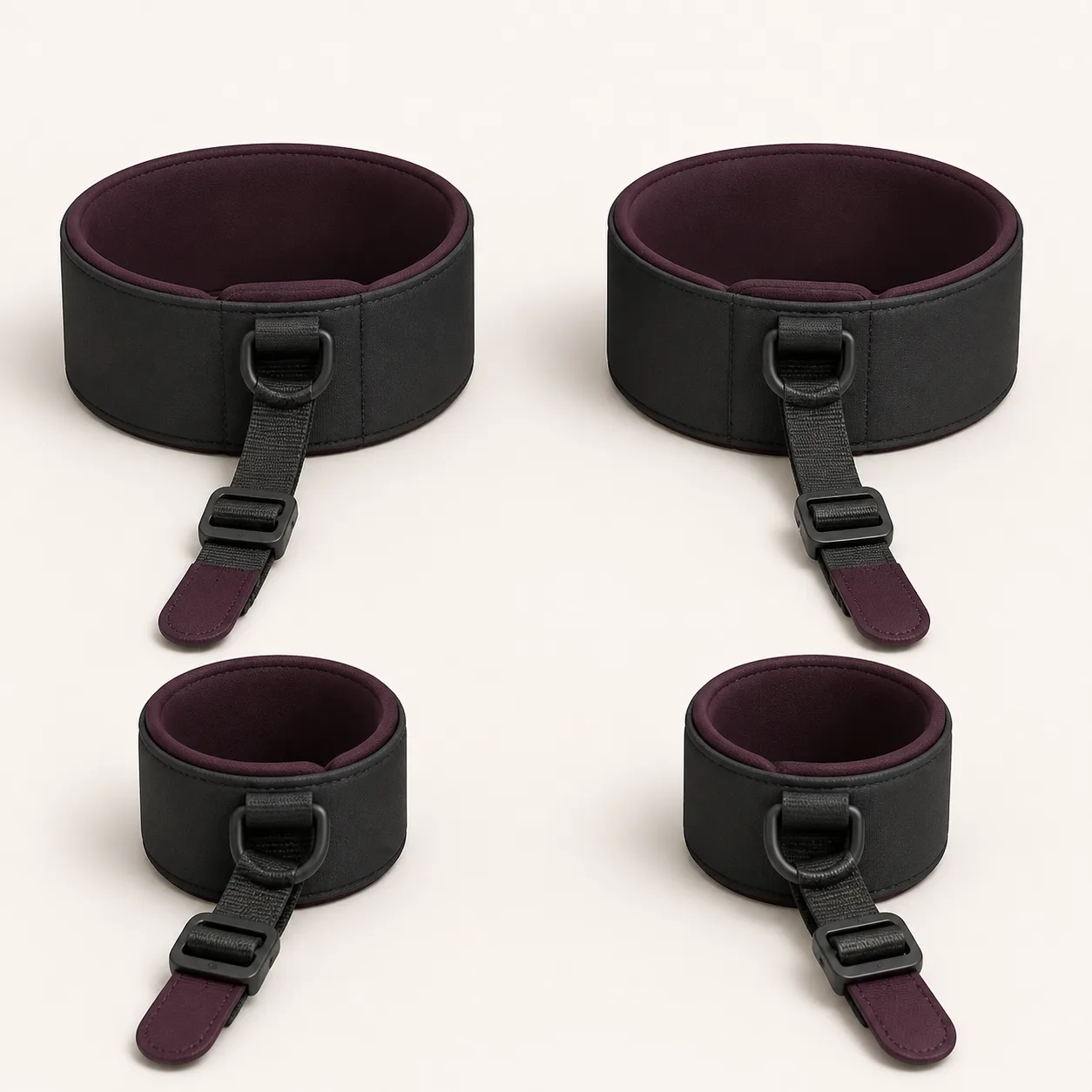
Four-Cuff Quick-Pull Bondage Restraint Set with Indexed Fit Tabs
A modular non-powered bondage restraint concept with two broad thigh cuffs, two smaller wrist cuffs, independent indexed fit straps and oversized quick-pull release tabs.
26,99 $
200 in stock
Four independently fitted cuffs support modular positioning
This four cuff bondage restraint set concept pairs two broad thigh cuffs with two smaller wrist cuffs. Each cuff has its own indexed fit strap, oversized plum pull tab, padded lining and blunt D-ring, allowing every position to be assessed separately instead of relying on one shared adjustment.

The image does not establish exact fit, closure strength, connector compatibility, materials or approved load.
Inventory every layer and closure component
Request a bill of materials for the outer shells, liners, padding, structural webbing, edge binding, thread, indexed straps, pull tabs, closure frames, pivots, keepers, D-rings, coatings, reinforcements, pigments and adhesives.
Confirm whether the wrist and thigh cuffs share hardware or use different ratings, because visual similarity does not prove equal capacity.
Separate wrist and thigh geometry records
Measure flat length, usable padded length, total width, edge thickness, padding thickness, ring position, strap width, pull-tab reach and closure overlap for all four cuffs. Record each part rather than averaging the pair.
The broader thigh units need their own curvature and taper map so the edges do not concentrate pressure when wrapped.
Map the complete indexed fit ranges
Close each cuff around a traceable cylindrical fixture at every usable index. Record internal circumference, overlap reserve, tab position, keeper engagement and whether the padded ends meet, overlap or leave a gap.
Exclude settings that expose a hard closure edge, leave too little strap reserve or allow the cuff to rotate freely.
Make every pull tab easy to identify by touch
Check the plum tabs with dry and damp gloved hands while the cuffs are empty. Measure reach, grip area, pull direction and the force needed to open the closure without loading the D-ring.
Each release must remain distinguishable from the ordinary adjustment tail and from any connector added later.
Challenge closure seating and false engagement
Close the indexed strap slowly, quickly and slightly off axis. Inspect whether the frame seats completely, the strap lies flat and the chosen index remains visible after a gentle fixture check.
Reject partial engagement, doubled webbing, hidden index marks, edge curling or a closure that appears secure before the strap is fully captured.
Inspect every D-ring and reinforcement path
Measure ring internal dimensions, wire diameter, weld quality, coating, rotation clearance and distance from the cuff edge. Trace the load path through webbing and stitching rather than treating a surface patch as structural proof.
Verify approved connector shapes so clips cannot wedge against the ring, lever the closure or rub the wearer.
Compare padding compression around each circumference
Use compliant instrumented fixtures representing the verified fit range. Record pressure at the closure, liner edges, ring root and opposite side under low approved connector loads.
Check whether the thigh cuffs roll or form a hard ridge and whether the narrower wrist cuffs bridge over the fixture instead of distributing contact.
Assess left and right pair consistency
Match the two wrist cuffs and the two thigh cuffs for dimensions, closure force, ring position, padding recovery and seam quality. Mark each sample so measurements remain traceable through cycle tests.
A pair should not rely on the wearer compensating for different index spacing or release behavior.
Keep circulation and release access observable
Fit only within a confirmed range, keep all four plum tabs visible and maintain immediate access to every closure. Check comfort, warmth, color, sensation and movement at short documented intervals.
Stop immediately for pain, numbness, tingling, coldness, swelling, color change, weakness, panic, unexpected tightening or difficulty reaching a release.
Limit the assembly to verified low-load positioning
Test complete cuffs on fixtures with separately capped axial, lateral and twisting loads. Record strap slip, ring rotation, seam movement, shell distortion, padding migration and closure opening.
This concept has no suspension, lifting, dragging, fall-arrest, body-weight or overhead rating. Never connect it where a slip or release could cause a fall or impact.
Cycle straps, rings and seams as one system
Run repeated open-fit-load-release cycles within documented limits, alternating index positions and connector angles. Inspect thread abrasion, webbing fuzz, frame wear, ring coating, liner separation and pull-tab damage at defined intervals.
Retire a sample from testing when its release force changes materially or any structural layer becomes visible.
Verify materials against skin and cleaning exposure
Obtain exact compositions for shells, liners, foam, webbing, binding, thread, frames, rings, coatings, pigments and adhesives. Review abrasion, colorfastness, corrosion, restricted-substance and skin-contact evidence for the ordered revision.
Leather, vegan, hypoallergenic, sweatproof and body-safe claims remain unconfirmed until supported by exact-model documentation.
Clean open cuffs and dry beneath every strap
Disconnect all approved accessories, open each closure and wipe the liners, edges, shell, straps, tabs, frames, keepers, D-rings and reinforced roots by the confirmed method. Move the webbing enough to expose covered surfaces without unthreading it.
Machine washing, soaking, high heat, bleach, alcohol, oil and hardware removal require specific textile, coating and reassembly evidence. Dry flat with straps open before storage.
Build the price from a four-piece verified set
An Alibaba thigh-cuff showroom currently displays an adjustable wrist-and-thigh restraint set at USD 1.03-1.33 with an MOQ of 15. It is a category benchmark only and does not establish this indexed quick-pull construction, exact four-piece configuration or approved supplier.
The procurement reference supports an EUR 26.99 planning price after allowing for China-origin freight, four-part measurement, indexed fit mapping, independent release checks, D-ring and reinforcement inspection, pressure mapping, pair consistency, cycle testing, material review, cleaning validation, protective packing and discreet fulfillment. Exact quotation, packed dimensions, weight, freight, duty, tax, insurance, payment fees and delivery terms remain pending.
Frequently asked questions
Are the wrist and thigh cuffs interchangeable?
No. They have different widths and intended fit ranges, which must be confirmed for the exact set.
What do the indexed tabs indicate?
They provide repeatable fit reference points, but each position still needs measured circumference and adequate strap reserve.
Can a D-ring be connected to any clip?
No. Use only connector sizes and shapes approved for the verified ring geometry and low-load limit.
May the set support body weight?
No suspension or body-weight use is included in this concept.
Should all four cuffs be tightened equally?
No. Fit each limb independently, keep releases visible and avoid pressure that affects comfort, sensation, warmth, color or movement.
Which faults require retirement?
A slipping strap, false seat, damaged tab, bent or corroded ring, broken thread, exposed reinforcement, compressed padding, rough edge, cracked frame or liner separation.
Reviews
There are no reviews yet.