


Six-Roller Planetary-Cage Automatic Stroker with Split Service Shell
August 14, 2026
Twin-Cradle Differential-Rock Automatic Stroker with Captive Liner Carrier
August 14, 2026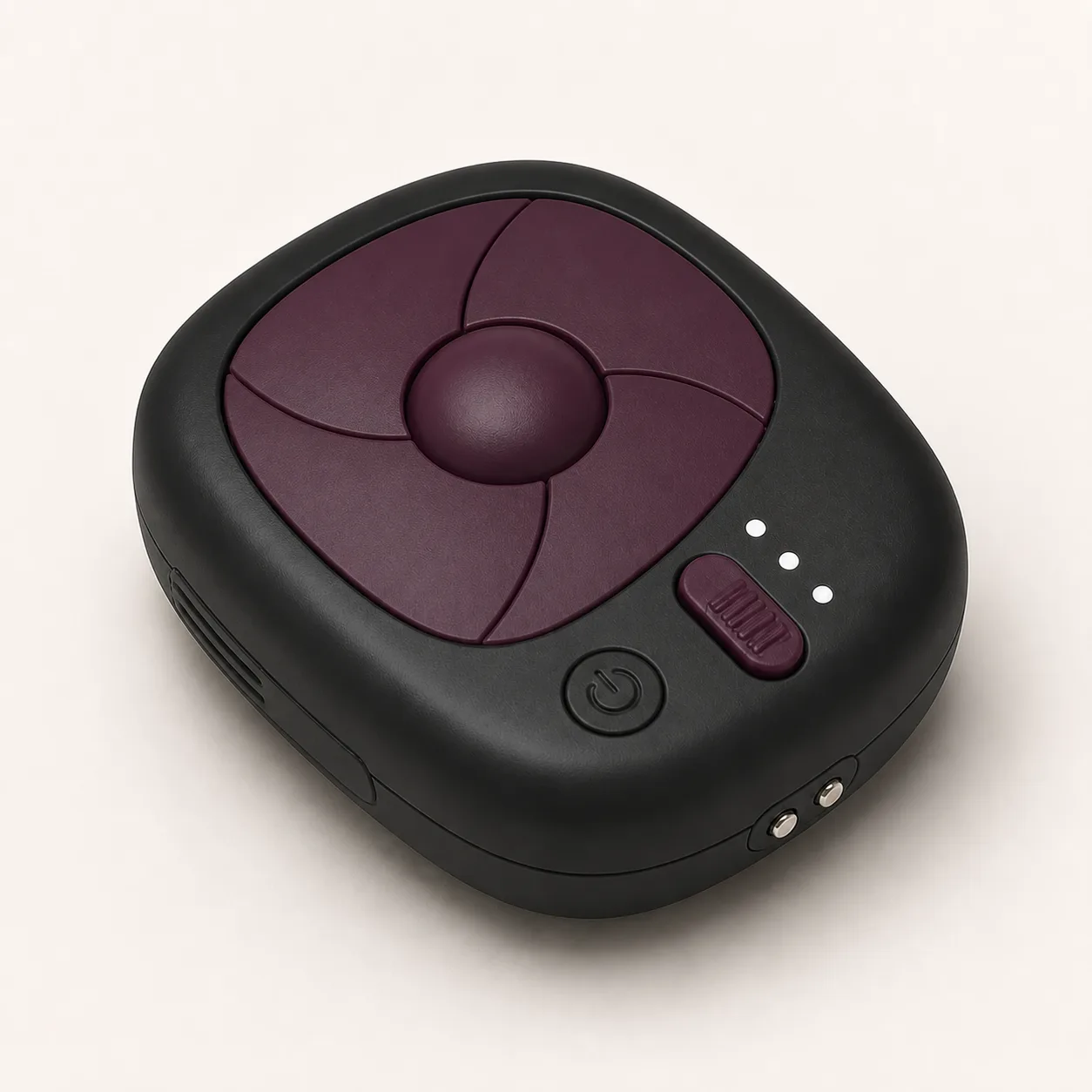
Four-Shutter Three-Aperture Palm Vibrator
A compact palm vibrator concept with one central dome, four guarded shutter leaves and a three-position aperture slider.
47,99 $
200 in stock
Set dome exposure with four guarded shutters
This four-shutter three-aperture palm vibrator concept places one smoky-plum vibration dome inside a charcoal rounded-square shell. Exactly four curved shutter leaves surround the dome, while one plum slider and three white dots propose three repeatable exposure diameters.

The image defines a testable mechanism and does not confirm shutter motion, aperture size, output, materials, battery or production status.
Name the aperture drive and electrical stack
Label shell S0; dome D0; shutters L1-L4; shutter tracks T1-T4; guarded seams G1-G4; slider A0; positions I1-I3; power control B0; grip ribs R1-R2; contacts J1-J2; linkage, actuator, controller, cell, seals, pigments and fasteners.
Require exact-sample drawings and firmware identity before assigning function to visible components.
Measure the palm shell and underside
Record length, width, thickness, edge radius, mass, center of gravity, shell deflection, underside curvature and grip texture. Check seams around the aperture field, controls and charging tail.
Reject rocking, sharp parting lines, shell collapse, loose panels, tack or exposed hard transitions.
Characterize the central dome
Measure D0 diameter, height, hardness, edge blend, surface finish, runout and mount stiffness. Record displacement and tilt under centered and offset fixture preload.
Reject dome-to-shutter contact, shell separation, sharp seams or mount movement beyond defined limits.
Calibrate shutter L1 through L4
Measure travel, radial position, overlap, track clearance, opening force and reset accuracy for every leaf. Observe motion from closed to open and open to closed directions with high-resolution video.
Four visible leaves are not synchronized until their edges reach measured targets without binding or collision.
Verify three proposed aperture states
Map A0 travel and I1-I3 to exposed dome diameter, open area, leaf overlap, slider force and backlash. Approach each state from both directions under no load and controlled preload.
Three dots remain reference marks until direct geometry confirms three distinct openings.
Map output across every exposure diameter
Record acceleration, frequency and harmonics at the dome center, four shutter edges, shell corners, grip ribs and underside. Use a fixed sensor grid at each confirmed aperture and program.
Compare output concentration, shell transfer and shutter resonance rather than relying on one peak value.
Repeat aperture tests under preload
Use calibrated compliant fixtures to measure exposed area, dome compression, shutter edge force, slider drift, output, current and temperature. Test centered and modestly offset contact.
Reject leaf closure, abrupt binding, dome contact, unstable programs or excessive local pressure.
Document power control and stop priority
Map B0 and A0 actions for startup, program, intensity, aperture selection, pause, immediate stop, travel lock and low-battery response. Test dry, damp and gloved fixture input.
The shortest stop action must work from every confirmed aperture without requiring program cycling.
Assess palm grip and control stability
Measure dry and damp friction at R1-R2 and underside contact zones. Log vibration transfer, grip compression and accidental slider or button actuation across all programs.
A compact shell still requires repeatable control without forcing contact with moving shutter edges.
Validate charging and battery protection
Confirm J1-J2 polarity, input limits, charge time, operating time, low-voltage cutoff, standby drain and contact temperature. Check interrupted charging, partial contact and repeated discharge.
Battery chemistry, capacity, cable specification and transport documents remain pending supplier evidence.
Log sound heat and shutter resonance
Measure A-weighted sound and temperatures at D0, L1-L4, tracks, shell, controller, cell, button and contacts for every verified aperture and output program.
Distinguish intended output from leaf chatter, track buzz, shell resonance, loose fasteners and motor wear.
Probe seams tracks and cleaning recesses
Apply visible test soil to shutter seams, tracks, dome edge, shell joint, slider, button, ribs and contacts. Record residue, drying time, swelling, corrosion and leaf drag after repeated wiping.
No waterproof or immersion claim is made without exact-model ingress documentation and testing.
Confirm materials and cyclic durability
Request declarations for the dome, shutter leaves, tracks, shell, grips, button, pigments, adhesives and seals. Cycle aperture changes, output, preload, cleaning, charging and storage, then remeasure leaf timing, dome mount, sound and heat.
Retire samples for cracks, shutter drift, track binding, dome separation, abnormal heat, fluid entry, charging faults or cell swelling.
Build landed price after aperture validation
An Alibaba rechargeable mini-vibrator category page showed one example at USD 2.24 to 2.43 with a ten-piece minimum. It is a broad benchmark only and does not identify this four-shutter palm design or an approved supplier.
The public procurement benchmark supports an EUR 47.99 planning price after provisional allowance for China-origin freight, exact samples, shutter and dome metrology, three-aperture calibration, spatial and loaded output maps, sound, heat, charging, cleaning, fault and fatigue work, protective packing and discreet fulfilment. Exact supplier, quote, MOQ, dimensions, materials, motor, battery, packed weight, freight, duty, tax, certification, payment terms and lead time remain pending.
Frequently asked questions
How many shutter leaves are shown?
The concept uses exactly four curved leaves around one central dome.
Are there three confirmed openings?
No. The three-dot slider requires measured diameter, area and retention data.
Do the shutters move during vibration?
Position stability and resonance must be measured under every program and preload.
Can the leaves touch the dome?
Guard clearance must be verified throughout travel and controlled fixture loading.
Is the device waterproof?
No ingress rating is claimed for the tracks, seams, controls or charging contacts.
Which faults require retirement?
Cracks, shutter drift, track binding, dome separation, heat, fluid entry or cell swelling.
Reviews
There are no reviews yet.