


Dual-Rim Oval Air-Pulse Stimulator with Deep and Shallow Bayonet Seals
August 14, 2026
M110 Black LCD Heated Thrusting Masturbator
August 14, 2026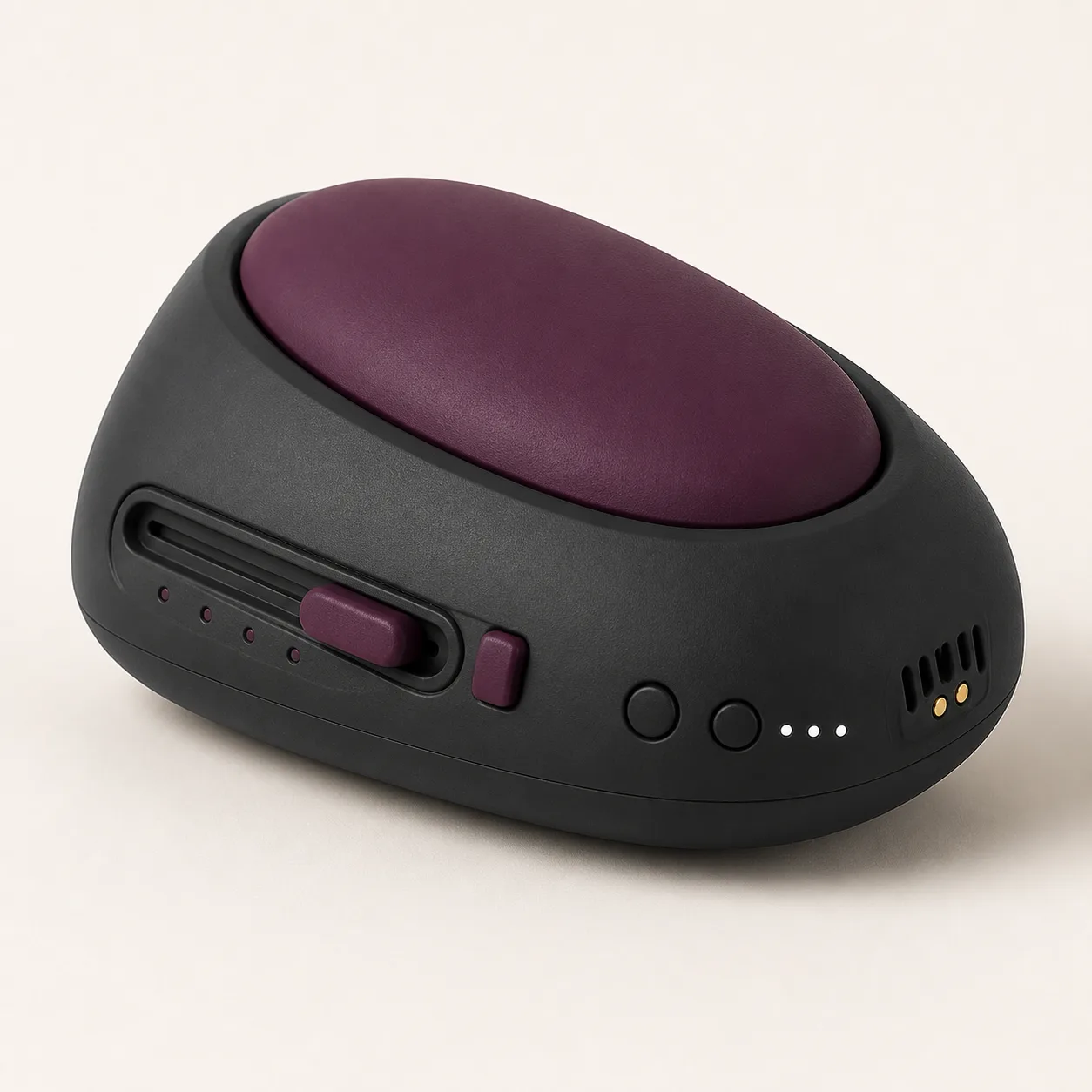
Four-Stop Eccentric-Shift Palm Vibrator with Guarded Amplitude Slider
A rechargeable palm vibrator concept with a broad contact plateau, proposed four-position internal offset adjustment and a separate slider lock.
41,99 $
200 in stock
Shift the proposed counterweight before choosing a program
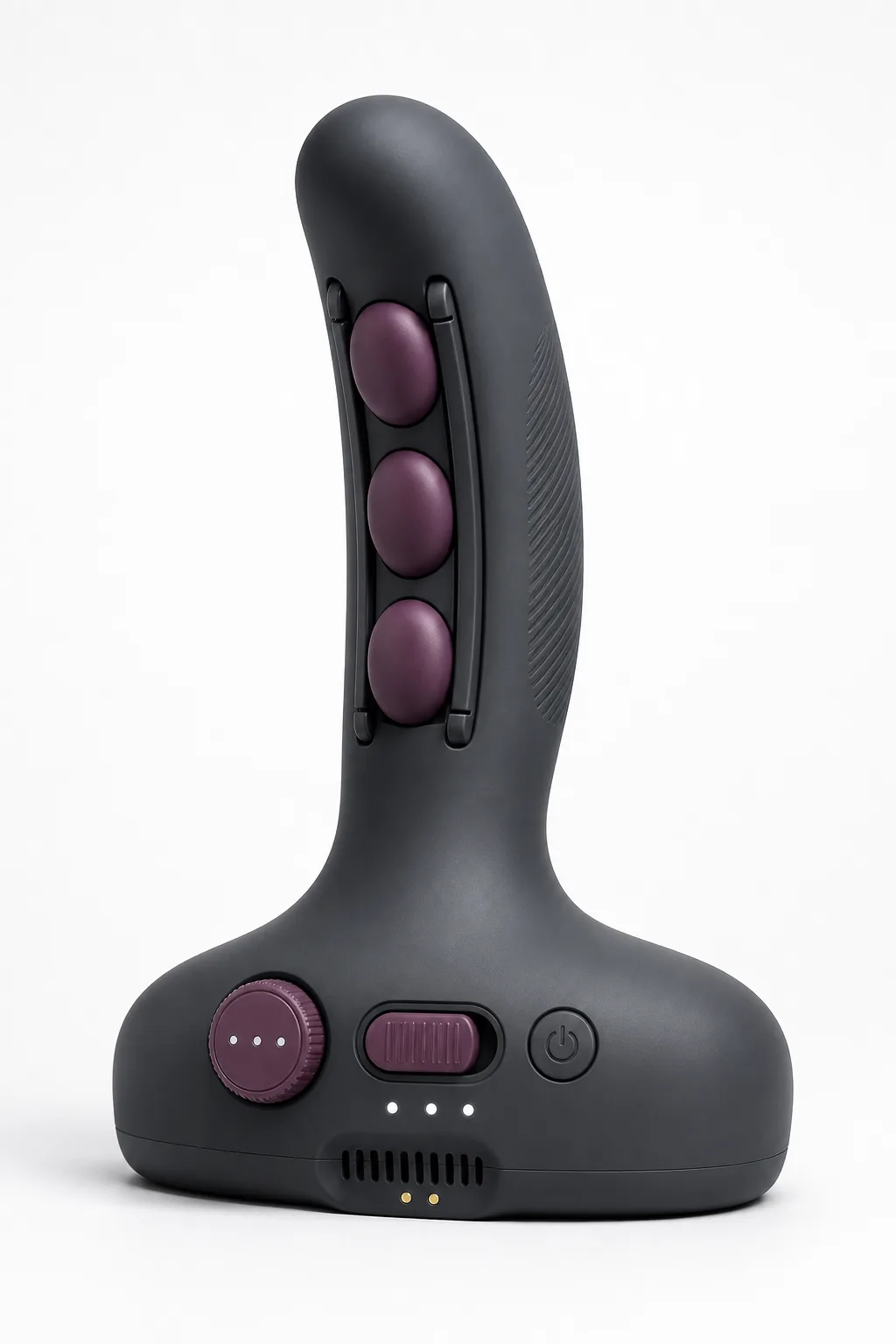
This eccentric shift palm vibrator concept places a captive four-stop slider along one side of a rounded triangular shell. The proposed mechanism changes internal counterweight offset independently of the electronic program, while a separate locking tab is intended to hold the selected track position.

The image does not prove the internal mechanism, number of true offsets, amplitude range, programs, output, runtime, ingress protection, materials or supplier approval.
Inventory the entire shift mechanism
Request an exploded drawing and bill of materials for the contact plateau, shell, frame, motor, shaft, eccentric mass, movable carrier, rail, four detents, slider, linkage, lock tab, stops, sensors, controller, buttons, indicators, cell, vent, contacts, seals, pigments, lubricants and adhesives.
Confirm whether the motor moves with the carrier or only the counterweight changes position, because the two architectures create different loads and wear points.
Measure shell and plateau geometry
Record overall length, width, height, edge radii, plateau length, width, crown height, surface profile, slider projection, track length, lock-tab clearance, vent area, contact spacing, mass and center of gravity.
Repeat measurements at every track position to identify shell distortion, shifting balance or a carrier that pushes against the housing.
Map pressure across the broad plateau
Press the device against a standardized compliant pad at controlled forces and measure contact area, center pressure, perimeter pressure and shell-edge engagement. Repeat with the long and short axes rotated.
Compare powered and unpowered conditions so vibration-induced rocking is not mistaken for a larger static contact patch.
Calibrate all four slider stops
Record track coordinate, travel, detent force, tactile confirmation, lateral play and accidental movement resistance at each visible dot. Approach every stop from both directions to expose backlash.
Verify the slider cannot park between defined positions while appearing locked or strike an internal moving part.
Prove the separate locking tab works
Measure lock travel, actuation force, engagement depth and resistance to vibration-induced release. Test lock-first, slider-first and attempted movement while locked to identify ambiguous states.
The user interface should provide one clear method to confirm a stable position without relying only on color or sound.
Map output at every mechanical position
On a fixed compliant mount, measure acceleration in three axes, dominant frequency, harmonics, rise time, decay, current, shell motion and center-of-gravity shift at all four stops for every verified electronic program.
Create separate maps rather than assuming the slider changes only intensity; a shifted mass can alter direction, resonance, noise and hand-transmitted movement.
Verify controls independently of the slider
Document startup hold, initial level, program sequence, increase and decrease behavior, pause, immediate stop, memory, lockout and low-charge indication. Repeat after changing the mechanical stop while powered and unpowered.
Confirm a mechanical adjustment cannot silently overwrite the electronic state or restart the motor after a stop command.
Test grip and unintended slider contact
Measure dry and damp grip force, one-handed orientation and button reach using standardized fixtures. Observe whether normal grip pressure touches the slider, lock tab, vent or charging contacts.
Raised track rails should protect the captive slider without producing sharp pressure lines or trapping skin.
Separate airborne sound from surface buzz
Record sound pressure at fixed distance and transmitted vibration through wood, glass and a compliant pad for every stop and program. Note rattles, carrier knocks, vent whistles and track chatter.
A quieter airborne reading does not offset excessive surface transmission or an unstable device that walks across a table.
Validate cell, charging and thermal margins
Confirm cell chemistry, rated capacity, protection, charger input, contact polarity, charge time, runtime method, storage guidance and transport paperwork. Verify operation is blocked during charging unless expressly designed otherwise.
Log temperature at the plateau, track, lock tab, controls, vent, contacts, motor zone and cell across all stops under free and compliant loading.
Challenge drops, ingress and fault states
Ingress claims require exact evidence for the plateau seam, track, lock, buttons, indicators, vent and contacts. Perform controlled drop and vibration tests, then repeat slider alignment, output, stop and charging checks.
Test a jammed carrier, displaced slider, obstructed vent, stalled motor and low-voltage cutoff using protected fixtures. Do not repeatedly energize a hot or rattling sample.
Cycle movement and vibration together
Run repeated unlock, four-stop traversal, re-lock, program selection, compliant loading, immediate stop, charging, cleaning, drying and storage cycles. At checkpoints repeat detent, play, acceleration, frequency, current, sound, heat and shell-gap measurements.
Retire the sample after carrier drift, detent loss, unintended slide, lock failure, rattle, cracked rail, opening seam, exposed conductor, swollen cell or abnormal heat.
Clean the track without flooding the shell
Obtain exact material and cleaner compatibility data before testing. Clean the plateau, perimeter seam, track rails, slider ends, lock-tab gap, buttons, indicators, vent and charging contacts using the documented method.
Measure drying and inspect the recessed track for residue before moving the slider, charging or closed storage. Immersion remains unapproved without verified ingress evidence.
Price after the mechanical effect is measured
An Alibaba rechargeable mini-vibrator listing currently shows a category example at USD 2.24-2.43 with MOQ ten. It is a category benchmark only and does not confirm the illustrated eccentric-shift carrier, four-stop track or independent lock.
The procurement reference supports an EUR 41.99 planning price after allowing for China-origin freight, exact-model sourcing, teardown, shell and plateau metrology, four-stop calibration, lock testing, three-axis output maps, grip and noise trials, charging and thermal review, fault testing, cycle life, material evidence, cleaning validation, protective packing and discreet fulfillment. Exact quotation, packed size, weight, freight, duty, tax, insurance, payment fees and delivery terms remain pending.
Frequently asked questions
Does the slider control speed?
It is proposed to change mechanical offset; its actual effect and separation from electronic programs require measurement.
Are there four verified amplitudes?
No. Four visible positions do not prove four distinct or repeatable outputs until instrumented testing is complete.
Can the slider move while powered?
The approved adjustment sequence and interlock behavior remain pending exact instructions and fault testing.
Does the lock tab prevent all movement?
Engagement depth and resistance to vibration, grip pressure and repeated cycling must be verified.
Can the device be immersed?
No ingress claim is made; use only the documented cleaning method for the exact sample.
Which faults require retirement?
A drifting slider, failed lock, cracked rail, loose carrier, opening seam, exposed conductor, swollen cell, abnormal sound or abnormal heat.
Reviews
There are no reviews yet.