



Rail-Indexed Sliding-Pad Rabbit Vibrator with Independent Dual Controls
August 14, 2026
Washable Care-Preparation Chair Armrest Protectors, Pair
August 14, 2026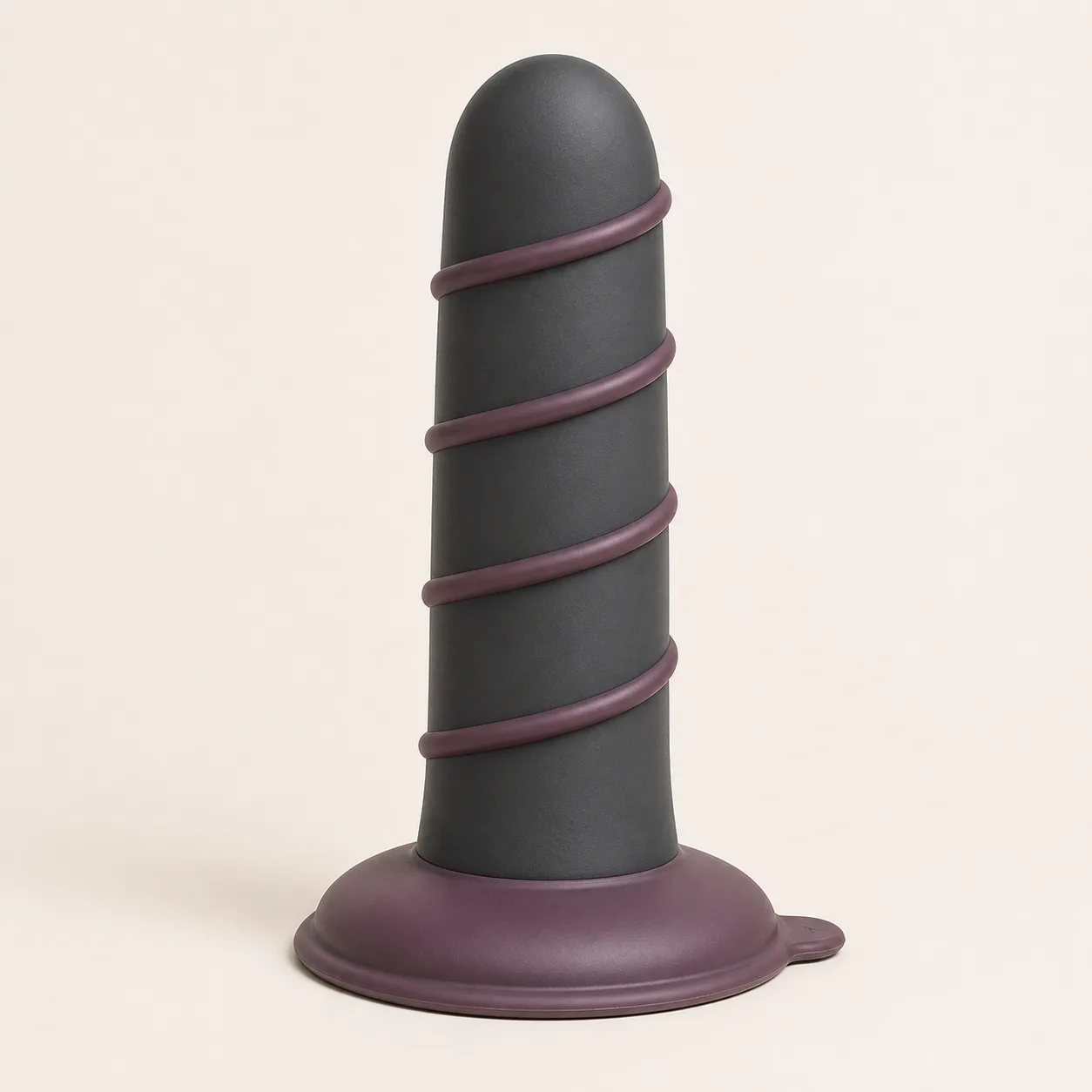
Four-Turn Helical Suction-Base Dildo
A non-powered, non-anatomical tapered dildo concept with one raised helix making four visible turns, a broad suction base and integrated release tab.
32,99 $
200 in stock
Use four helical turns as a measurable design feature
This four-turn helical suction-base dildo is a non-powered, non-anatomical concept with one raised smoky-plum helix making four visible turns around a tapered charcoal body. One broad circular suction base and a small edge tab complete a design intended for specification-led comparison rather than unverified performance claims.

The rendering is not a scale drawing and does not confirm body-contact material, flexibility, usable dimensions, suction strength or production status.
Count the helix before approving a sample
Mark the raised path at its lower start, each of the four complete visible turns and its upper endpoint. Record pitch, ridge width, ridge height, edge radius and distance from the rounded tip and base collar.
Reject interrupted molding, sharp transitions, trapped debris, asymmetrical pitch or an unplanned fifth turn. Production tolerance must be agreed in writing.
Measure the tapered body at fixed checkpoints
Record total length, usable length and circumference or diameter at the tip, upper quarter, midpoint, lower quarter and collar. Add base diameter, base thickness and tab projection using calibrated tools.
Publish only the measured production specification. The catalog image must never be used to estimate size or suitability.
Define firmness without relying on touch words
Request outer-material identification, hardness data and a documented deflection test at multiple shaft heights. Compare the straight body, helical ridge and base because each zone may behave differently under load.
Terms such as soft, flexible or firm need a method, temperature and tolerance range before they become product claims.
Inspect the rounded tip and ridge endpoint
The dome should be checked for molding seams, thin spots, voids, tack, pigment variation and abrupt changes where the raised helix ends. Use magnification and a clean lint-free cloth to detect catches.
Any sharpness, exposed component, crack or persistent surface defect disqualifies the sample.
Evaluate the broad suction base on several surfaces
Test clean dry glass, glazed tile and another approved non-porous surface through a repeatable press, dwell and bounded pull method. Record hold time and release under vertical, lateral and angled hand loads.
Texture, grout, dust, moisture, cleaner residue and edge loading can reduce stability. No surface-independent suction claim is made.
Check the release tab without stressing the shaft
Measure tab thickness, reach and tear resistance, then confirm that it admits air under the base without requiring a sharp pull on the body. Inspect the tab-root radius after repeated release cycles.
The base is a stabilizer, not a weight-bearing anchor. Plan every position so an unexpected release cannot cause a fall or impact.
Map the single-piece molding boundary
Supplier drawings should identify whether the body, helix, collar, base and tab are one material, bonded sections or overmolded zones. Inspect every transition for gaps, flash, adhesive residue and differential stretch.
Construction method, pigment system, cure process and internal structure remain pending documentary evidence.
Verify lubricant compatibility before use
Obtain written guidance for the exact production material and patch-test the chosen lubricant on an approval sample. Observe swelling, haze, tack, colour transfer, cracking and surface change after the defined exposure time.
Use only a verified compatible lubricant and enough to reduce drag; increased friction is a reason to stop and reassess, not to add force.
Set a conservative first-use protocol
Begin with clean hands, a fully inspected surface and the shallowest controlled contact. Keep the base accessible, move slowly and preserve a direct withdrawal path.
Stop immediately at pain, numbness, bleeding, unexpected resistance or any change in the product surface. Persistent symptoms require appropriate medical advice.
Prevent helix drag from becoming excessive
The raised path creates changing contact geometry, so movement speed and lubrication should remain conservative. A shopper should be able to pause without maintaining pressure or awkward leverage.
Do not rotate the product to force the ridge path, and do not continue if the helix catches a barrier or develops a rough edge.
Clean all four turns and the base recess
Follow validated limits for cleaner, water exposure, temperature and contact time. Work along the full helix, collar, base edge, tab root and underside recess, then rinse only as the confirmed care specification permits.
Boiling, bleach, soaking, dishwashers and abrasive tools are excluded unless the final supplier evidence expressly supports them.
Dry, inspect and store without compression
Air-dry all ridge valleys and the suction recess completely. Store the product separately from unverified materials, pigments, heat, sunlight and sharp objects while keeping the base flat and the shaft unstressed.
Before the next session, compare the helix, tip, collar and tab with a dated acceptance image.
Require traceable material and batch documents
The supplier file should identify outer composition, additives, pigments, cure system, country of origin, restricted-substance evidence, batch coding, manufacturing date, shelf guidance and intended-use classification.
Body-contact suitability, hypoallergenic language, waterproofing and certification remain unconfirmed until valid market-specific evidence is reviewed.
Build price from a category reference, not a promise
An Alibaba suction-cup dildo category page displayed one soft-product example at USD 3.20 to 6.78 with MOQ 1. It is a general category benchmark only and does not identify this four-turn non-anatomical design, its material or an approved supplier.
The public procurement reference supports an EUR 32.99 planning price after provisional allowance for China-origin freight, exact-sample measurement, material review, molding and ridge inspection, suction testing, cleaner and lubricant compatibility, protective packing and discreet fulfilment. Exact supplier, quote, MOQ, dimensions, composition, hardness, packed weight, freight, duty, tax, certification, payment terms and lead time remain pending.
Frequently asked questions
Are there four separate rings?
No. The concept shows one continuous raised helix making exactly four visible turns around the body.
Is the product powered?
No. This is a non-powered manual concept with no motor, battery or controller.
Will the base attach to every surface?
No. Each clean, dry, non-porous surface requires its own controlled stability test.
What material is planned?
Exact outer composition and hardness remain pending traceable supplier documents and sample testing.
What are the final dimensions?
No dimensions are approved until a production sample is measured at fixed checkpoints.
How should the helical ridge be cleaned?
Use only the cleaner and method validated for the confirmed material, reaching all four turns and drying every valley completely.
Reviews
There are no reviews yet.