



Twin-Spine Split-Head Sensory Crop with Sliding Flex Gate
August 14, 2026
Four-Turn Helical Suction-Base Dildo
August 14, 2026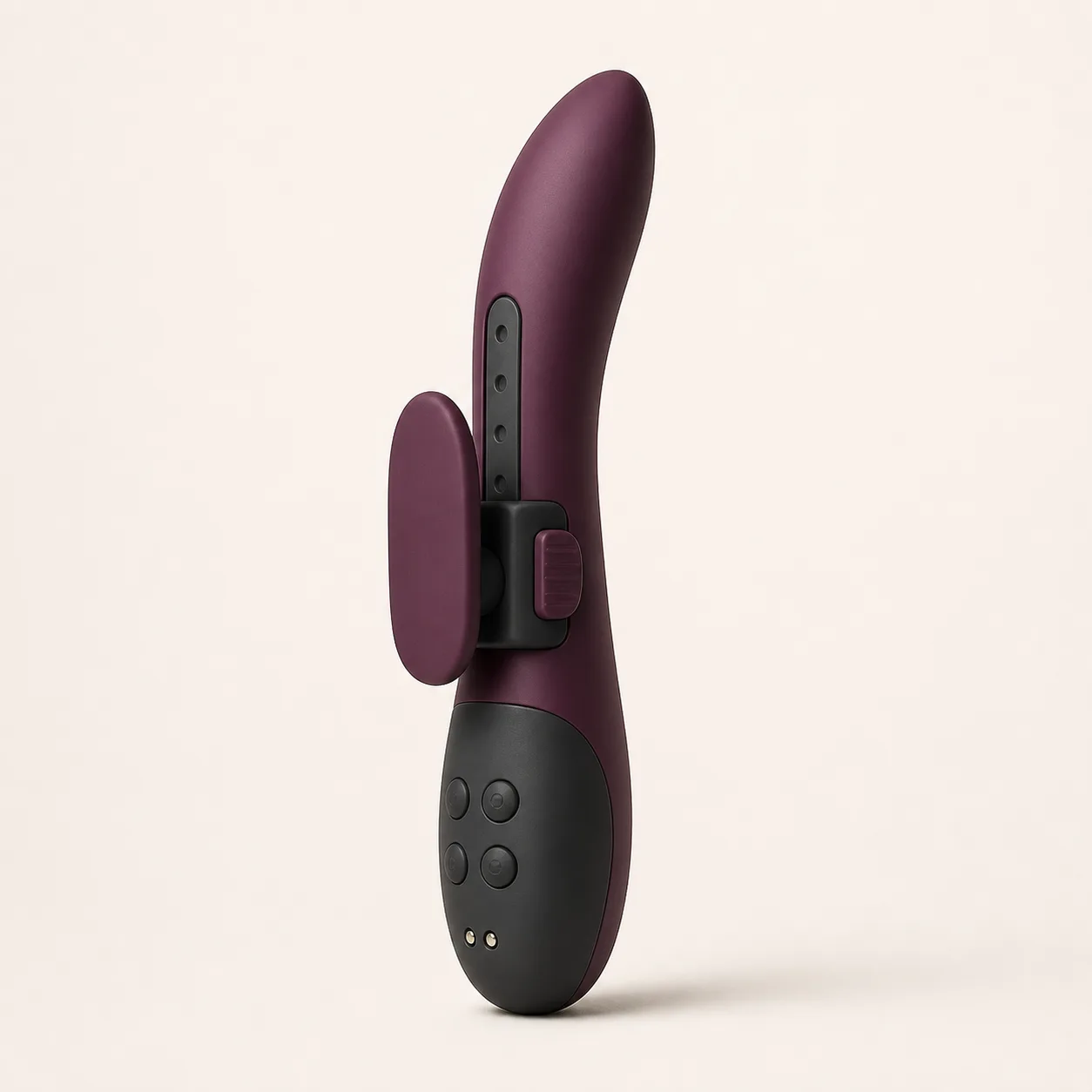
Rail-Indexed Sliding-Pad Rabbit Vibrator with Independent Dual Controls
A rechargeable rabbit-style vibrator concept with a broad external pad that locks at four heights on a straight rail and separate local control groups.
43,99 $
200 in stock
A sliding carriage changes pad height without bending an arm
This sliding-pad rabbit vibrator concept pairs a curved deep-plum main body with a broad external pad mounted on a short charcoal rail. Four visible index points identify proposed carriage positions, and a wide thumb tab releases the carriage for deliberate height changes.

The pad moves in a straight path and stays parallel to the body. It is not a hinge, flexible ear or automatic travel mechanism.
Inventory the rail system before evaluating fit
Confirm the main body, external pad, carriage shell, release tab, rail, four index points, upper and lower stops, controls, battery and charging contacts. Request disclosure of hidden teeth, springs, pins, bushings, seals, motor mounts, wires, fasteners and adhesives.
A visible index mark does not prove that a concealed locking tooth is fully seated.
Measure the body and adjustment envelope separately
Record total length, maximum width, tip dimensions, curved-body offset, grip length, mass, center of gravity, pad length, pad width, carriage thickness, rail length and the distance from pad center to body centerline at every position.
Define any usable boundary only after the exact sample and instructions establish one.
Map all four carriage positions
With power off, press the release tab, move the carriage to each index and let the tab recover without forcing it. Record travel distance, actuation force, tactile engagement, audible cue, backlash and the pad-to-tip relationship at every stop.
Test the sequence from both directions because a spring can seat differently after upward and downward travel.
Challenge the lock against slip and twist
Mount the clean sample on a padded fixture and apply low controlled loads to the pad below written supplier limits. Measure vertical slip, carriage rotation, rail deflection, tab lift and permanent offset at each index.
Any uncommanded movement, skipped index or exposed sharp edge fails qualification.
Compare pad alignment through the whole rail
Use a profile gauge to check whether the broad pad stays parallel to the main body as it moves. Record lateral offset, angular drift, edge-to-body clearance and the closest approach between pad, carriage and curved shaft.
A position that brings a hard carriage corner into the contact zone should be excluded even if the lock holds.
Treat every moving gap as a pinch and residue zone
Probe around the release tab, carriage sides, rail ends and hidden tooth path with approved gauges while the unit is switched off. Check whether skin, hair, fabric or cleaning debris can enter a closing gap.
Reposition only when the product is clean, dry, unpowered and away from the body.
Measure both vibration channels independently
Identify which controls operate the main body and which operate the external pad. On an instrumented soft fixture, log amplitude, frequency, pattern order, startup level, shutdown time and motor interaction first for one channel, then the other, then both together.
Separate buttons do not establish electrically independent motors until testing confirms the behavior.
Check whether carriage height changes delivered output
Repeat pad measurements at all four positions using the same fixture preload and control setting. Monitor the rail, carriage, release tab, grip and main body for resonance, buzzing, energy loss or a new sound as overlap changes.
A rigid rail can transfer vibration into the hand or amplify noise at one index.
Verify controls by function rather than icons
Map required hold time, short-press sequence, increase and decrease behavior, channel selection, memory, lockout, indicator meaning, accidental activation force and complete power-off. Repeat with dry and damp gloved hands.
The user must be able to stop both channels promptly without touching the sliding mechanism.
Set the lowest practical pad position first
Before contact, power off, choose a carriage index on a padded fit form and perform a gentle external pull-and-twist check. Begin with the lowest verified output on one channel, then evaluate the second channel only after fit remains controlled.
Do not move the carriage during contact and never force the body or pad to match anatomy.
Use pressure change and carriage movement as stop signals
Stop for pain, numbness, irritation, unexpected pressure, pinching, loss of control, rail movement, tab lift, new rattle, visible damage, odor, liquid entry or excessive heat. Remove the product gently and inspect the carriage before another use.
Shared use requires compatible barrier guidance and complete cleaning evidence for the exact surface and rail assembly.
Validate charging and temperature at the rail base
Request cell chemistry, rated capacity, charge voltage and current, cable specification, charge time, runtime method, cycle life and protection circuitry. Log temperature at the battery, grip, charging contacts, rail base, carriage, pad motor and main motor during the longest approved combined program.
Do not charge while wet, covered, unattended or connected to an unverified power source.
Verify materials and clean under the carriage
Obtain composition for every contact surface, rail, carriage, release tab, springs, pins, seals, pigments, wire jacket and adhesive. Review hardness, porosity, restricted-substance, skin-contact, lubricant, barrier and cleaner compatibility evidence for the ordered revision.
Power off and clean only by the confirmed method. If carriage removal is not explicitly approved, move it between indexes while wiping accessible rail faces, then dry the tab recess, rail ends and charging contacts fully; soaking, boiling, bleach, alcohol and abrasive tools are not approved without exact evidence.
Price the locking rail as a qualification cost
An Alibaba rabbit-vibrator showroom lists a rechargeable ten-mode model at USD 6.69-6.99 with a two-piece minimum. It is a category benchmark only and does not establish this rail-indexed sliding-pad design, a legal supplier or a production quotation.
The procurement reference supports an EUR 43.99 planning price after allowing for China-origin freight, exact-model quotation, component and dimension inspection, four-position mapping, lock-load and twist tests, alignment and pinch-gap review, independent output and resonance measurement, control mapping, battery and thermal validation, materials, cleaning trials, protective packing and discreet fulfillment. Packed size, weight, freight, duty, tax, insurance, payment fees and destination terms require confirmation.
Frequently asked questions
Does the pad bend toward the main body?
No. This concept moves the pad along a straight rail while keeping it parallel to the body.
Can the pad slide while the vibrator is running?
No. Switch off, move away from the body and change the index only with the product clean and dry.
Are the four dots intensity settings?
No. They mark proposed carriage positions; vibration settings must be mapped through the separate controls.
Do the two button groups prove dual motors?
No. Motor count, channel independence and combined behavior require exact-sample testing.
Which position is universally best?
None. Reach, clearance, pressure and control must be evaluated on a padded fit form for the intended user.
Which faults require retirement?
A slipping carriage, skipped index, cracked rail, weak release tab, sharp edge, exposed wire, swelling, abnormal heat, persistent odor or residue trapped beyond cleaning access.
Reviews
There are no reviews yet.