



Three-Leaf Split-Crown Rabbit Vibrator with Triple-Groove Thumb Rest and Dual Oval Controls
August 14, 2026
Six-Roller Planetary-Cage Automatic Stroker with Split Service Shell
August 14, 2026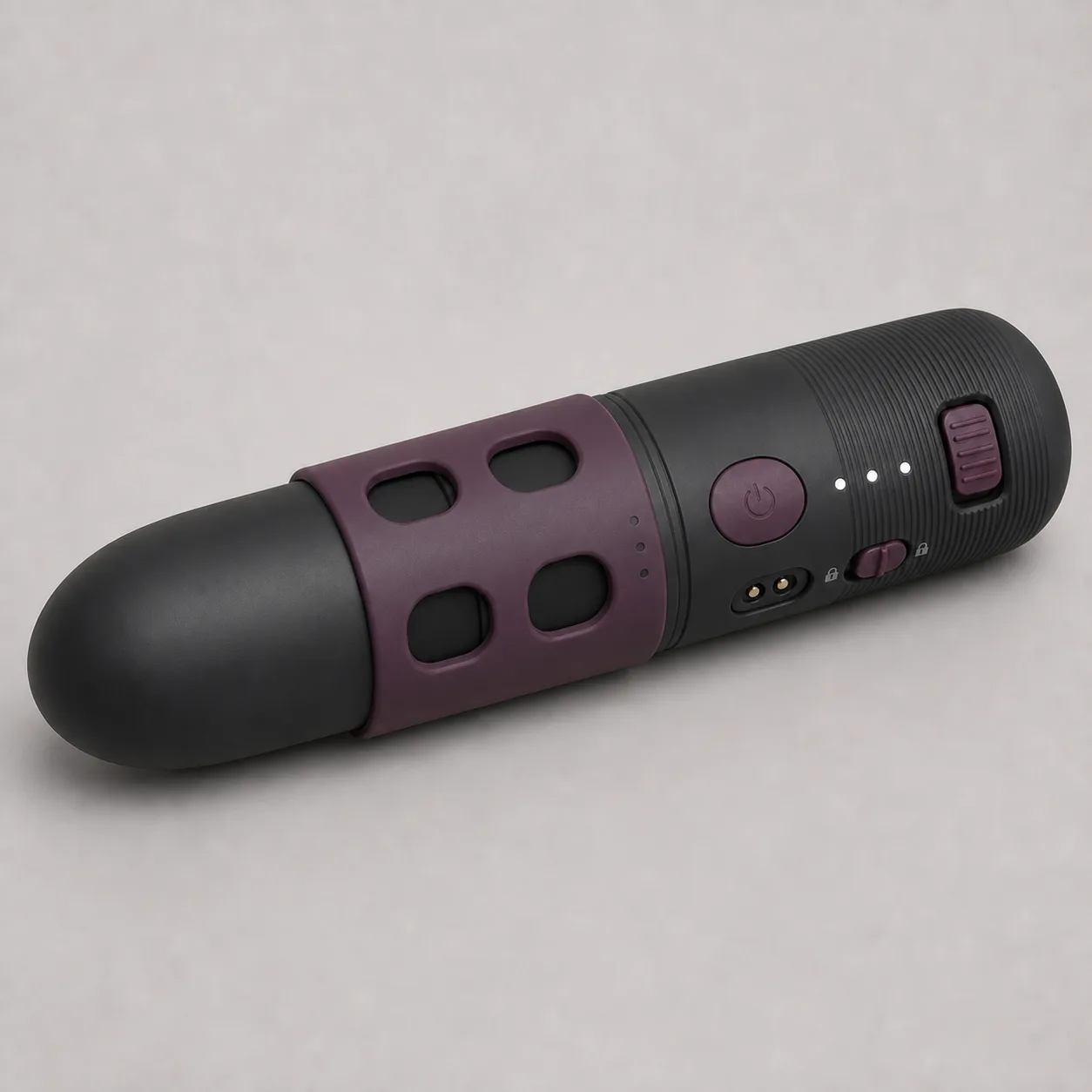
Four-Window Sliding-Damper Bullet Vibrator with Three-Stop Sleeve
A compact bullet vibrator concept with a rounded head, four-window sliding damper sleeve, three axial stops, ribbed grip and separate stop control.
42,99 $
200 in stock
Separate the bullet core from its adjustable sleeve
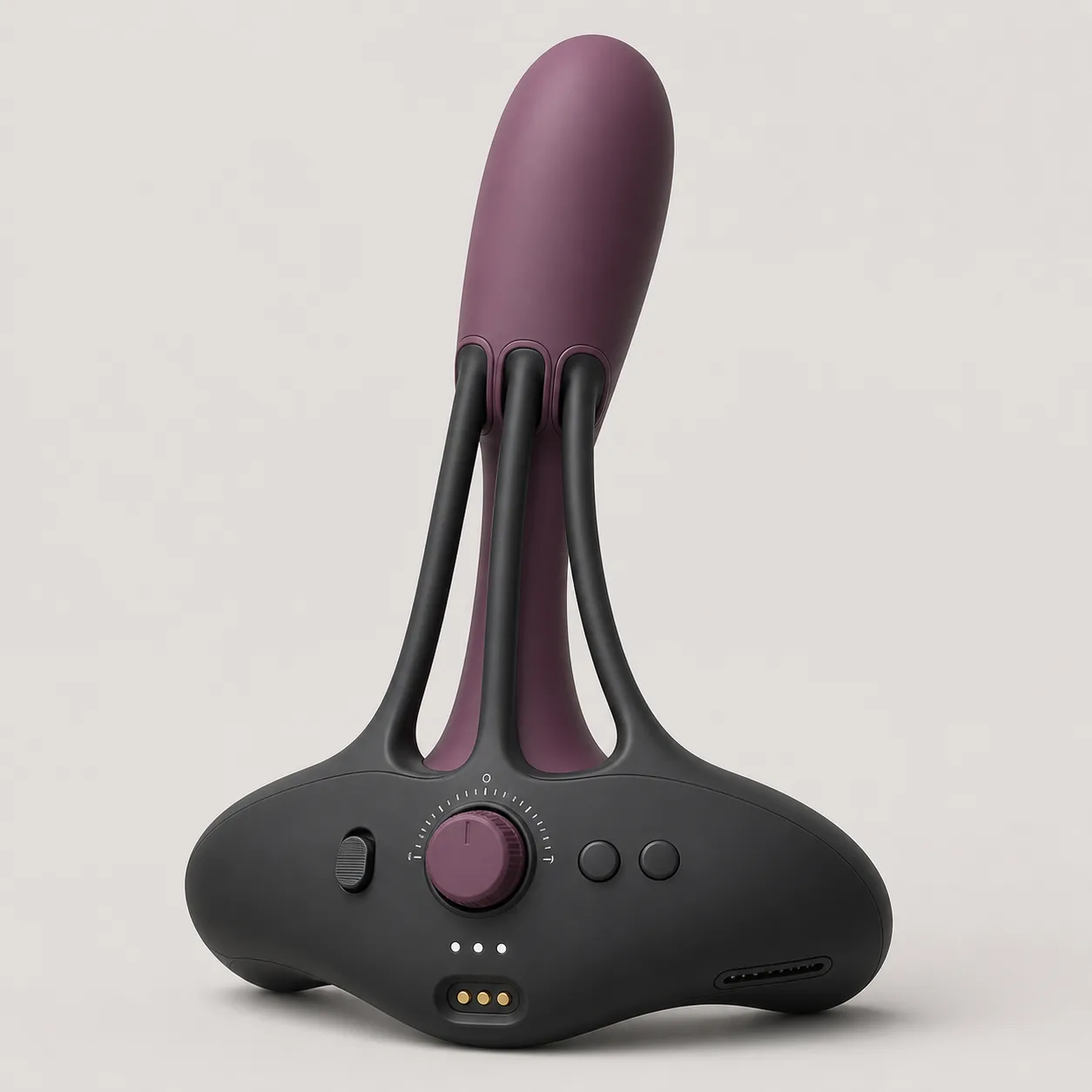
This four-window sliding-damper bullet vibrator concept combines one charcoal capsule body with a rounded oval head, a ribbed grip tail and one smoky-plum sleeve parked on axial rails. Exactly four open windows form a two-by-two grid on the sleeve. A three-dot position scale, power button, wide stop slider, status lights, travel lock and two charging contacts remain accessible.

The image proposes an isolation-adjustment mechanism; it does not prove damping, output, material, ingress or production claims.
Inventory the core sleeve rails and controls
Require part-level records for shell, head skin, motor, eccentric mass, mounts, shaft, sleeve, windows W1-W4, isolation bridges B1-B4, guide rails, three detents, end stops, power button, stop slider, indicators, travel lock, controller, cell, protection circuit, contacts, seals, fasteners, coatings, pigments, lubricants and adhesives.
Trace mechanical, electrical and heat paths before treating the sleeve as functional.
Measure the full device in all three sleeve positions
Record length, head diameter and radius, body diameter, sleeve width and thickness, window dimensions, rail travel, detent spacing, grip length, control reach, mass and center of gravity at stops P1, P2 and P3.
Repeat after loaded operation, sliding cycles, cleaning and storage conditioning to detect drift or swelling.
Profile the rounded head and underlying core
Map crown shape, edge continuity, surface hardness, friction, coating thickness, deformation, rebound and attachment to the internal shell. Inspect for thin zones or hard transitions near the sleeve boundary.
Reject tack, pigment transfer, tearing, delamination, exposed rigid edges or a head that rotates independently without a documented design reason.
Inspect windows W1 through W4 individually
Measure each opening’s length, width, corner radius, wall thickness and clearance to its bridge. Probe all edges at each sleeve stop and under bounded squeeze, twist and vibration loads.
Four similar openings in a render do not guarantee four equal load paths. Preserve W1-W4 identities during teardown and testing.
Characterize bridges B1 through B4
Document bridge construction, stiffness, compression set, attachment and contact with the core as the sleeve travels. Measure whether any bridge bottoms out, lifts, rubs or changes alignment.
Reject whitening, cracks, permanent set, debris generation or bridge-to-window contact that creates a pinch or rattle source.
Calibrate three sleeve stops and rail retention
Measure axial position, detent force, sliding friction, backlash and pull-off resistance at P1-P3 from both travel directions. Repeat with dry, damp and contaminated rails using only approved test media.
The sleeve must not drift across positions during the documented output envelope or obscure a control, light or charging feature.
Quantify how sleeve position changes output
Record acceleration, dominant frequency and harmonics at the head, core, sleeve, each window bridge and grip across every confirmed program and P1-P3 position. Test unloaded and on standardized compliant fixtures.
Report attenuation, amplification, resonance and hand-transmitted output separately; avoid assuming that softer feel means lower head output.
Verify power stop and travel-lock logic
Document startup, mode selection, intensity steps, indicator meanings, memory, wide-slider stop action and travel-lock sequence. Challenge rapid input, simultaneous controls, low voltage, charging and restart after power interruption.
The stop control should have priority in every verified state. Exact response time remains pending measurement.
Audit battery charging and electrical protection
Confirm cell chemistry and capacity, charger input, polarity, charge time, runtime, overcurrent, overcharge, undervoltage and temperature protection from exact-sample evidence. Inspect the two contacts and surrounding recess.
Do not publish battery or charging figures copied from a visually similar bullet.
Map sound heat current and vibration leakage
Log current, A-weighted sound and temperature at the head, motor zone, sleeve, bridges, rail ends, controller, cell, grip and contacts. Compare P1-P3 through continuous and pulsed programs.
Investigate tonal rattles, sleeve buzz, local hot spots, current spikes and shifts that grow after sliding cycles.
Screen gaps cleaning access and ingress paths
Probe the head joint, four window edges, bridge clearances, sleeve ends, rails, detents, buttons, stop slider, lights, lock, grip ribs, contacts and shell seam for residue and moisture traps.
Define wiping, rinsing and drying only after the exact construction is known. No waterproof or ingress claim is accepted without evidence.
Challenge restrained output and sleeve faults
Use protected fixtures to test bounded head restraint, sleeve obstruction, partial detent engagement, bridge contamination, blocked slider, low voltage and interrupted charging. Capture current, heat, control response and recovery.
Retire a sample that restarts unexpectedly, traps the sleeve, exposes an edge, overheats or shows cell deformation.
Cycle the moving sleeve and set retirement criteria
Cycle P1-P3 travel, detents, buttons, stop slider, travel lock, charging, output, cleaning, drying and storage. Inspect rails and bridges at fixed intervals and remeasure output, sound and heat.
Set limits for rail wear, sleeve looseness, window damage, bridge set, detent drift, control delay, charging faults, abnormal noise, persistent residue and surface failure.
Build landed price after mechanism proof
An Alibaba rechargeable-mini-vibrator page showed one bullet example at USD 2.24-2.43 with MOQ ten. It is a category benchmark only and does not verify this four-window sliding sleeve or an approved supplier.
The procurement reference supports an EUR 42.99 planning price after provisional allowance for China-origin freight, exact-sample sourcing, core and sleeve teardown, W1-W4 and B1-B4 inspection, rail calibration, loaded output mapping, controls, charging, sound, heat, current, cleaning, fault and cycle tests, protective packing and discreet fulfilment. Exact quote, MOQ, dimensions, materials, cell, packed weight, freight, duty, tax, certification, payment terms and lead time remain pending.
Frequently asked questions
What does the sliding sleeve change?
Head output, sleeve vibration and grip leakage at P1-P3 require instrumented comparison.
Are all four windows open?
The concept shows four openings; exact wall and bridge construction require sample inspection.
Can the sleeve move during operation?
Detent force and drift under every verified program remain pending.
Does the wide slider stop output immediately?
Control priority and stop response time must be measured across battery states.
Is the bullet waterproof?
No ingress rating is claimed for the head, windows, rails, controls or charging contacts.
Which defects require retirement?
Rail looseness, cracked windows, bridge damage, drift, heat, noise, charging faults or cell swelling.
Reviews
There are no reviews yet.