



Mirrored Twin-Pod Couples Vibrator Set with Dual-Well Charging Dock
August 14, 2026
Navy and Silver Seven-Piece Bondage Set with Cross Connectors
August 14, 2026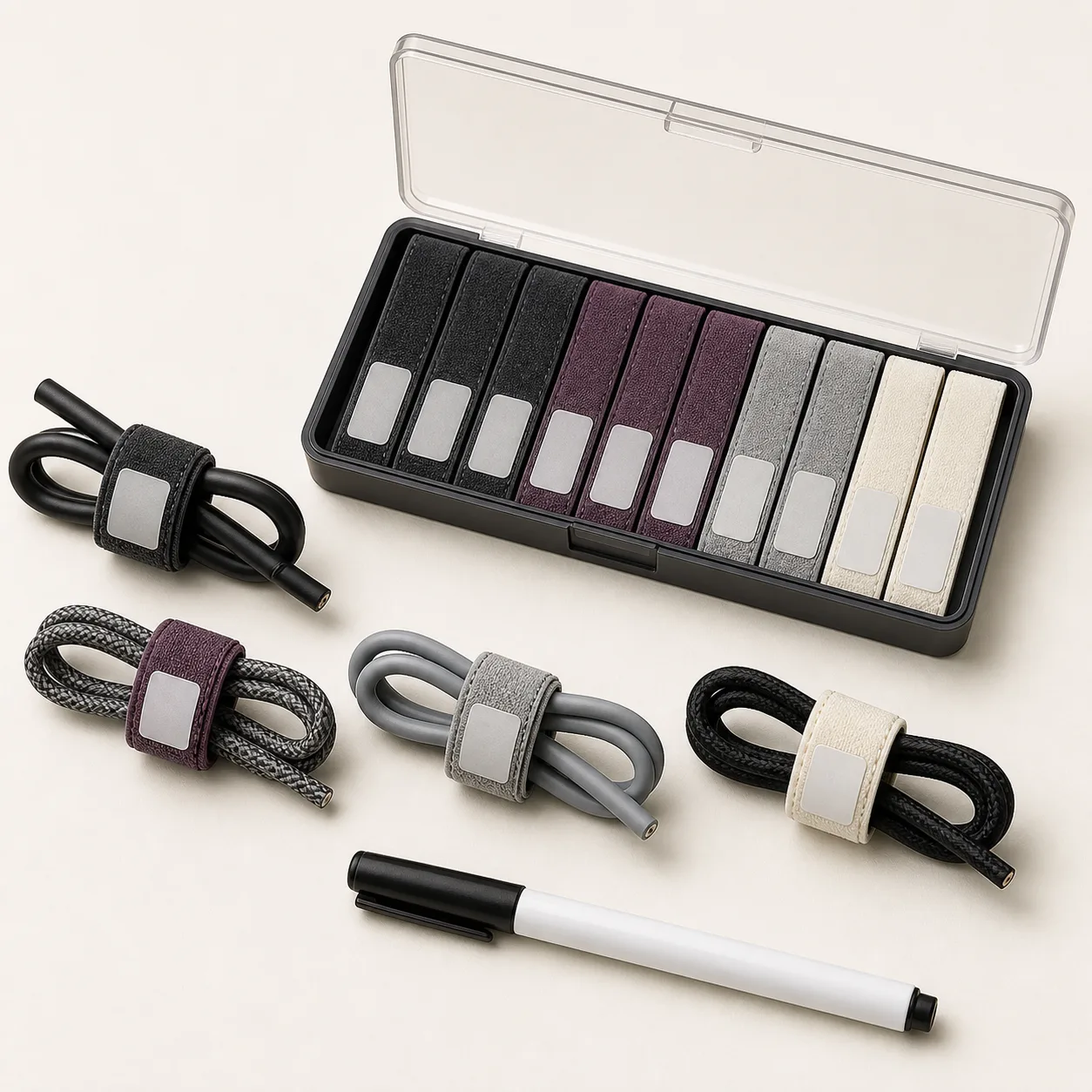
Reusable Writable Hook-and-Loop Charging Cable Labels
Reusable color-coded hook-and-loop cable labels with blank writing panels, a proposed storage tray and a device-code workflow for disconnected leads.
9,99 $
200 in stock
Label the cable before a storage drawer becomes a guessing game
The writable charging cable labels concept uses short colored hook-and-loop straps with blank marking panels. Wrapped around a safely coiled lead, each label can connect the cable to a private device code while a slim tray keeps unused straps and the proposed marker together.

The label organizes a lead; it does not prove that the cable is electrically compatible with any device.
Use a device code instead of an ambiguous connector name
Two cables may share a plug shape while differing in voltage, current, wiring, polarity or communication support. Assign a neutral code to the exact device and keep its detailed mapping in a private inventory.
Consult the original device and charger markings every time power specifications matter.
Place the strap away from plugs and strain relief
Attach the label on a straight cable section or around the middle of a loose storage coil. Do not wrap it across a connector shell, flexible strain relief, damaged insulation or an area that must bend during use.
Leave ventilation openings and control surfaces completely clear.
Match strap length to cable diameter and coil size
A strap that is too short may barely engage, while excess length can catch on neighboring leads. Measure closure overlap on thin, braided and thicker round cables without compressing the insulation.
The approved cable-diameter and coil-size ranges remain pending.
The writing panel needs a defined marking system
Test the proposed pen on the final panel surface for legibility, drying time, smearing and removal. A permanent ink may defeat reuse, while an easily erased mark can disappear during ordinary handling.
Marker inclusion and the approved rewriting method have not been confirmed.
Colors need a private legend to stay meaningful
Charcoal, plum, grey and cream can indicate device groups, inspection status or storage locations. Record the chosen meaning rather than assuming a color communicates voltage, connector type or safety status.
Check colorfastness before labels touch pale cables or fabric cases.
Hook-and-loop closure loses performance with contamination
Lint, hair and residue can fill the hook field and reduce engagement. Inspect both faces before use and retire a strap that opens without deliberate peeling or develops exposed hard edges.
Closure-cycle life must be established on representative samples.
Coiling still follows the cable maker’s bend guidance
A label can hold an existing coil but should not force a lead into a tight radius. Use broad loops, avoid sharp folds and keep connector ends from bearing the coil’s weight.
Damaged, kinked or heat-discolored cables should be isolated for assessment.
Keep chargers, leads and adapters as separate inventory items
A charging setup may include a wall adapter, power lead, conversion piece and device cable with different ratings. Give each component its own code and store matched sets only after their specifications are verified.
Do not use a textile strap to join energized components into a bundle.
Disconnect and cool equipment before labeling
Unplug both ends, allow warm hardware to reach room temperature and inspect the insulation. Apply or adjust labels only while the cable is fully disconnected.
A strap must never cover damage or make a questionable lead appear serviceable.
Heat and flame behavior set storage boundaries
Fiber identity, hook material, writing panel and edge treatment remain pending. Keep labels away from heaters, high-load adapters and any cable location that becomes warm during normal operation.
No flame-retardant, heat-resistant or electrical-insulation claim is approved.
Clean straps separately with the confirmed method
Remove the label from the cable before cleaning. Use only the verified process for the final materials, clear debris from the closure and dry the strap completely before reattaching it.
Avoid solvents that can attack the panel, ink, adhesive layers or cable jacket.
The tray should separate blanks from labels awaiting review
A clear-lid tray can prevent unused straps and the proposed marker from scattering through a drawer. Reserve separate positions for blank labels, active codes and pieces with unclear writing.
Tray latch strength, marker retention and all included quantities remain pending.
Incoming inspection should test writing and closure together
Measure strap and panel dimensions, then test overlap, peel force, repeated cycles, edge softness, lint pickup, marker drying, smear resistance and controlled erasing. Inspect stitching or bonded edges for loose hard fibers.
Quarantine labels with weak engagement, sharp edges, unstable color, persistent odor or panels that cannot hold a readable code.
The reference price is for one label component
An Alibaba entry from Dongguan Jia En Technology Co., Ltd. displays multi-color writable nylon cable labels at USD 0.08 per piece with MOQ 500 pieces. Exact fiber, dimensions, closure life, writing system, colors and kit contents remain pending.
The procurement reference supports sample inquiry only. The EUR 9.99 plan provisionally includes China-origin freight, sorting, closure and ink testing, tray assembly and documentation; packed mass, freight, duty, tax, insurance, payment fees and destination terms remain pending.
Frequently asked questions
Does a matching plug shape make two cables interchangeable?
No. Verify electrical and communication specifications from the device and cable documentation.
Where should a label sit?
Use a straight section or the middle of a broad disconnected coil, away from plugs, strain relief and damaged insulation.
Is the marker included?
Marker and tray inclusion remain pending until the final kit specification and samples are approved.
Can the labels stay attached during charging?
That use is not approved; remove the label if it could trap heat, obstruct inspection or contact powered hardware.
How many times can a label be reused?
No cycle claim is approved until closure and writing-panel tests are completed on production samples.
When should a strap be discarded?
Remove it from use after weak closure, frayed or sharp edges, dye transfer, persistent odor or unreadable marking.
Reviews
There are no reviews yet.