



Remote Heated Rocking Prostate Massager
August 14, 2026
Two-Sided Texture Pocket Stroker
August 14, 2026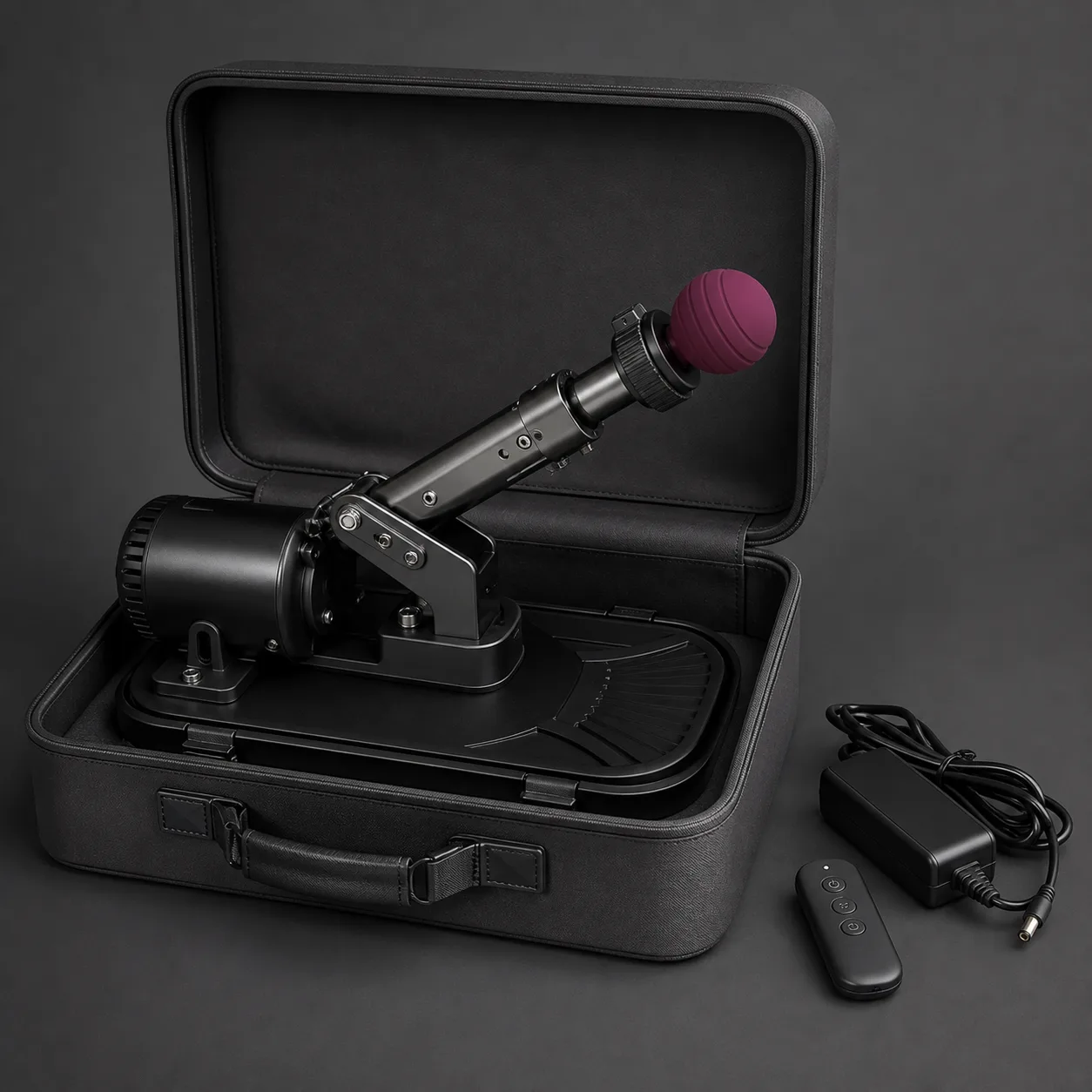
Portable Multi-Angle Thrust Machine in Carry Case
A portable thrust machine concept in a rigid carry case with adjustable locking arm, 12V power, detachable attachment and remote; exact operating limits remain pending.
149,99 $
200 in stock
A compact machine still demands workshop-level checks
This portable multi-angle thrust machine concept packages a powered drive, adjustable arm and control set inside a rigid carry case. Portability changes storage and setup, but it does not reduce the need for mechanical inspection, a stable operating surface and a wearer-accessible stop.

The illustration is not a dimensional drawing and does not verify clearance or stroke.
The opened case becomes part of the base
Before power is connected, place the case on a level, rigid surface and check every foot, latch, hinge and mounting point. A lid that shifts or a base that rocks can redirect the drive arm under load.
Do not operate on a mattress, sofa, lap or other soft surface.
The angle hinge needs a positive mechanical lock
Record each usable arm angle and confirm that the hinge cannot creep when the drive changes direction. The locking control should be reachable without passing a hand through the mechanism.
Set and lock the angle only while the machine is unplugged.
Attachment retention is separate from angle adjustment
Identify the connector type, insertion depth and any collar or pin that secures the detachable head. Pull-test the joint at rest and inspect it after repeated cycles.
An attachment that loosens, rotates unpredictably or exposes a sharp edge is not approved.
Stroke and frequency define the real working envelope
The D55 sourcing lead lists a 55 mm stroke and 90 to 240 cycles per minute. These figures must be measured on the exact production unit at every approved angle and under representative load.
Start at the shortest, slowest verified setting rather than relying on the controller label.
Pinch and crush zones extend beyond the moving tip
Keep fingers, hair, jewelry, cables and loose fabric clear of the arm, linkage, hinge and motor housing. Mark the full forward and backward travel before positioning the user.
Stop immediately if the base migrates or any object enters that envelope.
Emergency stopping must work without the remote
Test the local power control, remote stop command and behavior after power interruption. The wearer or an attendant should be able to disconnect the 12V supply without reaching across moving parts.
Never leave an energized machine unattended.
Remote control is useful only when its map is unambiguous
Confirm pairing, range, speed direction, angle-related functions and whether a held button behaves differently from a tap. Label the stop command after testing rather than assuming its icon.
Keep the local control and power connection accessible throughout use.
The adapter is a safety-critical component
The listing describes 100–240V input, 12V output and 36W rated power. Verify the supplied adapter, plug type, cable strain relief, polarity, regional compliance and heat rise on the final unit.
Operate dry and indoors, and remove power before inspection, adjustment or cleaning.
Extra functions cannot be bundled into one promise
The source mentions telescopic motion, heating, vibration, swinging and spraying. Each function needs separate confirmation because different D55 packages may include different heads, reservoirs, motors or controllers.
No mode count, temperature range or liquid-handling claim is approved yet.
The contact attachment needs its own specification sheet
Request overall length, usable length, maximum diameter, connector dimensions, silicone formulation, hardness and surface finish. The rounded non-anatomical attachment in the concept image is a merchandising visualization only.
Reject seams, odor, pigment transfer, tears or exposed internal hardware.
Clean the detached attachment away from the machine
Switch off, unplug and remove the head by the confirmed method. Wash only the body-safe contact part with warm water and a compatible mild cleanser, then rinse and dry its connector completely.
Lubricant and wash water must not enter the drive coupling.
The drive housing requires dry maintenance
Wipe the case, arm and controls with a lightly damp cloth while disconnected. Inspect fasteners, cable insulation, ventilation openings, hinge wear and unusual residue before storage.
Do not immerse the motor, adapter, remote or case unless component-specific ingress evidence says otherwise.
Setup should be rehearsed before intimate use
Run the machine without a user, observe its full path at every intended angle and practise stopping it from both controls. Recheck base stability whenever angle, speed or attachment changes.
Stop for pain, numbness, bleeding, pinching, unexpected heat, burning odor, abnormal noise or loss of control.
The preview price includes a heavy-item allowance
The Alibaba reference lists USD 50 for 10–499 pieces, USD 48 for 500–999, USD 42.88 for 1,000–2,999 and USD 39.71 from 3,000, with a USD 52 sample price. It also gives 2.9 kg net weight, 3.5 kg gross weight and a 30 × 12 × 12 cm package.
The D55 supplier lead is a procurement reference only. The EUR 149.99 plan allows for China-origin freight, packed weight and electrical/mechanical inspection while supplier identity, exact accessories, duty, tax, insurance and delivery terms remain pending.
Frequently asked questions
Can the arm angle be changed during operation?
No. Disconnect power, set the angle, engage the mechanical lock and test the full path without a user.
Are 55 mm and 240 cycles per minute confirmed?
They are source-listed figures that still require measurement on the approved unit.
Does every D55 include heat, vibration and spray modes?
That is not confirmed. Each function and included accessory must be matched to the exact order variant.
Can the case sit on a bed?
No. Use a level, rigid surface where the base cannot rock or sink.
Is the motor housing washable?
No immersion instruction is approved; clean powered parts only by the verified component method.
What happens if the remote fails?
The local stop and the power disconnection route must remain accessible and must be tested before use.
Reviews
There are no reviews yet.