


Three-Stop Hinged Padded Elbow Restraint Brace Pair
August 14, 2026
Lavender Satin Handkerchief-Hem Slip and Sheer Mesh Robe Set
August 14, 2026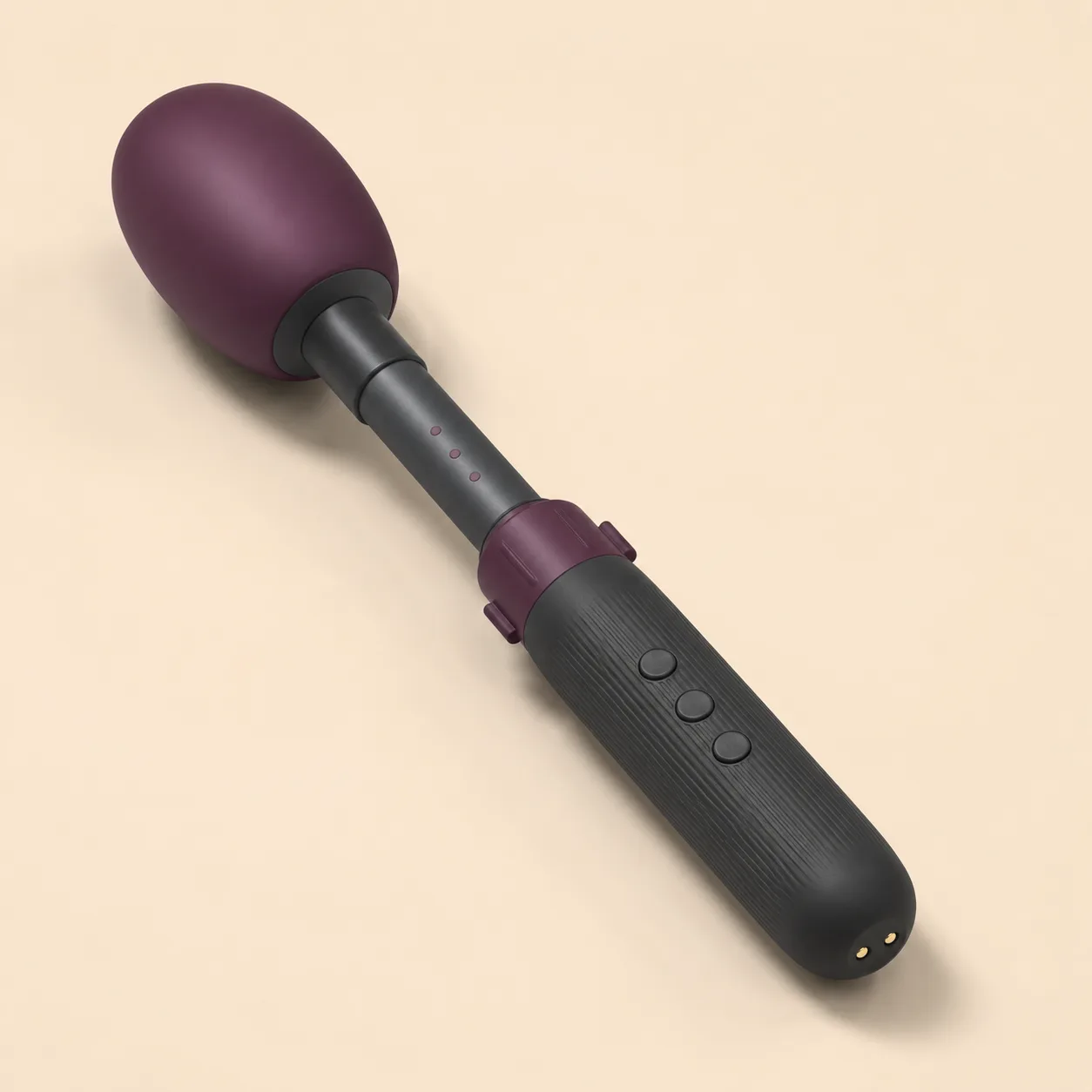
Quarter-Turn Three-Length Telescoping Handle Wand with Fixed Broad Dome Head
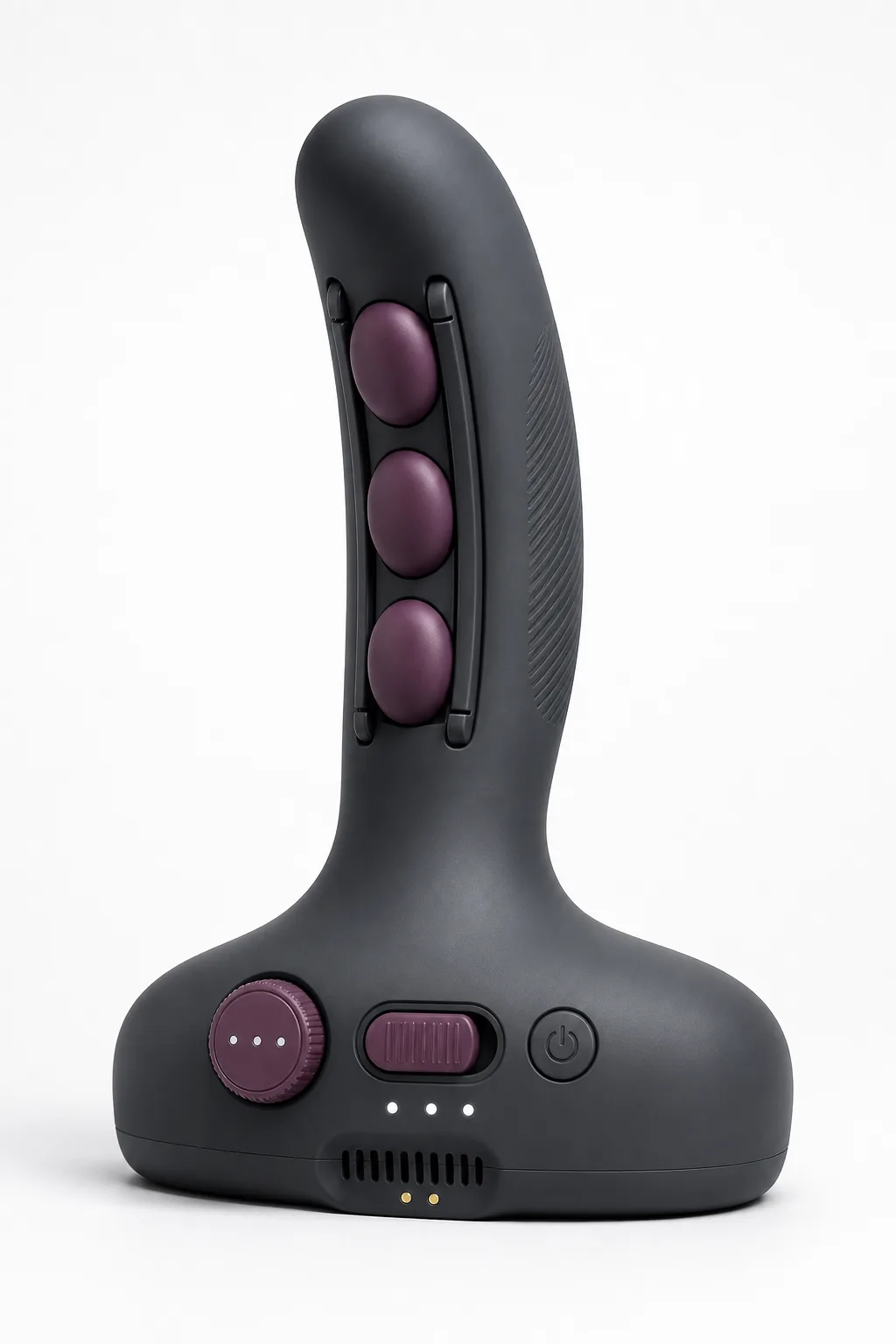
A rechargeable external wand concept with a fixed broad dome head and a three-position telescoping handle secured by a quarter-turn locking collar.
44,99 $
200 in stock
Three handle lengths change reach without changing the head
This telescoping handle wand concept uses a fixed broad deep-plum dome and a charcoal upper tube that slides into a thicker ribbed grip. Three index dots mark proposed lengths, while a wide plum collar turns through a short path to lock the selected position.

The extension system changes reach and leverage only. It is not an intensity control, flexible neck or removable head.
Inventory the nested handle and concealed stops
Confirm the fixed head, neck, upper tube, lower grip, locking collar, opposing tabs, index detents, controls, battery and charging contacts. Request disclosure of hidden anti-rotation keys, bushings, end stops, springs, seals, wires, fasteners and adhesives.
A cosmetic collar without a positive internal lock is not acceptable.
Measure all three assembled lengths
Record head width, thickness and edge radius, neck length, tube diameter, grip circumference, collapsed length, middle length, full length, total mass and maximum extension. Measure the exposed tube and collar overlap at every index.
Each published dimension should identify the locked position used for measurement.
Map the quarter-turn lock sequence
With power off, rotate the collar to release, move the tube until one dot aligns, then rotate to the verified stop. Record unlock torque, extension force, lock angle, tab orientation and tactile engagement for all three positions.
A dot aligned with the collar does not prove that the internal key is seated.
Challenge axial and torsional retention
Mount the grip on a padded fixture and apply controlled push, pull and twist loads at the head below documented limits. Repeat with the handle collapsed, mid-length and fully extended while watching the collar and index.
Any collapse, extension, collar rotation or skipped position fails qualification.
Measure tube play and long-handle whip
At each setting, apply a low side load at the dome and record angular deflection, lateral play, rebound and residual bend. Monitor the tube joint for rattle and compare movement parallel and perpendicular to the collar tabs.
The longest setting may offer reach but also increases leverage on the joint and wrist.
Inspect the telescoping seam as a pinch zone
Use feeler gauges around the collar while extending and retracting the clean sample. Test whether skin, hair or fabric can enter between tube, collar and grip, including when a user holds near the lock tabs.
Adjust length only while switched off and away from the body.
Compare balance at each reach setting
Place the assembled wand on a low-friction balance fixture and locate its center of gravity at all three locked lengths. Record wrist torque for neutral, head-up and head-down grip orientations.
A longer handle is not automatically easier to control, especially if the head mass is unchanged.
Map vibration transfer through the sliding joint
Measure amplitude, frequency and sound at the dome, neck, upper tube, collar and lower grip for every output setting and handle length. Listen for collar chatter and check whether joint play changes the delivered waveform.
Consistent motor settings can produce different handle vibration when tube overlap changes.
Qualify the fixed broad dome separately
Use a soft instrumented fixture to map output across the dome center, shoulder and rounded edge. Record temperature and deformation under light, documented pressure without using the head as a lever.
The permanently mounted dome should not rotate, detach, expose a seam or contact the telescoping tube.
Confirm controls remain reachable at every length
Identify power, increase and decrease functions by test. Measure long-press timing, setting order, memory, accidental activation force and full shutdown while holding the short, middle and long grip positions.
Changing reach must not move a hand across a live button or charging contact.
Use externally with the collar positively locked
Before external contact, select the shortest practical length, lock the collar and perform a gentle pull-and-twist check. Begin at the lowest verified output and support the grip without holding the moving seam.
Stop for pain, numbness, irritation, unexpected tube movement, collar rotation, rattle, excessive vibration at the hand, odor, heat or loss of control.
Validate battery wiring across the moving tube
Request cell chemistry, capacity, charge input, cable specification, runtime and protection circuitry. Determine whether power wires cross the telescoping joint, then inspect strain relief and cycle the handle while unpowered before thermal testing.
Log temperature at the battery, controls, collar, tube joint, neck and dome during the longest approved program.
Verify materials and clean the nested seam
Obtain composition for the dome, neck, both tubes, grip ribs, collar, bushings, keys, seals, pigments, wire insulation, lubricants and adhesives. Review fatigue, corrosion, porosity, restricted-substance and skin-contact evidence.
Power off, collapse only to the confirmed service position, wipe approved surfaces and use a soft swab around the collar without flooding the nested tube. Dry the seam and contacts fully; soaking, boiling, bleach, alcohol and abrasive tools are not approved without exact evidence.
Price the reach mechanism above a fixed wand
An Alibaba rechargeable-wand showroom lists a full-size handheld wand at USD 9.79-10.69 with a one-piece minimum. It is a category benchmark only and does not establish this three-length quarter-turn handle, a legal supplier or a production quotation.
The procurement reference supports an EUR 44.99 planning price after allowing for China-origin freight, exact-model quotation, full length and component measurement, collar operation, axial and torsional retention, tube play, pinch-seam review, balance and output mapping, fixed-head testing, wire-strain and thermal validation, materials, cleaning tests, protective packing and discreet fulfillment. Packed size, weight, freight, duty, tax, insurance, payment fees and destination terms require confirmation.
Frequently asked questions
Does extending the handle increase power?
No. It changes reach and leverage; motor output must be measured separately at every length.
Can the collar be adjusted while the wand is running?
No. Switch off, move away from the body and use both hands on the clean mechanism.
Is the broad dome removable?
No. The concept uses one permanently mounted head with no interchangeable cap.
Which length offers the best balance?
That depends on measured center of gravity, wrist torque, grip orientation and personal control.
How is a locked position checked?
Confirm collar stop and tab orientation, then perform a gentle external pull-and-twist check before power-up.
Which faults require retirement?
A rotating collar, skipped index, tube play, joint rattle, visible wire, cracked bushing, loose dome, swelling, abnormal heat or trapped residue.
Reviews
There are no reviews yet.