



Y.Love YAI66W 027 Pink Wireless Remote Vibrating Egg
August 14, 2026
Quarter-Turn Three-Length Telescoping Handle Wand with Fixed Broad Dome Head
August 14, 2026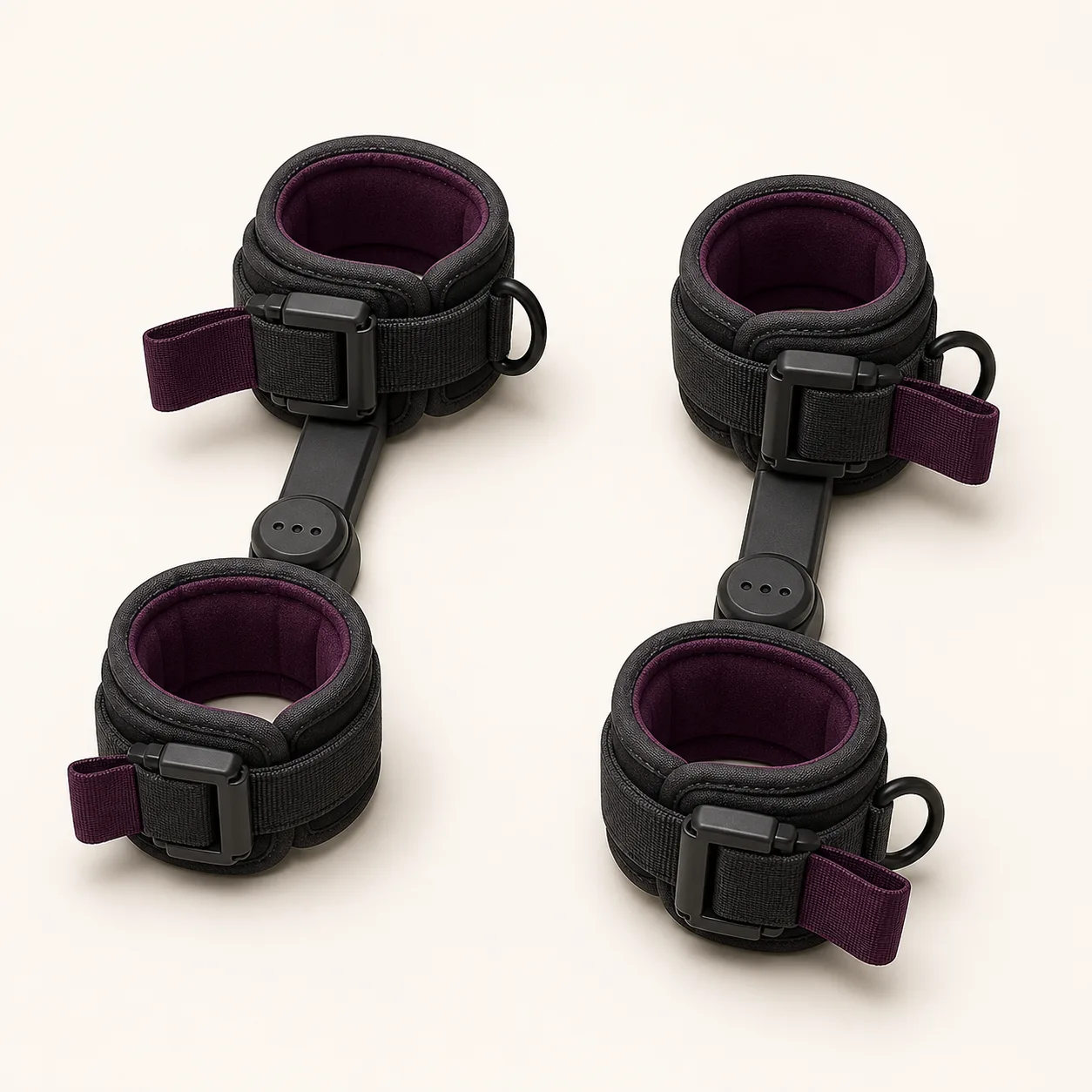
Three-Stop Hinged Padded Elbow Restraint Brace Pair
A matched BDSM restraint pair with two padded cuffs per brace, a short guarded three-stop hinge, separate cam closures and oversized quick-release tabs.
45,99 $
200 in stock
Link two padded cuffs with an indexed elbow bridge
This hinged elbow restraint brace concept is supplied as a matched pair. Each brace joins two broad padded cuffs through one short guarded hinge bridge, with three proposed angle positions, separate cam closures, oversized quick-release tabs and one outer D-ring for controlled low-load positioning.

The image does not prove fit range, angle stops, pressure distribution, release behavior, padding, material composition, load rating or supplier approval.
Inventory every part in both braces
Request an exploded drawing and bill of materials for four cuff shells, liners, padding layers, edge binding, fit straps, cam bodies, cam levers, pull tabs, bridge arms, hinge discs, pins, bushings, stops, detents, guards, two D-rings, reinforcement patches, webbing, thread, coatings, pigments and adhesives.
Document mirrored and common parts so left and right assemblies cannot be mixed during inspection.
Measure upper and lower cuffs separately
Record open length, usable circumference, width, padding thickness, edge radius, overlap, strap length, cam position, tab projection and D-ring offset for every cuff. Compare the two cuffs on a brace rather than assuming identical geometry.
Inspect the liner for seams, folds, hard transitions and compression set.
Map the usable fit range
Test all indexed strap positions on standardized cylindrical and tapered fixtures, recording closure engagement, overlap, slack, local pressure and strap tail management. Include minimum, middle and maximum settings.
No size label is accepted until both cuffs close securely while preserving rapid release and conservative pressure.
Characterize each hinge bridge
Measure bridge length, cuff-axis spacing, hinge pin diameter, radial and axial play, friction, rotation range, hard-stop contact, bridge twist and cuff misalignment. Apply modest loads in flexion, extension and side directions.
Reject a hinge that binds, exposes an edge, pinches the cuff liner or carries load through one cheek only.
Calibrate the three proposed angle stops
Measure stop angle, detent depth, engagement force, false-seating resistance and repeatability for both braces. Approach each position from both directions with fixtures empty and under conservative cuff load.
The three visible dots prove no angle or restriction limit until measured.
Map pressure and monitor circulation
Use instrumented limb-form fixtures to map contact area, peak pressure, edge loading and pressure change as hinge angle and cuff tension vary. Check both straight and tapered forms.
During consensual use, keep release tabs reachable, monitor color, temperature, sensation and comfort continuously, and release immediately for numbness, tingling, pain, discoloration, coldness or withdrawn consent.
Test every quick-release path
Measure tab recognition, deliberate pull force, travel, cam opening and time to slack with dry, damp and gloved hands. Repeat at several cuff settings and hinge angles.
Either cuff must open without first moving the bridge, D-ring or opposite brace; reject false opening or a tab hidden beneath webbing.
Limit D-rings to verified low loads
Inspect ring material, weld or molded join, coating, orientation, reinforcement footprint and rotation clearance. Apply controlled low loads in permitted directions while recording deformation and pressure changes.
These rings are not suspension points, fall-arrest anchors or proof of any body-weight capacity.
Probe hinge and cam pinch zones
Inspect hinge discs, stop windows, bridge-to-cuff joints, cam mouths, strap slots, D-ring bases and tab attachments throughout adjustment, flexion and release. Use articulated probes rather than fingers.
Guards must block access without hiding cracks, trapping residue or obstructing deliberate release.
Verify stitching and reinforcement
Map stitch pattern, seam allowance, thread ends, bar tacks, webbing folds and load paths around cams, bridges, tabs and rings. Test pull direction, cyclic tension and abrasion at every reinforcement patch.
Retire a brace with skipped stitches, frayed webbing, torn binding, lifted padding, loose hardware or spreading holes.
Confirm materials and cleaner compatibility
Obtain exact declarations and restricted-substance evidence for textiles, padding, liners, polymer hardware, rings, coatings, dyes, thread and adhesives. Check odor, color transfer, tack, swelling, cracking, corrosion and delamination after the proposed cleaner and drying process.
Leather, vegan, breathable, hypoallergenic, medical and certification claims remain pending exact-model documents.
Compare the pair for consistency
Measure cuff ranges, hinge stops, release forces, pressure maps, D-ring orientation and mass on both braces. Track side-to-side deviation before and after cycling.
A matched appearance does not establish matched fit, angle or release behavior.
Cycle fit, hinge, release and cleaning
Run repeated strap adjustments, cam closures, hinge changes, detent seating, low-load positioning, rapid releases, cleaner exposure, measured drying and storage. At checkpoints repeat geometry, fit, pressure, play, stop accuracy, release force, stitches and ring inspection.
Validate cleaning beneath liners, along edge binding, through cams and strap slots, around hinge guards, bridge seams, tabs, rings and reinforcement patches.
Price after paired release testing
An Alibaba padded-leather-restraints showroom currently displays a padded adjustable cuff category example at USD 12.70-14.20 with MOQ one piece. It is a category benchmark only and does not confirm this four-cuff paired brace, three-stop hinge or independent quick-release design.
The procurement reference supports an EUR 45.99 planning price after allowing for China-origin freight, exact-model sourcing, teardown, separate cuff metrology, fit fixtures, hinge and stop calibration, pressure maps, release testing, low-load ring review, pinch inspection, stitching analysis, pair consistency, combined cycle life, material evidence, cleaning validation, protective packing and discreet fulfillment. Exact quotation, MOQ, packed size, weight, freight, duty, tax, insurance, payment fees and delivery terms remain pending.
Frequently asked questions
Are these ordinary wrist cuffs?
No. Each brace links two padded cuffs with a short indexed bridge; exact elbow-area fit remains pending.
Are three hinge angles guaranteed?
No. Stop angle, engagement and repeatability require paired sample testing.
Can either cuff release independently?
That is the design intent, but every cam and pull tab must pass loaded release tests.
Can the D-rings support body weight?
No. They are proposed only for verified conservative low-load positioning and never suspension.
How are the liners cleaned?
Only by a compatible method that reaches seams, bindings, cams and hinges and confirms complete drying.
Which faults require retirement?
A jammed cam, hidden tab, loose hinge, weak stop, cracked guard, bent ring, frayed strap, torn padding, skipped stitches or material transfer.
Reviews
There are no reviews yet.