



S-HANDE SHD-K010-2 Remote Rose Couples Ring
August 14, 2026
Extended-Size Lace-Trim Satin-Look Slip and Robe Set – 4 Colours
August 14, 2026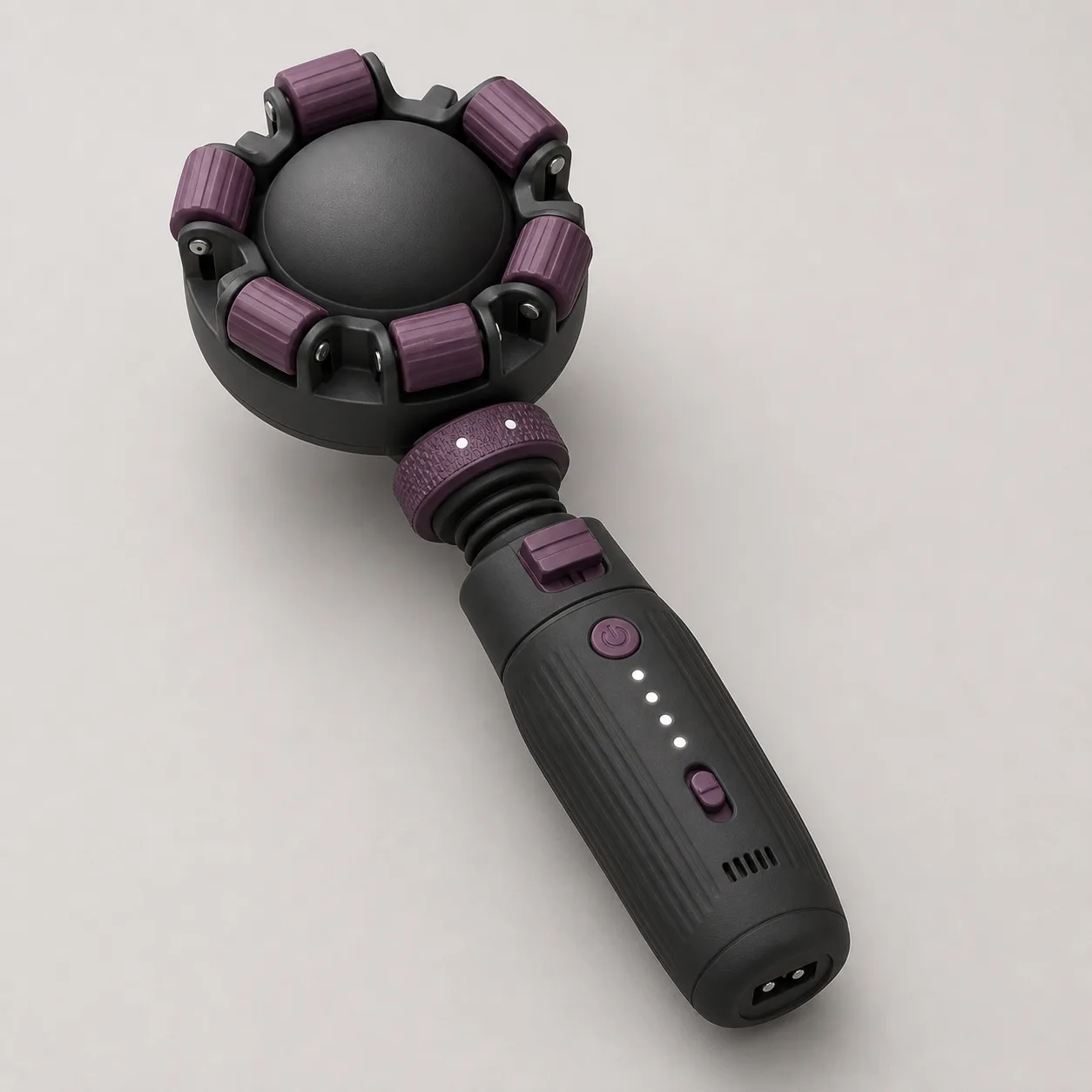
Six-Roller Radial-Crown Wand with Two-Speed Drive Collar
A radial-crown wand concept with one fixed central dome, six individually mounted perimeter rollers and a two-position drive collar.
76,99 $
200 in stock
Read the crown before reading the controls
This six-roller radial-crown wand concept surrounds one fixed charcoal central dome with exactly six separate smoky-plum rollers. Each roller sits in its own guarded fork around the perimeter. A plum collar marked with two dots proposes two drive states, while the flexible neck, ribbed grip, stop slider, indicators, lower switch, vents and charging contacts remain visible for inspection.

The image defines an evaluation concept, not evidence for speed, material, ingress, battery or production claims.
Freeze the six-roller bill of materials
Label the central dome D0; rollers R1-R6; forks F1-F6; axles A1-A6; crown carrier C0; drive collar C1; neck N1; handle shell; controls; indicators; controller; cell; contacts; vents; seals; pigments; lubricants and adhesives. Require drawings and part revisions for the exact sample.
Roller count, axle type and the mechanical link between C1 and the crown must agree across samples.
Map crown diameter and radial spacing. Measure overall head diameter, dome height, roller envelope, centre-to-roller radius, angular spacing, fork width, axle offset and crown mass. Record values at six clock positions rather than averaging away a local defect.
Compare unloaded geometry with standardized compression and after thermal conditioning.
Profile the fixed central dome
Capture dome radius, crown height, edge blend, surface friction, hardness, wall thickness, deformation, rebound and attachment to C0. The dome should be evaluated separately because it does not rotate with R1-R6.
Reject exposed hard structure, persistent set, tack, pigment transfer, cracks or delamination.
Measure rollers R1 through R6 separately
For every roller, log diameter, width, roundness, surface finish, hardness, mass, axle runout and free-rotation torque. Mark each component so results cannot be pooled without traceability.
Reject flat spots, edge chips, binding, excessive wobble, discoloration or uneven drag.
Inspect six forks axles and guarded gaps
Measure fork stiffness, axle retention, end play, radial play, guarded clearance and accessible pinch gaps through full roller travel. Probe F1-F6 under centered and offset loads.
Reject cracked forks, loose axles, abrasive seams, trapped debris or any gap that closes unpredictably.
Quantify crown runout and concentricity
Rotate the assembly slowly and record radial and axial runout at D0 and R1-R6. Compare crown centre, neck axis and carrier reference surfaces, then repeat after loaded cycling.
Visible orbit, periodic impact or a drifting centre calls for teardown before output testing.
Verify the two-speed drive collar
Document collar detents, torque, tactile difference, direction logic and whether the two dots represent speed, gearing or another function. Measure transition time and unintended movement under grip loads.
No two-speed claim is accepted until both states are linked to measured roller motion on an exact sample.
Characterize roller rotation and friction
Measure start torque, steady torque, rotational speed, slip, stall behavior and coast-down for R1-R6 in each verified collar state. Use both dry fixtures and approved conditioned surfaces.
Compare individual roller traces to locate one slow axle instead of reporting only crown averages.
Map dome pressure against roller contact
Use instrumented compliant forms to separate load carried by D0 from load carried by R1-R6. Record engaged area, local pressure, roller deflection, fork displacement and head tilt across controlled approach angles.
Claims about comfort or fit require bounded geometry, loading and user testing beyond this planning page.
Separate output from rotational motion
Record acceleration, frequency, harmonics and phase at D0, every roller, C0, N1 and the grip for each confirmed electronic program and collar state. Repeat with the roller drive stopped if the design permits.
This matrix shows whether vibration and rolling are independent, coupled or mechanically transferred.
Trace neck and handle reaction
Measure flexible-neck angle, bending stiffness, torsion, rebound, fatigue set, grip acceleration and balance with the crown unloaded and compressed. Observe whether crown torque twists the handle or changes roller alignment.
Reject neck cracks, permanent lean, shell buzz, loose ribs or rising grip vibration.
Verify controls battery and charging logic
Document startup, program selection, collar interaction, stop priority, lower-switch function, lock sequence, indicator meanings, input limits, cell architecture, charge time, operating time and protection circuits.
Exact electrical values remain pending supplier documents, teardown and direct measurement.
Log current sound heat and constrained faults
Measure current, A-weighted sound and temperature at D0, R1-R6, forks, carrier, neck, controller, cell, grip, vents and contacts. Challenge one-roller restraint, full-crown restraint, partial collar engagement, low voltage and power loss in guarded fixtures.
Reject abnormal heat, delayed stop, unexpected restart, scraping, tonal rattle or cell swelling.
Screen seams residue cleaning and fatigue
Inspect dome edges, roller surfaces, six forks, axle ends, carrier joints, collar detents, neck folds, buttons, slider, lights, switch, vents, grip ribs and contacts for residue and moisture traps. Cycle rolling, output, loading, collar changes, stopping, charging, wiping, drying and storage.
No waterproof statement is made without exact-model ingress evidence.
Build landed price after crown validation
An Alibaba magic-wand category page showed one example at USD 2.11-2.45 with a three-piece minimum. It is a broad benchmark only and does not confirm this six-roller architecture or an approved supplier.
The procurement benchmark supports an EUR 76.99 planning price after provisional allowance for China-origin freight, exact samples, teardown, six-roller metrology, fork and axle tests, crown runout, drive-state mapping, pressure, vibration, controls, charging, sound, heat, faults, cleaning and fatigue work, protective packing and discreet fulfilment. Exact quote, MOQ, dimensions, materials, cell, packed weight, freight, duty, tax, certification, payment terms and lead time remain pending.
Frequently asked questions
Do all six rollers rotate?
R1-R6 motion and drive coupling require exact-sample measurement.
What do the two collar dots mean?
Their connection to speed or gearing remains pending functional verification.
Does the central dome rotate?
D0 is specified as fixed in this concept and must be checked against the production sample.
Can one roller be serviced separately?
Axle retention, parts access and supplier service policy remain pending.
Is the wand waterproof?
No ingress rating is claimed for the crown, collar, controls, vents or contacts.
Which defects require retirement?
Loose axles, cracked forks, roller binding, crown runout, heat, charging faults or cell swelling.
Reviews
There are no reviews yet.