


HB-2426 Black Textured Vibrating Ring Sleeve
August 14, 2026
Enovart ET-AW-012 White Mini Wand Vibrator
August 14, 2026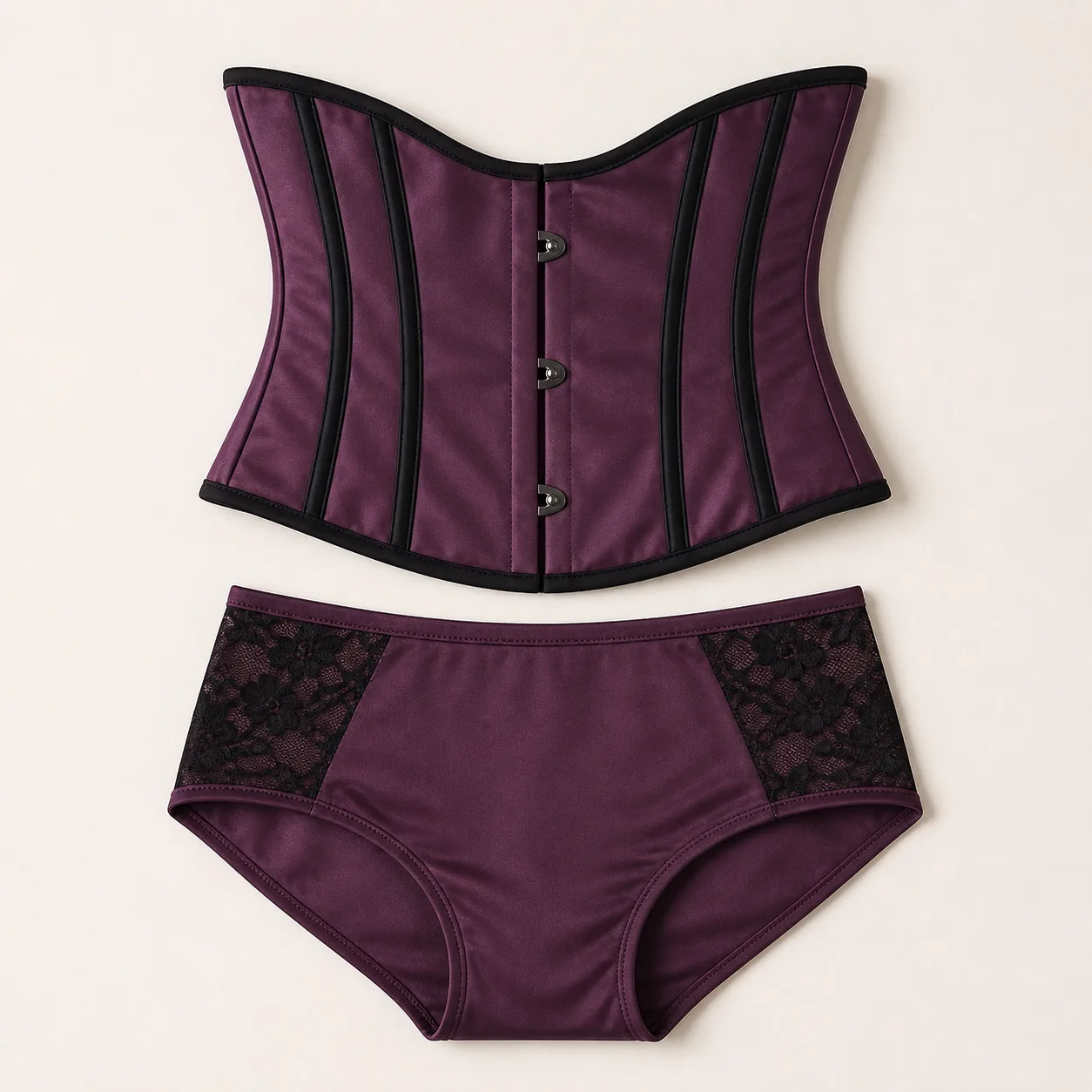
Six-Stay Underbust Corset with Three-Clasp Front Busk and High-Waist Brief
A smoky-plum two-piece lingerie concept with one curved underbust corset, six black support channels, three front busk clasps and a high-waist lace-panel brief.
49,99 $
200 in stock
Frame a curved underbust line with six vertical support channels
This six-stay underbust corset and high-waist brief set contains exactly two smoky-plum garments. The waist cincher places three black channels on each side of a central three-clasp front busk, while black binding traces its curved upper and lower edges. A separate closed-front brief combines a high waist with two black floral-lace side panels.

The image records design intent only. Fibre content, insert type, hardware, dimensions, stretch, opacity, graded fit and production readiness remain pending.
Audit the two-piece pack before sealing
The proposed pack includes one underbust corset and one high-waist brief. Give each piece a component code and confirm shade, label position, hygiene liner, folding method and count at final inspection.
No bra, stockings, garter straps, robe, jewellery or spare hardware is included. Approved sealed samples must define the final pack.
Measure the curved upper edge at three landmarks
Record the centre-front height, each underbust peak and both side heights without pulling the binding. Add the horizontal distance between peaks and the length along the finished curve so pattern and garment measurements can be compared.
Underbust describes the silhouette, not universal breast support or a medical fitting function.
Label support channels S1 through S6
Number the six proposed black channels from the wearer’s left to right and capture length, width, spacing, seam allowance and distance from the upper and lower bindings. Flex each area through the expected motion range and inspect for migration, sharp ends or stitching damage.
The internal insert material, stiffness, end caps and durability require supplier disclosure and physical testing; the visual cannot establish steel, plastic or another construction.
Inspect the three-clasp front busk as one closure system
Identify the upper, middle and lower clasp positions, then record centre spacing, alignment, opening force, closing engagement and resistance to accidental release. Check the two front panels for twist or edge mismatch when all three points are fastened.
Hardware alloy, coating, nickel release, corrosion resistance and cycle life remain unverified.
Compare upper and lower binding around every curve
Measure finished binding width at the centre, channels and side seams. Inspect stretch recovery, stitch density, skipped stitches, puckering and any hard overlap that could press against skin.
The upper and lower edges should lie smoothly in approved fit trials without claims of reshaping or posture correction.
Map the satin-like panels between the black channels
Give each visible plum panel a pattern reference and document grain direction, sheen, width at top and bottom, seam position and acceptable shade variation. Use controlled light to distinguish fabric rippling from colour inconsistency.
Satin-like describes the proposed surface appearance only. It does not establish silk content, weave or fibre blend.
Measure the corset at waist, top edge and lower edge
Record the closed waist circumference, upper-edge span, lower-edge span, centre-front height, centre-back height and both side lengths for every size. State tolerances separately for the shell, binding and closure alignment.
Do not infer a compression level from the flat image. Fit pressure and adjustment range require graded samples and consenting-adult wear trials.
Fit the high-waist brief independently of the corset
Capture relaxed and extended waist, high hip, front rise, back rise, side depth and both leg openings. Check that the brief can be worn comfortably with or without the cincher and that its waistband does not become trapped beneath the lower binding.
Coverage and elastic pressure vary by body and size; final fit guidance awaits approved grading.
Mirror the two floral-lace side panels deliberately
Measure the left and right inserts by top width, bottom width, seam length, motif scale, transparency and stretch direction. Compare both sides for shade and structural balance while allowing only the motif variation written into the purchase specification.
Lace composition, snag resistance and openness must be tested rather than inferred from appearance.
Verify the brief gusset and inner seam finish
Document gusset length, width, layer count, fibre declaration, attachment method and any removable hygiene liner. Inspect seam overlaps, thread ends, exposed elastic, abrasion points and dye transfer on the inside.
No antibacterial, odour-control or moisture-management claim is made without traceable evidence.
Build the size chart from finished garment data
Supplier size letters must be supported by underbust, natural waist, high hip, corset height, closed-corset circumference, brief rise and leg-opening measurements. Review closure alignment, channel position, edge pressure and brief coverage across every proposed size.
The sellable range remains pending graded patterns, samples and fit approval. Customers should not use forced closure as a sizing method.
Test shell, binding, lace and support components separately
Request fibre declarations, mass, stretch, recovery, shrinkage and colour data for the plum shell, black binding, lace, gusset, thread and any elastic. Ask for separate specifications for the six inserts and three clasp components.
Exact softness, breathability, support feel, wash behaviour and service life are unconfirmed until tested on approved production samples.
Validate colourfastness, clasp coating and care wording
Run dry and damp rub checks, wash trials and a perspiration-simulant assessment on every colour and trim. Record plum dye transfer, black trim bleeding, surface change, shrinkage, channel distortion, clasp corrosion and loss of closure alignment.
Hand-wash temperature, detergent, drying, ironing and storage instructions must follow results for the weakest verified component.
Plan landed pricing from comparable sourcing references
An Alibaba public wholesale page displayed a rose-pattern underbust waist cincher with three busk points at USD 4.54 to 5.81 with MOQ 10, alongside a satin corset reference at USD 4.36 to 5.63 with MOQ 10. These are category benchmarks, not quotations for this two-piece six-channel proposal or approved suppliers.
The public procurement reference supports an EUR 49.99 planning price after provisional allowance for China-origin freight, graded samples, channel and clasp checks, lace and gusset inspection, colourfastness, wash validation, discreet fulfilment and expected apparel handling loss. Exact supplier, quote, MOQ, sizes, colours, fibres, packed weight, freight, duty, tax, certification, payment terms and lead time remain pending.
Frequently asked questions
How many garments are included?
Exactly two are proposed: one underbust corset and one matching high-waist brief.
How many support channels are visible?
Six black vertical channel positions are specified, three on each side of the front closure.
How does the front close?
The concept uses three clasp points on a central busk. Final hardware and operating force require sample approval.
Are the stays made from steel?
No insert material is claimed. Composition, stiffness and end treatment remain pending supplier documents and tests.
Which sizes will be offered?
The size range and measurement chart await graded samples and fit approval.
Can it be tightened for medical support?
No. This is an apparel concept, not a medical or posture device. Do not force the closure or continue wear with pain, numbness, breathing restriction or skin injury.

Reviews
There are no reviews yet.