



Eight-Paddle Dual-Rail Travelling-Wave Automatic Stroker with Service Door
August 14, 2026
Low-Profile Care-Station Floor Cable Cover with Center Channel
August 14, 2026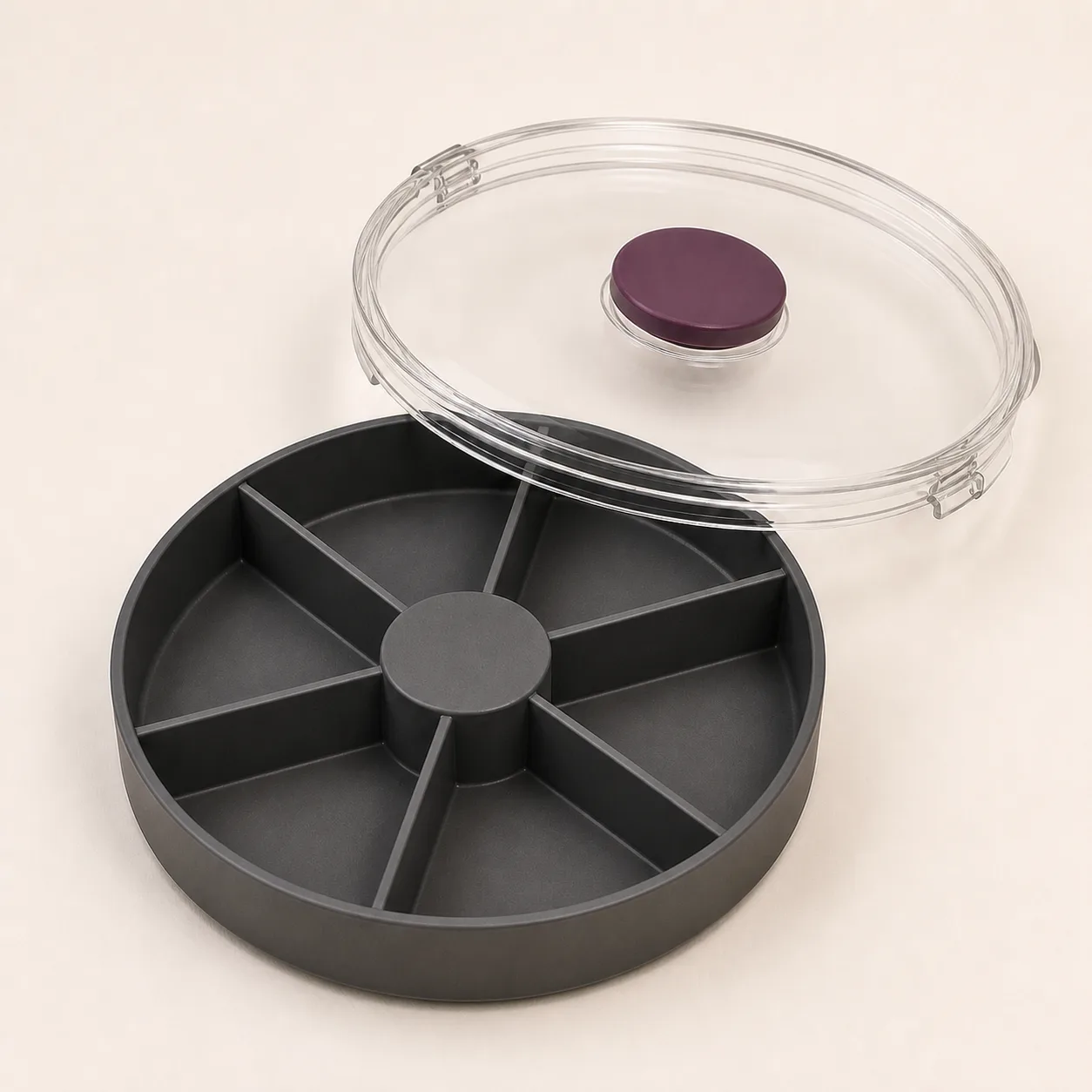
Six-Well Small-Parts Care Tray with Clear Snap Lid
A six-well dry staging tray with a clear snap lid for keeping maker-approved removable product-care parts in visible order.
13,99 $
200 in stock
Six visible wells can preserve the order of small removable parts
The small parts care tray concept gives detachable caps, covers, adapter rings or other maker-approved dry accessories a temporary mapped place during product care. Equal wedge-shaped wells circle a solid hub, and a clear lid lets the user check the count before the main product is moved.

The tray supports organization; it does not authorize disassembly.
Remove only parts named in the product instructions
Consult the exact model guide before separating any piece. Do not pry off bonded trim, seals, motors, battery doors, fasteners, valves or charging components simply because a seam is visible.
If removal requires a tool, unusual force or memory of an undocumented step, stop and ask the maker rather than risking damage or loss.
Keep the tray outside body care, medicine and food use
This organizer is not intended for pills, supplements, edible items, jewelry worn through the body or anything inserted into a person. It is also not a sterile field, specimen holder or dosing aid.
Dedicate the selected tray to compatible product-care parts and keep it separate from household serving containers.
Make an inventory before the first part leaves the product
Read the assembly diagram, count every approved removable piece and record its name and position on a separate care card. Photographing the intact product may help only when the maker permits it and private images are stored securely.
Do not rely on memory or well color when several rings and covers look alike.
Inspect every divider and lid edge under good light
Check the empty tray for cracks, sharp molding flash, stains, dust, oily residue, odor, warped dividers or a loose center hub. Examine the clear lid for chips, clouding, deep scratches and distorted snap points.
Reject any unit that can catch a soft component, shed a fragment or close unevenly.
Set the tray on a level dry nonporous surface
Place it inside the established care zone but away from sink edges, floor vents, cables and open cleaner. Keep the lid lifted on a clean surface where its inside face cannot collect debris.
The round base must sit flat without rocking before any small item is added.
Assign wells in the same sequence as disassembly
Begin at a chosen reference point and move clockwise, placing the first approved part in the first well and following the documented order. Leave unused wells empty rather than mixing pieces to save space.
A consistent sequence makes the reassembly check observable and reduces the chance of skipping a component.
Each part should fit without bending or stacking
Lay a piece flat with clearance from divider tops and the lid. If it bridges two wells, rises above the rim, coils under tension or must be compressed, move it to a larger approved container.
Do not stack similar rings because friction can transfer residue and hide the count.
Keep liquid out of the organizer
The wells are for dry temporary staging, not soaking, rinsing, measuring or mixing. Cleaner can migrate between compartments, attack an unverified plastic, become trapped under a component or spill when the lid is moved.
Use a separate maker-approved cleaning vessel when wet care is required, then dry and inspect each part fully before staging.
Close the clear lid only after every piece is dry
Confirm the documented count, wipe the rim by the approved method and lower the lid without shifting the tray. Press only the confirmed snap locations and listen or feel for an even closure without forcing the center grip.
Visible condensation, haze or droplets mean the contents are not ready for covered staging.
A clear cover supports counting but is not secure transport
Look through the lid to confirm that every well still contains the expected part and nothing is pinched at the rim. Clarity is an observation aid, not proof of closure strength.
Until drop, vibration and latch tests are complete, keep the tray horizontal on the work surface and do not carry it by the center grip.
Reassemble from the last occupied well backward
Follow the model instructions and reverse the documented sequence only when that guide specifies it. Inspect each part before installation, then confirm that its well is empty before moving to the next.
Stop when a piece does not seat easily; a spare-looking part may indicate an earlier step was missed.
Clean and dry the empty tray before storage
After all components are correctly installed, inspect the wells for particles or residue. Use only a cleaning method validated for the selected tray and lid materials, keeping snap channels and the underside of the grip accessible.
Store the tray open until every divider, rim and closure feature is completely dry.
The lid is not child-resistant or tamper-evident
Keep the empty organizer in a private adult-controlled cabinet. Do not use it to secure hazardous parts, button batteries, chemicals or items that could be swallowed.
No airtight, leakproof, impact-proof or tamper-indicating claim is made for the planned snap closure.
The sourcing reference requires size and material confirmation
An Alibaba six-compartment plastic tray listing from Ningbo Roff Industry shows USD 2.99-3.49 per unit with MOQ 20 units. Exact diameter, well geometry, polymers, lid construction, closure force and care-chemical compatibility remain pending.
The procurement reference supports sample inquiry only. The EUR 13.99 plan allows for China-origin freight, count and edge inspection, closure testing and discreet packing; packed mass, freight, duty, tax, insurance, payment fees and destination terms remain pending.
Frequently asked questions
Can I take apart any product over this tray?
No. Remove only components the exact model instructions identify as user-removable.
May cleaner be poured into the wells?
No. The organizer is for dry staging and has no verified liquid or chemical performance.
Does the lid lock securely for travel?
No transport claim is made until the selected closure passes drop and vibration testing.
Can two small rings share one well?
Use one component per assigned position whenever possible so the inventory remains visible.
Is the tray safe for pills or food?
No. The concept is dedicated to compatible dry product-care parts only.
When should the organizer be discarded?
Remove it from service after a crack, sharp edge, warped divider, cloudy lid, loose grip, failed snap, persistent odor or chemical reaction.


Reviews
There are no reviews yet.