



Corn-Kernel Remote Wearable Vibrator
August 14, 2026
Expandable Care-Supply Cabinet Shelf Riser with Slotted Top
August 14, 2026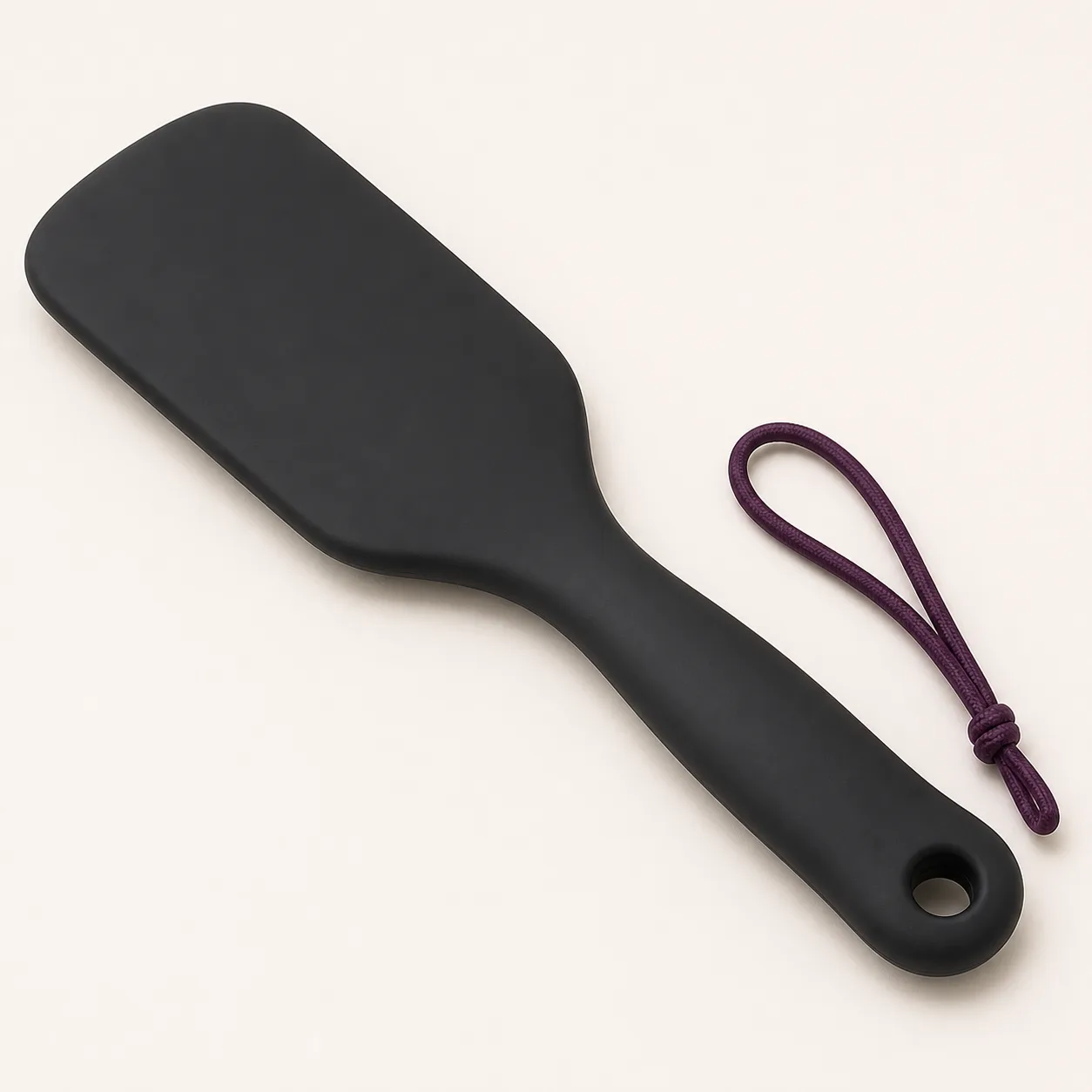
Slim Flexible Silicone Impact Paddle
A plain rounded impact paddle planned for consensual low-intensity sensation, compact controlled swings and frequent communication checks.
19,99 $
200 in stock
A flexible silicone impact paddle changes character with every swing
A slim flexible silicone impact paddle stores energy as the head bends, then releases it across a broad face. Handle speed, distance, wrist angle and follow-through can change sensation more than the paddle’s quiet appearance suggests. The responsible product story therefore begins with control and communication rather than intensity.
The supplier page presents model MLY-22098 at 275 × 40 × 8 mm and 89 g. Those dimensions, weight, polymer and flex remain pending measurement on the exact black production sample.

Consent is a live condition, not a one-time checkbox
Adults should agree on desired sensations, body areas, visible marks and firm limits before the paddle is picked up. Choose a clear stop word plus a nonverbal signal that works if speech becomes difficult.
Either person can stop immediately without explanation. Check in throughout the session because comfort, circulation, emotion and sensitivity can change after each sequence.
Map safe target zones before movement begins
Limit low-intensity impact to broad fleshy areas that have been mutually approved. Avoid the head, face, neck, throat, spine, kidneys, abdomen, breasts, genitals, joints, hands, feet and any area with prominent bone, injury or reduced sensation.
Never improvise a target after the swing starts. Good lighting and a stable position make placement easier to monitor.
Learn the paddle on a cushion first
Practice short controlled taps on a firm cushion while watching how far the head flexes and where it lands. Compare striking with the center, edge and tip; only the broad central face should define the planned contact area.
If the tip wraps around the cushion or the handle twists in the hand, shorten the swing. Control should be established before any body contact.
Warm-up is information gathering
Begin with light hand contact or very gentle paddle taps spaced far enough apart to observe the response. Ask about warmth, sting, thud, numbness and emotional comfort. Increase only one variable at a time.
There is no need to chase a visible mark. Color varies by skin tone, lighting, circulation and prior activity, and absence of redness does not prove that force was low.
Distance matters more than dramatic arm movement
Use compact wrist and forearm motion close to the target. Large overhead swings make placement and force harder to control. Keep the unused hand away from the travel path.
Pause after every small group of impacts. Reassess the target rather than building speed automatically.
The center face and the flexible tip feel different
The center spreads contact across a broader area, while the moving tip can concentrate a sharper sensation and wrap around curved anatomy. Procurement should characterize both on an instrumented target at defined speeds.
Until that data exists, keep the tip from becoming the primary contact point. Edge strikes and accidental wrap are reasons to stop and adjust technique.
The handle must stay secure without white-knuckle grip
Hold the contoured section with dry hands and a neutral wrist. The paddle should not rotate, slide or require excessive squeezing. Sweat or lubricant on the handle can reduce control.
If a wrist loop is supplied and validated, it should act only as drop retention. Never wrap it tightly enough to restrict circulation or use it to swing the paddle by the cord.
Rounded edges still need magnified inspection
Examine the head perimeter, handle transition and hanging eye for mold flash, cuts, bubbles, pits, hard inclusions and raised seams. Flex the edge under bright light to reveal cracks or whitening.
A nick can grow rapidly under repeated bending. Do not trim, sand or coat a defective edge; remove the paddle from service.
Flex and rebound require fatigue testing
Measure bending stiffness at several points and repeat a defined number of cycles. Record permanent curve, softening, tearing and changes in rebound. A paddle that becomes more flexible with age can produce a different tip speed.
The model’s claimed softness and durability remain unverified. Final instructions need a retirement criterion based on observed fatigue, not appearance alone.
Material wording needs batch-linked evidence
The listing calls the product 100% silicone and waterproof. Procurement must obtain polymer, pigment, additive, restricted-substance and skin-contact documentation for the exact model and color.
Tackiness, oily residue, strong persistent odor, color transfer or unexplained bloom are rejection signs. Marketing terms do not replace formulation review.
Marks and pain are not interchangeable measures
Some skin marks easily while other skin shows little color. Monitor reported sensation, swelling, temperature and movement as well as appearance. Stop for sharp pain, numbness, broken skin, rapid swelling, dizziness or distress.
Persistent pain, significant bruising, breathing difficulty, weakness or any concern about internal injury requires prompt medical attention.
Medication and health factors change the risk
Blood-thinning medicines, bleeding conditions, fragile skin, neuropathy, poor circulation, recent surgery and existing bruises can increase harm or hide useful feedback. Individual medical advice may be appropriate before impact play.
Alcohol and other impairing substances reduce judgment and response. The paddle should remain stored when either participant cannot monitor or communicate clearly.
Aftercare includes an honest skin check
Inspect the contacted area in good light and ask about tenderness, heat, numbness and emotional state. Use ordinary comfort measures appropriate to intact skin and avoid further impact on sore or marked areas.
Document unexpected reactions during product testing. Repeated bruising or a pattern of edge marks indicates a technique or design problem that should not be ignored.
Cleaning should preserve grip and surface integrity
Wash or wipe the paddle according to the validated method for the confirmed polymer. Pay attention to the handle transition, edge and hanging eye. Remove body products before they dry into the surface.
Harsh solvents, abrasive pads, boiling and appliance heat can alter softness or finish. Dry completely before inspection and storage.
Store the head flat and unstressed
Keep the clean dry paddle in its own compartment away from sharp tools, direct sunlight and incompatible soft materials. Do not fold the head, hang weight from the eye or trap it under heavy objects.
The pictured plum loop is a proposed accessory. Inclusion, fiber content, knot strength and colorfastness remain pending supplier confirmation.
Common questions about a slim impact paddle
Is the paddle suitable for maximum-force impact?
No such rating exists. It is planned for controlled low-intensity sensation play, with force and fatigue data still pending.
Can it be used on any body area?
No. Keep contact to mutually approved broad fleshy areas and avoid the head, neck, spine, kidneys, joints, genitals and injured tissue.
Does a broad head prevent bruising?
No. Speed, flex, placement, repetition, health factors and individual skin response all affect marking and injury risk.
Is the material confirmed as silicone?
Not yet. The marketplace claim needs batch-linked polymer and pigment evidence.
Should the wrist loop be tight?
No. If a loop is included, it must not restrict circulation and should never be used as a swinging handle.
When should the paddle be retired?
Stop using it for tears, nicks, hard spots, tackiness, permanent bending, color transfer or a changed rebound.
Observed supplier terms and provisional store price
Alibaba listing 1601383464927 displayed Guangdong Kain Electronic Technology Co., Ltd., model MLY-22098, USD 1.60 for 100–499 pieces, USD 1.50 for 500–999, USD 1.40 from 1,000 pieces and a USD 5.00 sample. It presented black color, 275 × 40 × 8 mm, 89 g, silicone and waterproof statements; every technical claim remains pending verification.
The planned EUR 19.99 display price provisionally allows for China-origin freight planning, sample purchase, dimensional and mass measurement, flex and rebound characterization, edge and seam inspection, handle and hanging-eye fatigue testing, wet-grip review, instrumented impact trials, polymer and pigment documentation, cleaning validation, consent and safety labeling, discreet packaging, payment processing and destination delivery. Freight, duty, tax, insurance, certification, lead time and purchasing terms remain pending.
Final approval binds shape, stiffness and handling together
The accepted specification must identify the exact head geometry, edge radius, handle, hanging eye, polymer, pigment, stiffness, rebound and package. A change in thickness, tooling, formulation or accessory begins a new review. Until then, dimensions, material, flex, durability, care and suitable intensity remain provisional.
Reviews
There are no reviews yet.