


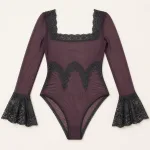
Square-Neck Long-Sleeve Lace Bodysuit with Three-Arch Waist Yoke and Scalloped Bell Cuffs
August 14, 2026
D5016 Plus-Size Lace Halter Babydoll: S-5XL, 4 Colours
August 14, 2026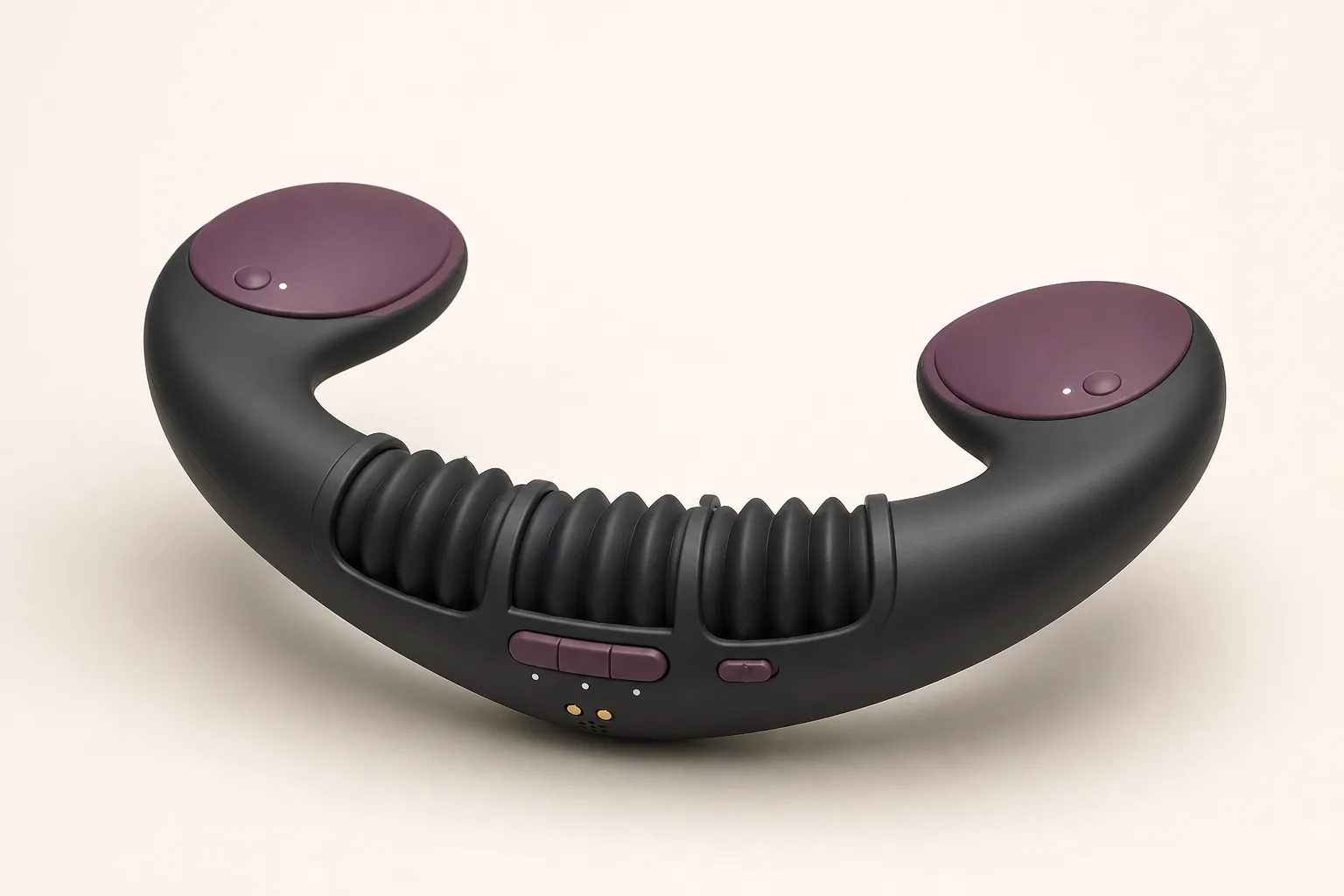
Three-Bellows Variable-Arc Couples Vibrator with Twin Contact Caps
A rechargeable couples-vibrator concept with two broad contact caps joined by exactly three guarded accordion-bellows sections and a lockable three-stop arc slider.
75,99 $
200 in stock
Join two contact caps through three bellows
This three-bellows variable-arc couples vibrator concept places two broad plum oval contact caps at the open ends of one shallow charcoal C bridge. Exactly three guarded accordion sections sit in series across the center, with a local three-stop compression slider and separate lock.

The image does not prove fit, arc range, bellows travel, motor count, synchronization, output, materials, sealing or production availability.
Inventory both ends and all three flex groups
Request an exploded bill of materials for caps A and B, contact skins, shells, actuators, moving masses, bridge arms, bellows B1-B3, fold cores, separator collars, guards, compression linkage, slider, detents, lock, controller, cell, controls, indicators, vent, contacts, conductors, seals, coatings, pigments, lubricants and adhesives.
Trace shared electrical and structural paths through every collar before treating the ends as independent modules.
Measure neutral arc and compressed states
Record overall span, cap centers, opening width, bridge radius, arm section, bellows lengths, fold pitch, collar spacing, guard depth, slider travel, mass and balance. Measure all geometry on a common plane.
Repeat at every confirmed compression stop approached from both directions and after bounded flex, output, cleaning and storage cycles.
Characterize contact caps A and B
For each cap, measure major and minor axes, crown, edge blend, hardness, compression, recovery, friction, control recess, shell seating and mass. Preserve A/B identity throughout testing.
Inspect for thin skins, voids, hard inclusions, tack, pigment transfer, edge lift, looseness and unequal response.
Calibrate each bellows section independently
For B1, B2 and B3, measure axial compression, lateral deflection, torsion, spring rate, hysteresis, rebound, residual set and fold-to-fold clearance. Compare actual load sharing across the series chain.
Reject fold inversion, local collapse, whitening, crease initiation, delayed recovery or one section taking nearly all displacement.
Screen collars folds guards and capture gaps
Use articulated probes and soft film at every fold valley, collar, guard edge, bridge transition, slider and lock through compression, bending and load. Map pinch, shear and residue traps.
Verify that the guard does not bottom against a fold and that cleaning and measured drying can reach all valleys.
Calibrate the three-stop arc slider
Record slider travel, detent force, lock action, backlash, indication and actual cap-center span and bridge radius at all three states. Test equal and asymmetric cap loads.
Reject false seating, stop drift, uneven bellows compression or a setting that closes a capture gap below the accepted clearance.
Identify drive allocation and bridge transmission
Teardown must identify motor count, moving masses, couplers, isolation mounts and conductor routing. Instrument both caps, all collars, each bridge arm and the central control housing.
Visible end controls do not prove separate motors or isolated channels; shared-structure transmission must be measured.
Resolve synchronization phase and link loss
Capture synchronized three-axis acceleration, displacement, frequency, phase, rise, decay and coast-down at A and B for every confirmed mode and arc state. Repeat free and under two compliant fixtures.
Document startup skew, drift, beat frequency, dropped transitions and behavior after one side stalls, depletes or loses any confirmed link.
Map two-cap pressure and arc interaction
Use two independent compliant surfaces to record contact area, peak pressure, load sharing, cap angle, span change and bellows compression under equal, one-sided and alternating loads. State fixture stiffness and preload.
Reject unstable cap roll, hard bridge contact, progressive arc closure or load transfer that hides one cap’s pressure peak.
Verify flex stability and conductor fatigue
Measure bridge twist, out-of-plane buckling, lateral drift and residual set through the intended arc envelope. Inspect flexing conductors and seals at every collar and arm transition.
Challenge conservative diagonal loads without claiming a body-fit range; stop for conductor strain, fold kinks, collar movement or asymmetric recovery.
Verify controls shutdown and recovery
Document local startup, levels, confirmed patterns, arc-adjustment rules, pause, immediate stop, memory and travel lock. Measure button force, recognition and time to zero output.
Confirm predictable behavior after slider movement, low voltage, one restrained cap, interrupted charging and power restoration without automatic restart.
Verify battery charging and ingress boundaries
Confirm cell chemistry, capacity, specified input, charge time, runtime, polarity, protection circuits, charge indication and charging interlock. Map current through every flex transition.
Inspect cap seams, bellows folds, collars, slider, lock, buttons, vent, shell joints and contacts. No ingress claim is accepted without exact-model evidence.
Log current sound heat faults and cycles
Measure current, A-weighted sound and temperatures at both caps, all bellows and collars, controller, cell, vent and contacts under all arc states and bounded loads. Challenge fold obstruction, uneven compression, stalled cap, blocked slider, low voltage and power interruption in protected fixtures.
Cycle output, arc changes, flex, two-point loading, charging, specified cleaning, measured drying and storage. Retire for torn skins, collapsed or cracked folds, collar migration, slider drift, guard contact, unstable phase, delayed stop, exposed contacts, abnormal heat, cell swelling or residue.
Build landed price after bellows validation
An Alibaba wireless couples-vibrator page showed a rechargeable category example at USD 2.85-3.56 with MOQ one. It is a benchmark only and does not confirm this three-bellows bridge or an approved supplier.
The procurement reference supports an EUR 75.99 planning price after allowing for China-origin freight, exact-set sourcing, cap, bellows and arc metrology, slider calibration, drive and phase mapping, gap, pressure and flex work, charging, current, sound, heat, faults and cycle testing, protective packing and discreet fulfillment. Exact quotation, MOQ, materials, battery, packed size, weight, freight, duty, tax, insurance, payment fees, certifications and delivery terms remain pending.
Frequently asked questions
How far do the bellows compress?
Travel, spring rate, rebound and safe clearance for B1-B3 require exact-sample measurement.
What do the three slider stops change?
Actual cap span, bridge radius, bellows load sharing and pressure at each stop remain pending.
Do both caps run independently?
Motor count, channel control and link behavior require teardown and synchronized traces.
Can the fold valleys pinch?
Every valley, collar and guard needs probe and soft-film screening through compression and flex.
Is the bridge waterproof?
No ingress claim is confirmed for caps, folds, collars, controls, vent, joints or contacts.
Which defects require retirement?
Torn caps, collapsed folds, cracks, collar movement, slider drift, guard contact, delayed stop, heat, swelling or residue.
Reviews
There are no reviews yet.