



Adjustable Under-Bed Restraint System with Four Padded Cuffs
August 14, 2026
Quick-Release Padded Collar & Detachable Chain Set
August 14, 2026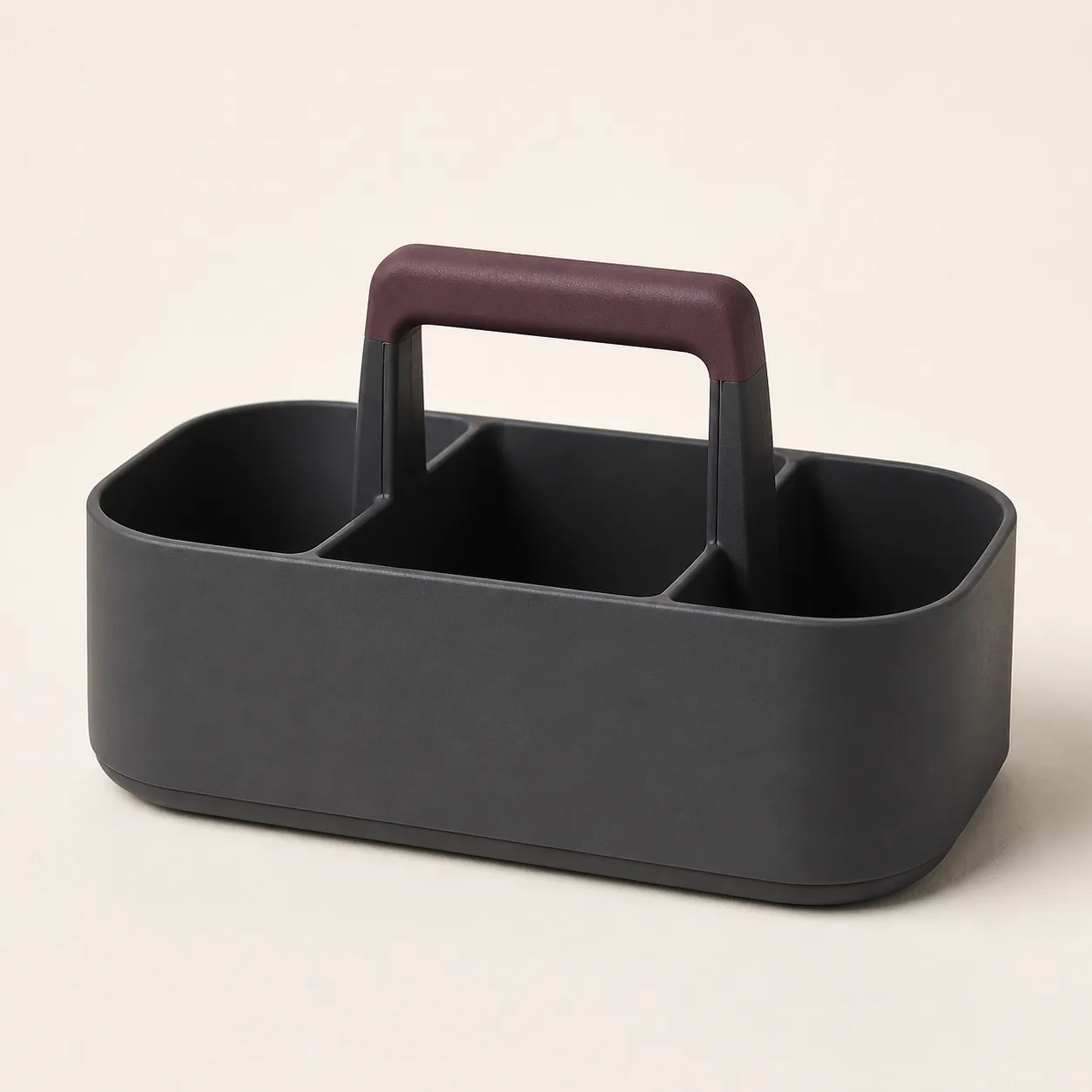
Three-Compartment Handled Care-Supply Caddy
A compact handled caddy concept with three open compartments for organizing approved routine care supplies during short controlled moves.
14,99 $
200 in stock
Three open zones can make a mobile care kit easier to audit
The handled care supply caddy concept divides a small set of approved routine supplies into three visible compartments. A central handle supports short controlled moves between closed storage and the prepared care station.

The caddy organizes containers; it is not a child-resistant cabinet or a liquid-containment tray.
Build the load list before filling a compartment
Choose only the items needed for the planned routine and read every label first. Closed compatible bottles, unused cloths and clean lightweight tools may each need a different bay after fit and material testing.
Do not use spare space as a reason to add unknown chemicals or unrelated personal items.
Keep incompatible substances in their approved storage
Never place leaking chemicals, batteries, aerosols, flammables, oxidizers, medicines, sharps or hot items in this open tote. Separate substances exactly as their labels and local rules require.
A divider wall does not provide chemical segregation or secondary containment.
Inspect the empty body and handle attachments
Check the rim, corners, divider junctions, base and handle for cracks, sharp molding flash, distortion, stains or unusual odor. Lift the empty caddy a few centimeters over a clear bench to confirm that the handle stays aligned.
Reject a unit that rocks, flexes unexpectedly or exposes a finger pinch point.
Confirm each container fits below a safe carry height
Measure the compartment footprint and the clearance beneath the handle. A bottle should remain upright without pressing against the handle, leaning over the rim or hiding its cap and label.
No universal compatibility is claimed for cleaner bottles, jars, brushes or chargers.
Assign one purpose to every compartment
A simple plan might separate closed care liquids, clean dry cloths and non-powered tools, provided all combinations are label-compatible. Keep used cloths, waste and unclean product parts outside the clean-supply caddy.
Review the layout whenever the supply list changes.
Load the heaviest approved item near the center
Place stable containers on the compartment floor rather than balancing them on dividers. Distribute mass across the base and keep tall items away from the outer corners.
Stop well below the pending total and handle load limits.
Close every cap before lifting the handle
Confirm each closure, wipe the exterior by its approved method and check that nothing can fall through the open top. Grip the center of the handle with a dry hand and lift smoothly.
Do not swing the caddy, carry it one-handed on stairs or hang it from a hook.
Clear the route before moving supplies
Open doors, remove cables and choose a level destination before lifting. Keep the caddy below chest height so the path and contents remain visible.
Set it down immediately if a bottle shifts, the handle bends or liquid appears.
Place it on a stable surface outside the wet zone
The base needs full contact with a level cleanable shelf or table. Keep the tote beyond sinks, floor edges, moving lids, direct sun and powered equipment.
Do not position an open caddy where children, pets or visitors can access its contents.
Remove one item without pulling on its neighbors
Grip the selected container at its body and lift vertically while watching the adjacent bay. Do not use a cap, nozzle, cable or brush head as a lifting point.
Set the item on the prepared work surface rather than across a divider.
Respond to a leak by unloading the whole caddy
Stop, isolate the area and follow the leaking substance’s label. Wear the specified protection and move unaffected items only when the procedure allows it.
The caddy has no confirmed leakproof or chemical-resistant performance, so do not use it as a spill basin.
Clean from the dividers toward the outer walls
Empty every compartment and use only a cleaner confirmed for the final body and pigment. Pay attention to divider junctions, handle roots and the base rim where residue can collect.
Do not immerse, steam or pour disinfectant into the tote unless that method is approved.
Dry and audit the caddy before restocking
Place the empty caddy upside down only on a clean protected surface if the final instructions permit it. Confirm that each corner and handle attachment is dry, then inspect the supply list and expiry information before refilling.
Store the prepared caddy inside closed adult-controlled storage, not on display.
The supplier reference requires care-supply qualification
An Alibaba divided portable cleaning-caddy listing from Taizhou Kexing Mould Plastic shows USD 1.79-1.96 per piece with MOQ 40 pieces. Dimensions, materials, handle strength, compartment fit, total load and cleaner compatibility require written confirmation and testing.
The procurement reference supports sample inquiry only. The EUR 14.99 plan allows for China-origin freight, handle and stability checks, fit trials, protective packing and discreet fulfillment; packed size, mass, freight, duty, tax, insurance, payment fees and destination terms remain pending.
Frequently asked questions
Can leaking bottles be carried inside?
No. Isolate a leak according to its label; no secondary-containment performance is claimed.
Does the caddy lock?
No lock or child-resistant function is stated. Keep it inside closed adult-controlled storage.
May used cloths share a compartment?
No. Maintain a separate used-cloth route to protect clean supplies.
How much weight can the handle carry?
The safe total and handle load remain pending sample tests.
Can bottles taller than the handle be packed?
Only after a stable fit is verified; items must not lean, obscure labels or press against the grip.
When should the caddy be removed from service?
Stop after a crack, sharp rim, loose handle, unstable base, chemical damage, persistent odor or residue that cannot be cleaned safely.


Reviews
There are no reviews yet.