


Wingpow BC11-24 White Bendable 25-Combination Wand
August 14, 2026
Twin-Cuff Three-Stop Over-Center Lever Restraint
August 14, 2026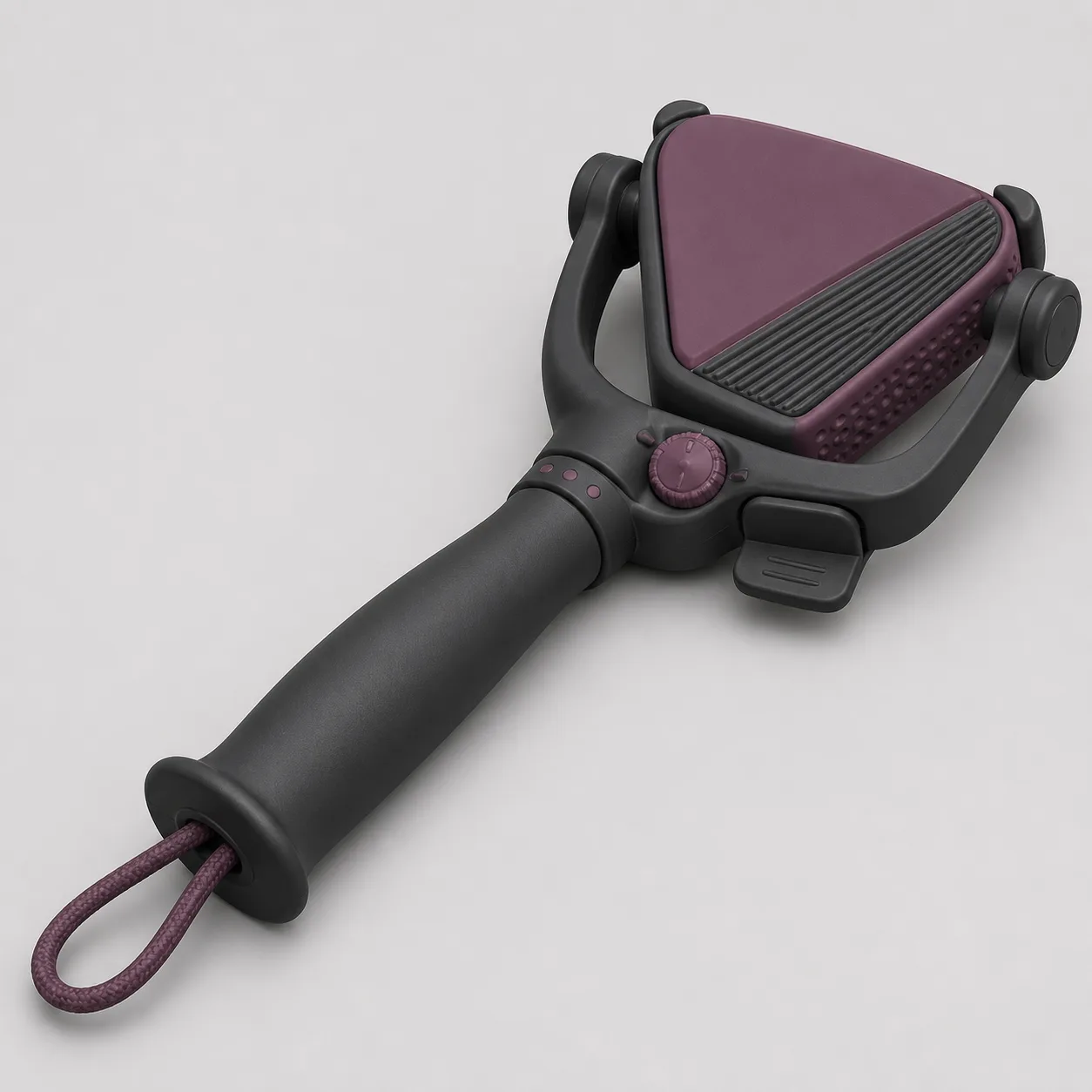
Three-Face Indexed Sensory Paddle with Guarded Flip Yoke
A guarded non-powered sensory paddle concept with one rotating triangular-prism head, three distinct face geometries and a separate indexed release.
42,99 $
200 in stock
Index one paddle head across three sensory faces
This three-face indexed sensory paddle concept captures one rounded triangular-prism head inside a broad protective yoke. A smooth plum face, shallow ribbed charcoal face and low dimpled plum face offer visibly different geometries, while a three-stop dial and separate release tab are intended to control face selection.

The image does not prove materials, softness, pivot strength, index retention, torque limiting, impact level, cleaning compatibility, dimensions or production availability.
Inventory the head yoke handle and lock parts
Request an exploded bill of materials for the three face skins, prism core, edge bands, transverse axle, bushings, guarded caps, yoke arms, hard stops, index wheel, detent parts, release tab, springs, torque collar, handle core, grip skin, flared guard, wrist-loop eye, cord, fasteners, pigments, lubricants and adhesives.
Preserve component identity and drawing revision through incoming inspection, assembly trials and matched-sample testing.
Measure external geometry and edge protection
Record overall length, handle diameter, guard diameter, yoke span, arm thickness, axle position, head width, face dimensions, corner radii, edge-band projection, mass and balance point. Measure face planes at every locked position.
Inspect all accessible edges for burrs, hard inclusions, molding flash, exposed fasteners and local thin regions.
Characterize the smooth face
Measure flatness, crown, edge blend, hardness, compression, recovery, friction and surface texture at a fixed temperature. Map thickness across the center, corners and border rather than relying on one nominal value.
Check the smooth face after bounded flex, cleaning and dry storage for gloss change, tack, pigment transfer, swelling or separation.
Characterize the ribbed face
Record rib count, pitch, height, width, end radius and alignment to the axle. Use replica or optical measurements to detect sharp ridge peaks, collapsed channels or inconsistent spacing.
Repeat compression and drag tests across and along the ribs because direction can change both sensation and cleaning difficulty.
Characterize the dimpled face
Map dimple count, diameter, depth, spacing, rim radius and local wall thickness. Probe valleys for trapped residue, voids and hard core contact under bounded compression.
Compare rebound and surface change before and after the supplier-specified cleaning sequence; material and cleaner compatibility remain pending.
Align the pivot axle and protective yoke
Measure axle runout, arm parallelism, bushing clearance, cap retention, head centering and free rotation before engagement. Load both ends of the head within a conservative fixture envelope and watch for arm spread or cap migration.
Reject exposed axle ends, rubbing edges, progressive looseness or a head that can leave the yoke without the deliberate service procedure.
Calibrate the three-position index dial
Measure rotation angle, detent torque, audible and tactile cues, hard-stop position and locked-face error for all three selections approached from both directions. Mark each sample so drift can be tracked through cycling.
Only a fully seated state should align a complete face; half-seated positions must not masquerade as secure engagement.
Verify the release tab and false-seat behavior
Record release force, travel, direction, reset time and access with dry and damp gloves. Challenge the mechanism with light asymmetric fixture force while keeping hands and probes outside the head path.
Document whether the tab can be pressed accidentally by the gripping hand and whether a blocked tab leaves an obvious non-ready state.
Screen guard gaps hair and film pinch points
Use articulated probes, soft film and representative fibers around both yoke arms, axle caps, index wheel, release tab, hard stops, collar and handle junction during rotation, locking and release.
Any persistent capture, shearing path or closing gap requires redesign or a validated guard; appearance alone is not evidence of pinch protection.
Evaluate the torque-limit collar
Measure collar position, rotational breakaway, reset behavior, hysteresis and witness-mark movement under controlled handle torque. Determine whether it slips, clicks or merely indicates load before assigning a function.
No protective torque threshold is confirmed until calibrated samples show repeatable behavior across temperature, cleaning and cycle age.
Measure static flex and fixture force
Clamp only at supplier-approved zones and record handle deflection, yoke spread, head displacement, index movement and residual set under gradually increasing bounded loads. Test face-center, edge and off-axis directions separately.
Stop before damage; do not translate fixture force into a claim about suitable use intensity.
Map dynamic impulse rebound and sound
Use an instrumented compliant target to compare peak force, impulse, contact duration, rebound, head rotation and A-weighted sound for each face at controlled swing speed. Keep the rig enclosed and separate from people.
Define conservative operating guidance only after repeatable data; exact impact force and safe-use limits remain pending.
Challenge faults then cycle clean and inspect materials
Simulate false indexing, worn detents, obstructed release, loose caps, damp grip and partial collar movement in protected fixtures. Quarantine samples with unexpected head rotation, cracked parts, delayed release or exposed hard components.
Cycle all three faces, release, collar, bounded flex, specified cleaning, drying and storage. Recheck geometry, hardness, play, detent torque, gaps, surface condition, cord eye and odor. Composition, restricted-substance testing and certification remain pending.
Build landed price after three-face proof
An Alibaba BDSM paddle page currently shows a PU-leather crop or paddle category example at USD 0.87-1.33 with MOQ one. It is a benchmark only and does not confirm this indexed prism head, guarded pivot, torque collar or an approved supplier.
The procurement reference supports an EUR 42.99 planning price after allowing for China-origin freight, exact-sample sourcing, three-face metrology, pivot and detent calibration, pinch screening, fixture, impulse, rebound, sound, fault, cleaning and cycle work, protective packing and discreet fulfillment. Exact quotation, MOQ, materials, packed size, weight, freight, duty, tax, insurance, payment fees, certifications and delivery terms remain pending.
Frequently asked questions
Does the head really provide three distinct faces?
The concept shows smooth, ribbed and dimpled faces, but production geometry and material differences require sample measurement.
Can the face change during use?
That depends on verified detent torque, hard-stop alignment, release design and wear; no retention claim is confirmed.
Does the collar guarantee a safe force?
No. Its actual function and calibrated threshold are pending, and it must not replace consent, communication or conservative technique.
Where should impact be avoided?
Avoid the head, neck, spine, kidneys, joints and other vulnerable areas; stop for sharp pain, numbness, dizziness, breathing difficulty or unusual marks.
How should the textured faces be cleaned?
Follow the confirmed material-specific method after supplier evidence; inspect rib channels and dimple valleys and dry completely before storage.
Which defects require retirement?
Cracks, exposed hard parts, loose axle caps, growing yoke play, unreliable indexing, delayed release, torn faces, persistent residue, cord-eye damage or unexplained material change.
Reviews
There are no reviews yet.