



Plus-Size Floral Lace Front-Zip Halter Teddy – Black or Purple
August 14, 2026
Four-Point Padded Cross Connector Set
August 14, 2026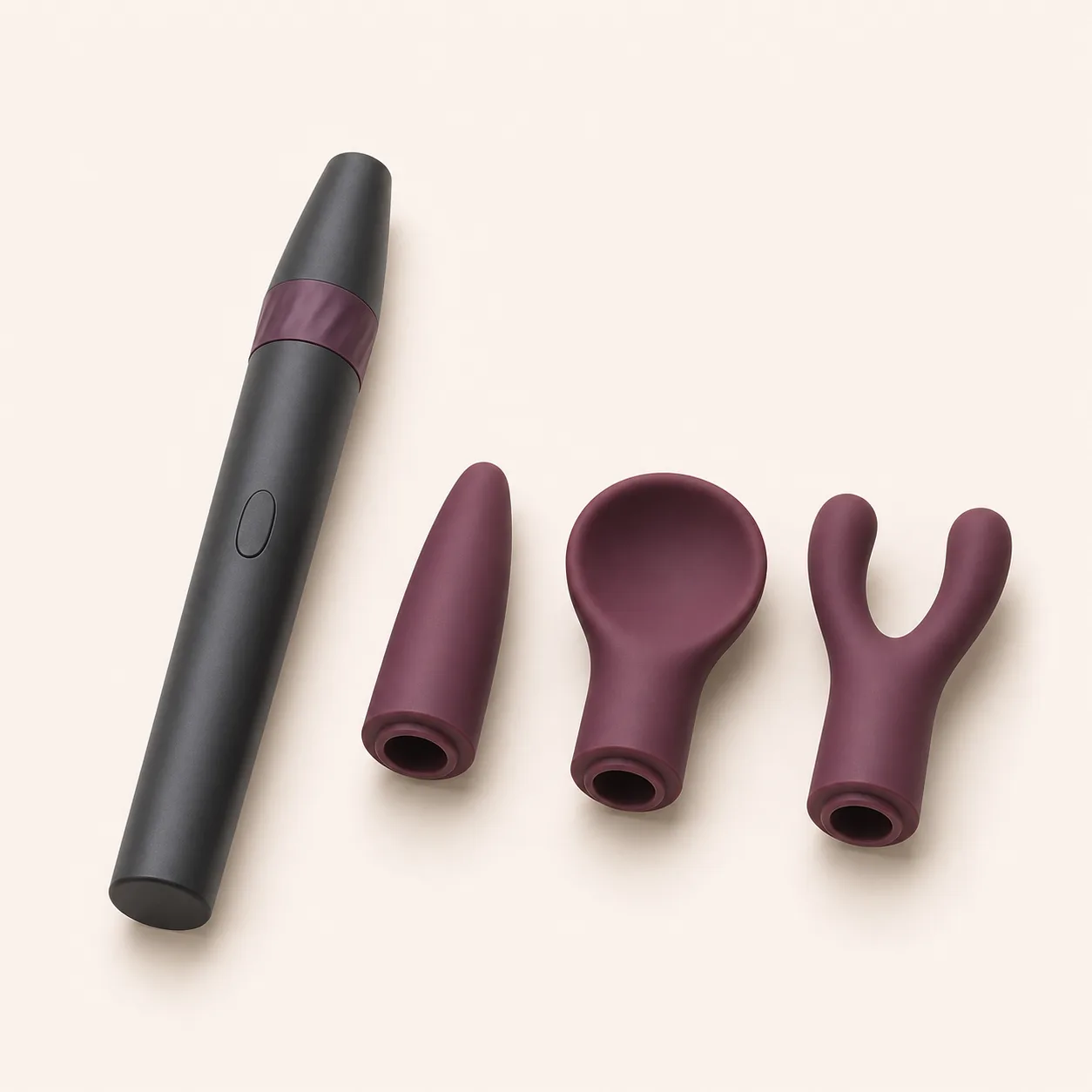
Three-Head Twist-Lock Precision Wand with Cone, Spoon and Fork Attachments
A slim rechargeable precision-wand concept with one charcoal twist-lock handle and exactly three smoky-plum external contact heads: rounded cone, broad shallow spoon and short forked twin-prong.
44,99 $
200 in stock
Switch one precision wand among three distinct contact heads
This three-head twist-lock precision wand with cone, spoon and fork attachments concept contains one slim charcoal rechargeable handle and exactly three detached smoky-plum heads. A rounded cone narrows contact, a shallow spoon broadens it and a short fork presents two rounded prongs.

The image establishes proposed count and exterior form only. It does not confirm dimensions, internal-use suitability, lock mechanics, materials, vibration output, charging, ingress protection or sale-ready production.
Audit exactly four pieces before sealing
Count one powered handle, one cone head, one spoon head and one forked twin-prong head. Cable, charger, storage case, stand, spare collar and any fourth attachment are excluded from the visible planned pack.
Match colour and connector revision, then reject a cracked shell, torn head, warped socket, sharp flash, sticky surface, loose collar, unreliable button, uneven finish or foreign matter.
Measure the handle and twist-lock collar
Record overall handle length, maximum diameter, grip diameter, base geometry, mass, button position, collar width, collar travel and attachment-interface depth. Map balance with every approved head installed.
Slim, pen-like, lightweight and travel-ready descriptions remain pending finished measurements, lockout evidence and transport guidance.
Characterize the rounded cone attachment
Measure cone length, base diameter, tip radius, taper angle, wall thickness, socket depth and mass. Confirm that the rounded tip stays free of mould seams, hard inclusions and exposed rigid support.
The cone changes contact area but does not establish insertable geometry. This page limits all three heads to external contact until model-matched dimensions, boundaries and instructions are approved.
Map the shallow spoon attachment
Record spoon length, bowl width, depth, edge radius, neck thickness, socket alignment and flex under bounded load. Compare the concave and convex faces for surface finish and local vibration response.
Broad contact and pressure distribution depend on material hardness, applied load and motor output; no comfort or performance outcome is guaranteed.
Inspect both prongs on the forked attachment
Measure prong length, diameter, centre spacing, opening depth, tip radii, symmetry and flex. Check the valley between prongs for cleaning access, flash, tearing and excessive stress concentration.
The fork is a short external contact head, not an anal retrieval base, restraint point, piercing tool or clamp.
Validate twist-lock engagement for every head
Document insertion depth, alignment mark, rotation angle, stop position, assembly torque, release torque, axial pull strength, side-load resistance and wear after repeated swaps. Each head must seat without a hidden gap that collects residue.
Reject partial engagement, free rotation, collar lift, socket cracking, visible debris or any head that loosens under the approved vibration and contact loads.
Map the single-button control sequence
Confirm long-press power, short-press stepping, startup state, intensity order, pattern order, memory, travel lock, low-battery signal and complete stop. The one-button appearance does not prove any mode count.
Measure accidental activation force and ensure the control remains reachable without gripping near the installed head.
Measure output with all three attachment loads
Record frequency, acceleration, displacement and sound at the bare coupling and at defined points on cone, spoon and fork heads. Repeat across battery state and bounded contact loads.
A narrow head may transmit output differently from a broad or split head. Powerful, deep, quiet, pinpoint and evenly distributed claims remain pending calibrated results.
Validate the battery charging path and protections
Require cell chemistry, nominal capacity, charge input, cable and adapter specification, charge time, runtime method, cycle life, overcharge protection, low-voltage cutoff and transport documents.
The image does not show a port or charging accessory. Rechargeable, fast-charge, long-runtime and standby claims remain pending production electronics and the final bill of materials.
Require materials hardness and bond records
Obtain exact compositions, supplier grades, pigments, additives, hardness values and bonding methods for the handle shell, collar, connector, button and all three heads. Test finished coloured components after ageing and validated cleaning.
Silicone, ABS, body-safe, hypoallergenic, phthalate-free, nonporous and skin-friendly descriptions remain pending traceable evidence.
Measure heat sound and ingress at the connector
Log temperature at the motor, collar, coupling and each installed head during the longest approved program. Record sound at a stated distance and background level with every attachment.
Waterproof, washable, submersible and whisper-quiet language is excluded until the assembled handle-head combinations pass documented ingress, thermal and acoustic protocols.
Set external-use and pressure boundaries
Install one clean, dry head while powered off, perform a pull-and-twist check and begin at the lowest verified setting. Keep the connector and collar visible and avoid prolonged concentrated pressure.
Stop for pain, numbness, irritation, pinching, unusual heat, head movement, collar slip, motor stall or loss of control. This is not a medical device and no therapeutic result is claimed.
Clean dry and store each socket separately
Power off, detach the head only by the approved release method and clean each component within its verified material and ingress limits. Pay particular attention to the spoon bowl, fork valley, connector shoulder and all sockets.
Dry every recess fully before reassembly or charging. Store heads without compression and separate from incompatible materials, sharp items, lint, heat and direct sunlight.
Build landed price from three-attachment benchmarks
An Alibaba massager-wand-attachment category page displayed a pen-shaped precision vibrator with three interchangeable attachments at USD 4.69 to 6.23 with MOQ 3, and a cordless wand with three attachments at USD 8.21 to 8.65 with MOQ 1. These are broad procurement references, not this twist-lock configuration or an approved supplier quote.
The public attachment-wand benchmark supports an EUR 44.99 planning price after provisional allowance for China-origin freight, four-piece inventory control, three unique moulds, connector-cycle and retention testing, motor, battery, ingress, material and cleaning validation, discreet fulfilment and expected quality loss. Exact supplier, quote, MOQ, dimensions, materials, hardness, lock geometry, modes, battery, charging accessories, packed weight, freight, duty, tax, certification, payment terms and lead time remain pending.
Frequently asked questions
What is included?
Exactly one powered wand handle plus one cone, one spoon and one forked twin-prong attachment.
Can the heads be changed while the wand is running?
No. Switch off, clean and dry the connector, then follow the validated twist-lock assembly sequence.
Are the attachments approved for internal use?
No internal-use claim is made until exact geometry, boundaries, materials and instructions are verified.
How many vibration modes are available?
Mode count, intensity steps, memory and travel-lock behaviour remain pending production-sample testing.
Can the wand be rinsed without a head installed?
Only if the open connector passes its declared ingress protocol and the final care instructions explicitly allow it.
When should an attachment be discontinued?
Discontinue a torn, sticky, swollen, permanently bent, rough, loose or incompletely locking head.
Reviews
There are no reviews yet.