


Combination-Lock Underbed Organizer with Dividers
August 14, 2026
Offset Orbit-Track Wand Massager with Captive Floating Pod
August 14, 2026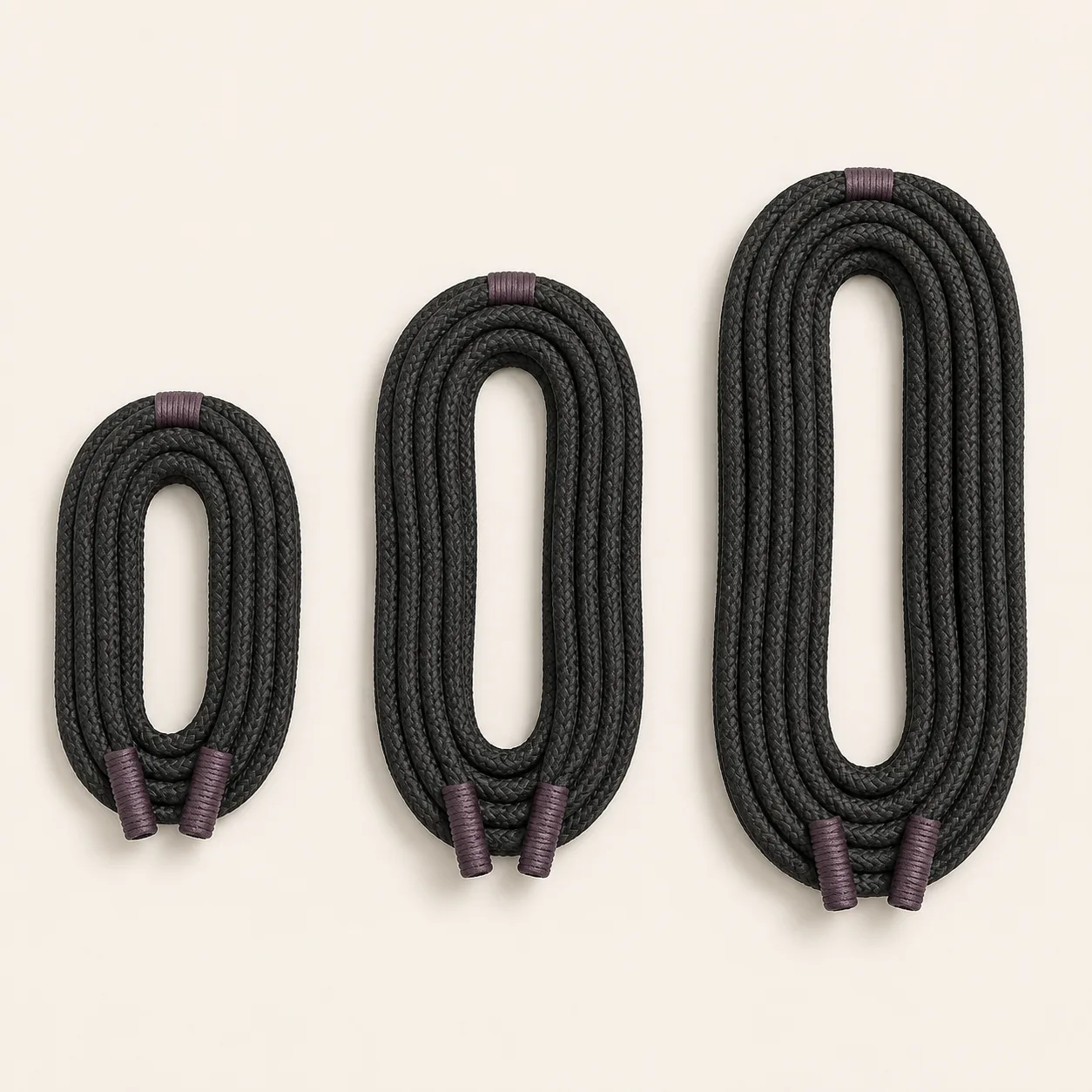
Three-Length Center-Marked Bondage Rope Set
A three-coil bondage rope concept with short, medium and long relative lengths, six finished ends and one contrasting centre marker per rope.
34,99 $
200 in stock
Use three distinct coils as a planning system
This three-length center-marked bondage rope set concept presents one visually short, one medium and one long charcoal braided rope. Every coil has two smoky-plum whipped ends and one contrasting centre marker intended to make midpoint finding faster during a pre-agreed floor-level restraint plan.

The image shows relative length only. It does not confirm actual metres, fibre content, diameter, tensile strength, skin friction, stretch, load rating or suitability for suspension.
Assign short, medium and long identifiers
Label ropes R-S, R-M and R-L on packaging or removable storage bands, not on uncertain body-contact zones. Record measured length, diameter, mass, colour and inspection status for each identifier.
Never rely on coil size after storage, because winding method can make equal lengths look different.
Measure each rope under the same low tension
Lay the rope straight without stretching and record end-to-end length, working diameter and mass. Repeat at multiple points to detect diameter variation, braid compression or hidden joins.
Exact lengths and tolerances remain pending approved samples; the words short, medium and long describe set order only.
Inspect braid construction strand by strand
Document braid pattern, strand count, core construction, splice method, surface fuzz, pick count and firmness. Flex representative sections while checking for glazing, broken fibres, hard inclusions and uneven compression.
No cotton, jute, hemp, nylon, silk, bamboo or sustainability claim is accepted without traceable composition evidence.
Verify six whipped ends
Inspect both ends of R-S, R-M and R-L for wrap length, thread security, adhesive, sharp melt points, stiffness and unraveling. Apply bounded hand pulls and repeated coiling cycles before accepting the finish.
End wraps should prevent fraying without creating a hard striking or pressure-concentrating section.
Calibrate the three centre markers
Confirm one marker per rope sits at the measured midpoint within tolerance. Check visibility in normal and low light, marker grip on the braid, dye transfer, seam bulk and movement after cleaning.
A centre mark speeds setup but does not replace counting wraps, monitoring pressure or maintaining an immediate release plan.
Map friction and stretch before body use
Measure dry and damp surface friction against approved test substrates, then record elongation and recovery under modest bounded loads. Repeat after the proposed cleaning cycle and storage period.
Low stretch, soft touch, non-slip and skin-friendly language requires numerical evidence and a defined method.
Plan consent, positions and stop signals first
All adults should agree on permitted areas, excluded areas, intensity, duration, verbal and nonverbal stop signals and who can release every line. Keep a suitable emergency cutting tool immediately accessible even though none is included in the set.
Do not use rope on the neck, airway or across a position that prevents breathing, communication or self-reporting.
Exclude suspension and load-bearing use
This concept is limited to conservative floor-level positioning. Supplier tensile data, knots and braid appearance do not qualify the ropes for suspension, partial suspension, lifting, body-weight support or fall arrest.
Keep every setup stable if a person shifts, relaxes or asks for immediate release.
Protect circulation and nerves
Use broad, flat, non-crossing wraps away from joints and vulnerable nerve paths. Monitor colour, warmth, sensation, swelling, capillary response and the ability to communicate throughout the scene.
Release immediately at numbness, tingling, coldness, unusual colour, increasing pain, weakness, panic or breathing change.
Keep knots visible and releasable
Select only knots the responsible adult can identify, inspect and undo under reduced dexterity. Position them away from pressure points and prevent hidden tightening under movement.
Never place a jam-prone knot where a cutting tool cannot reach safely without contacting skin.
Review the setup continuously
Do not leave a restrained person unattended or asleep. Recheck every wrap after position changes and at short agreed intervals, with more frequent checks when sensation or mobility is reduced.
Alcohol, sedatives, illness, injury, impaired communication and uncertain technique are reasons to postpone restraint.
Clean without changing braid behaviour
Follow verified limits for cleaner, water temperature, agitation, rinse and drying. Test dye transfer and shrinkage while ensuring the end whips and centre markers do not loosen, harden or trap residue.
Machine washing, bleach, boiling, high heat and disinfectant claims remain unavailable until the exact fibre and finishes are known.
Dry loose and inspect before recoiling
Dry each rope through its full thickness without tight bends or heat. Run the entire length through clean hands, checking braid, core, markers and six ends before forming separate storage coils.
Withdraw any rope with cuts, glazing, hard spots, severe fuzz, contamination, dye transfer, loose markers or unstable end wraps.
Build landed price from a rope benchmark
An Alibaba bondage-rope category page displayed one 5 m or 10 m rope example at USD 0.68 to 1.05 with MOQ 30. It is a broad category reference only and does not identify this three-length centre-marked set or an approved supplier.
The public procurement benchmark supports an EUR 34.99 planning price after provisional allowance for China-origin freight, three-rope measurement, fibre and braid review, friction and stretch checks, six-end and three-marker inspection, dye, wash, drying and separated-packaging tests, discreet fulfilment and expected textile handling loss. Exact supplier, quote, MOQ, lengths, materials, packed weight, freight, duty, tax, certification, payment terms and lead time remain pending.
Frequently asked questions
How many ropes are included?
The concept contains exactly three separate coils in short, medium and long relative orders.
What do the plum centre markers indicate?
Each proposes a quick midpoint reference, subject to measurement and marker-durability testing.
Can these ropes be used for suspension?
No. This concept is limited to conservative floor-level positioning and is not load-rated for suspension.
What fibre is used?
Exact fibre, core, braid and finishes remain pending traceable supplier documents and approved samples.
Are emergency shears included?
No cutting tool appears in the set, but an appropriate emergency release tool must remain immediately accessible.
How should the ropes be washed?
Final cleaning and drying instructions depend on verified fibre, dye, end-whip and centre-marker tests.
Reviews
There are no reviews yet.