


Twin-Cam Padded Thigh Cuff Pair with Three-Slot Floating Bridge
August 14, 2026
Polarity-Keyed Docking Pair Vibrators with Shared Sync Bridge
August 14, 2026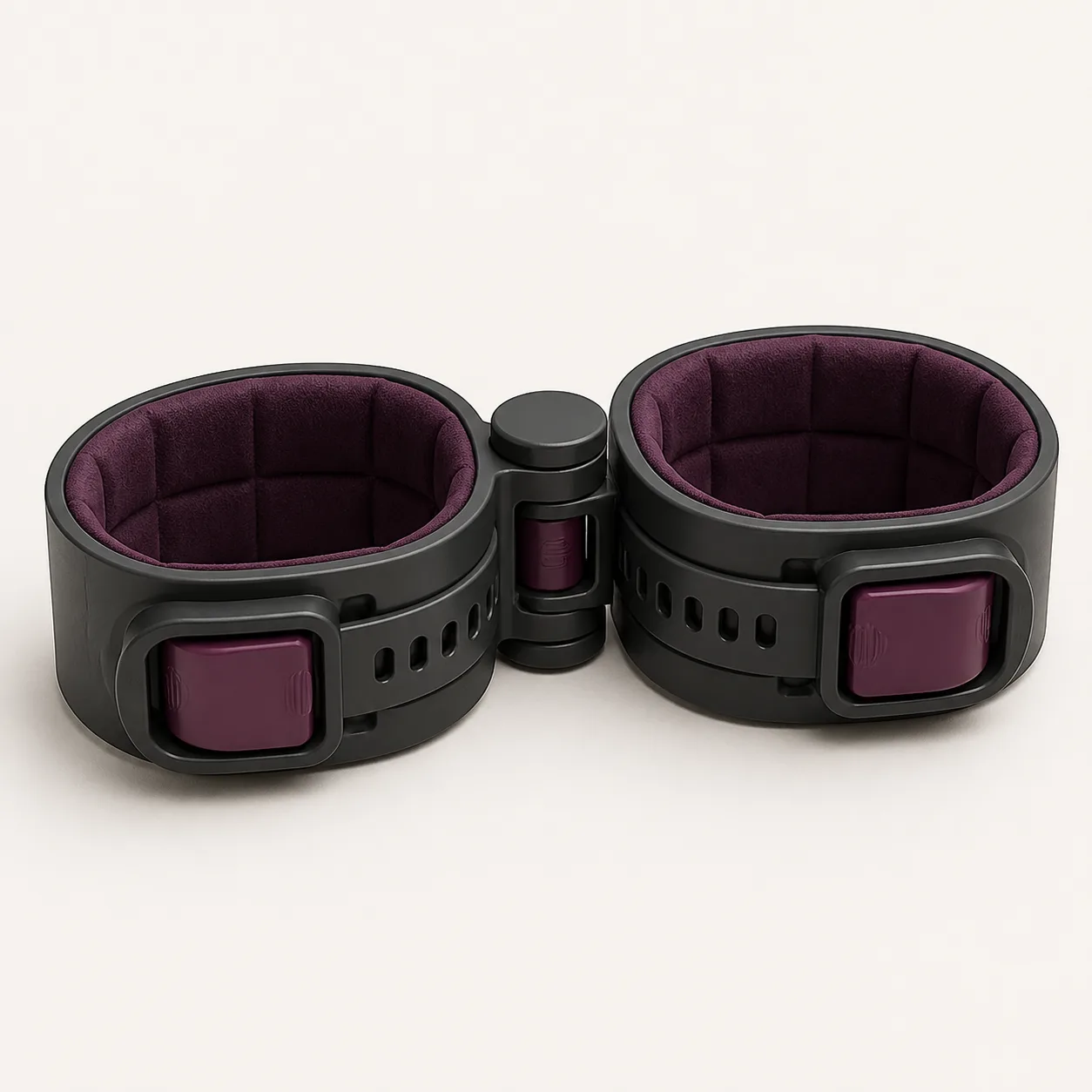
Twin-Hinge Figure-Eight Padded Wrist Restraint with Guarded Releases
A compact side-by-side wrist restraint concept with two padded adjustable cuffs, a double-axis center hinge and independent guarded quick-release paddles.
39,99 $
200 in stock
Keep both cuffs side by side without a loose chain
This twin hinge padded wrist restraint concept joins two broad oval cuffs through one compact double-axis center link. Each cuff combines a size ladder, deep inner padding and a guarded release paddle, while a small center window is proposed for visible load-state feedback.

The image does not verify cuff range, load rating, hinge freedom, release force, status-window meaning, materials, durability or production availability.
Trace every restraint and release component
Request an exploded drawing and parts list for both shells, inner pads, edge bindings, ladder straps, rounded slots, pawls, springs, release paddles, guards, hinge discs, axles, bushings, center link, status element, fasteners, pigments, coatings, thread, adhesives and lubricants.
Left and right components need revision identifiers because a mixed pawl or spring can change fit and emergency opening behavior.
Calibrate both adjustment ladders
Measure closed internal circumference, width and ovality at every usable slot on each cuff. Record strap insertion depth, pawl engagement, slot-edge radius, one-step spacing and resistance to accidental over-tightening.
Verify the final slot does not pull the strap beyond its supported guide or create an unsupported sharp tail.
Map pressure beneath the padding
Use compliant wrist-form fixtures in several sizes to record circumferential pressure, peak pressure at edges, pad compression and load transfer near the hinge. Test neutral and rotated hinge positions.
Reject hard spots, folded padding, shell-edge contact or a pressure peak that grows sharply after only one ladder step.
Measure the twin-hinge envelope
Record flexion, extension, yaw, roll, lateral play, hard-stop angle and required torque for both pivots. Map how the cuff openings move relative to each other throughout the permitted envelope.
Look for a position where hinge discs, guards, shell edges or strap tails form a pinch gap or concentrate leverage.
Define the status window with evidence
Identify the sensing or mechanical element behind the center window and document what each visible state actually means. Correlate indication with measured center-link load and hinge angle.
A color change is not a calibrated safety limit until threshold, tolerance, hysteresis, temperature effects and cycle drift are established.
Prove both guarded releases independently
Measure access, travel, actuation force, debounce or latch movement, complete opening time and re-latch behavior for each paddle with bare and gloved hands. Test from every hinge angle.
The raised guards should resist incidental contact without blocking a deliberate one-handed release. Neither side may depend on a key or powered control.
Run controlled pull and torsion tests
Apply gradual loads through instrumented fixtures in axial, lateral, opposing and twisting directions. Record shell deformation, ladder slip, hinge torque, center-link load, status indication and release force.
Set conservative working limits from the weakest verified mode and stop before destructive testing unless a dedicated sacrificial sample is used.
Write a fit and monitoring protocol
Define an initial loose setting, maximum permitted compression, check interval, skin and circulation observation, position-change rule, communication signal and immediate-release plan. Never leave a restrained person unattended.
Fit guidance must account for padding compression and swelling over time rather than relying on the first ladder position alone.
Inspect every edge and pinch zone
Use feeler gauges, magnification and articulated fixtures to inspect cuff rims, slot edges, strap tails, release guards, hinge discs, axle ends and the center-link gap. Repeat under bend and torsion.
Retire any sample that exposes a burr, cracked edge, protruding fastener, widening joint or gap capable of trapping skin.
Validate sweat and cleaner compatibility
Obtain exact composition and restricted-substance evidence for surfaces, padding, coatings, pigments, thread, adhesive and lubricant. Condition separate samples with synthetic sweat and only documented compatible cleaners.
Measure color transfer, swelling, stiffness, tack, odor, pad compression, ladder friction, bond strength and release behavior after exposure.
Cycle adjustment, hinge and release together
Run repeated open, fit-fixture, ladder tighten, hinge articulate, staged load, status observation, rapid release, cleaning, drying and storage cycles. At checkpoints repeat geometry, pressure, slip, hinge play, window threshold and release timing.
Retire the sample after ladder wear, pawl skip, slow opening, torn padding, delamination, hinge drift, axle movement, false indication, corrosion or permanent shell distortion.
Clean deep padding and moving joints carefully
Follow the verified method for the exact materials. Inspect inner-pad seams, cuff rims, ladder slots, pawl cavities, paddle guards, hinge discs and status-window edges without flooding hidden joints.
Measure drying by mass and articulate the hinge only after surfaces are dry. Stored moisture can change padding, corrode hardware or raise release friction.
Protect hinge alignment during shipping
Use a transit insert that supports both open cuffs without preloading the hinge, compressing the padding or pressing either release paddle. Abrasion barriers must not shed fibers into ladders or joints.
Confirm packed size and weight through a production pack-out before calculating China-origin freight, duty, tax, insurance, inspection, payment fees or delivery terms.
Price after emergency opening is demonstrated
An Alibaba padded-handcuff listing currently shows an adjustable locking category example at USD 13.35-14.85 with MOQ one. It is a category benchmark only and does not confirm this twin-hinge figure-eight structure, guarded releases or status window.
The procurement reference supports an EUR 39.99 planning price after allowing for exact-model sourcing, teardown, dual-ladder calibration, pressure mapping, hinge-envelope analysis, status correlation, independent quick-release tests, controlled loading, edge inspection, cycle life, material evidence, cleaning validation, protective packing and discreet fulfillment. Exact quotation and all unverified costs remain pending.
Frequently asked questions
Does the center window show a certified load?
No. Its meaning, threshold, tolerance and drift require instrumented correlation on exact samples.
Can either cuff be opened alone?
Independent one-handed opening must be verified for both guarded paddles at every permitted hinge angle.
Is the hinge rigid?
The two-axis movement envelope, stops, play and torque remain pending measured confirmation.
How tight should the cuffs be?
Use only a verified fit protocol with conservative compression, frequent checks and an immediate-release plan.
Can the assembly be submerged?
No ingress claim is made; hidden pawl, hinge and status cavities require the documented cleaning method.
Which faults require retirement?
A skipped ladder, slow release, torn pad, sharp edge, loose axle, false status, cracked shell, corrosion or permanent distortion.

Reviews
There are no reviews yet.