



Paired Finger-Loop Couples Vibrator Set with Dual-Channel Remote
August 14, 2026
Honey MTY-27 Blue Compact Automatic Stroker
August 14, 2026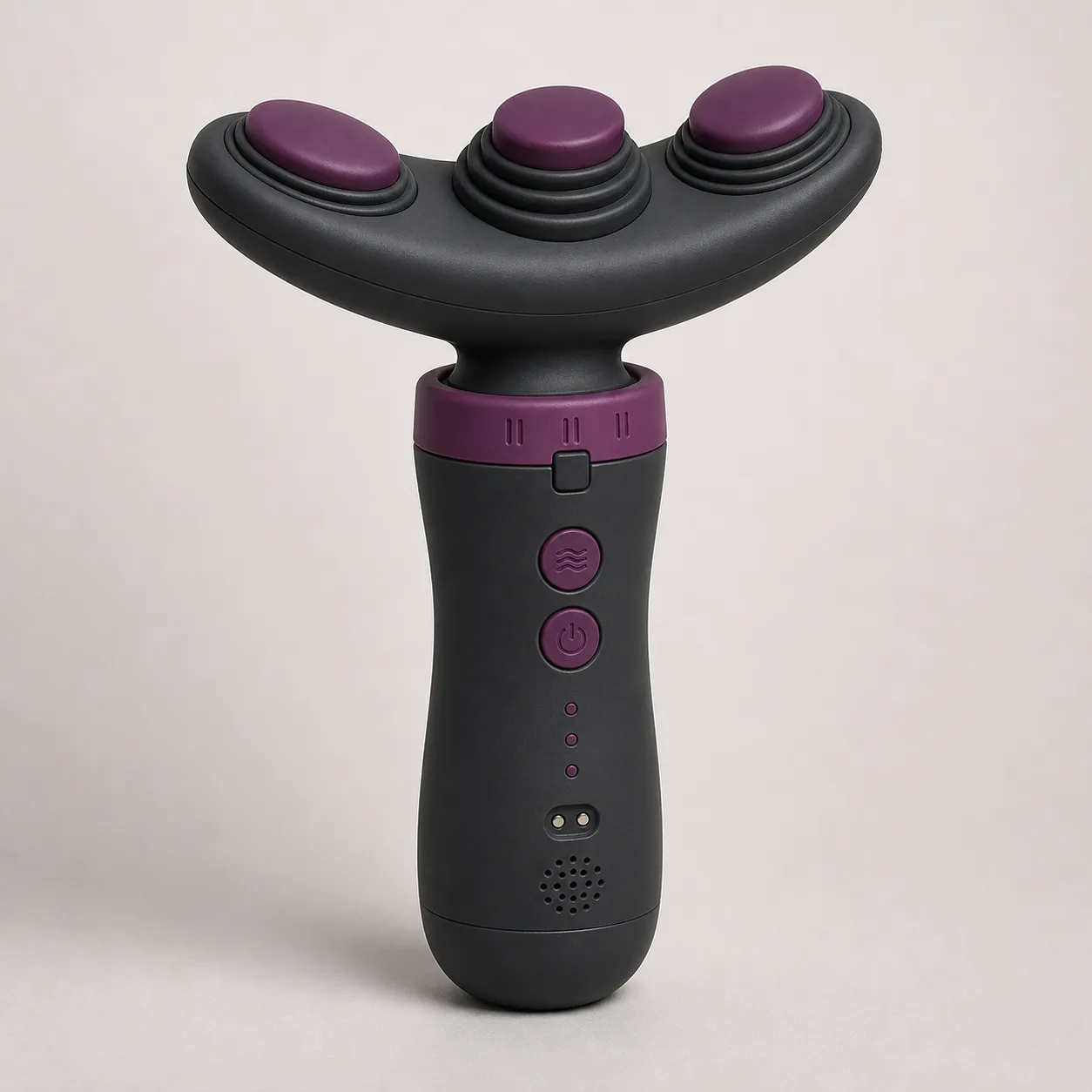
Three-Pad Differential-Stroke Tapping Wand with Timing Collar
A broad crescent-head wand concept with three individually guarded oval tapping pads and a lockable three-stop timing collar.
61,99 $
200 in stock
Deliver three offset tapping strokes across one crescent head
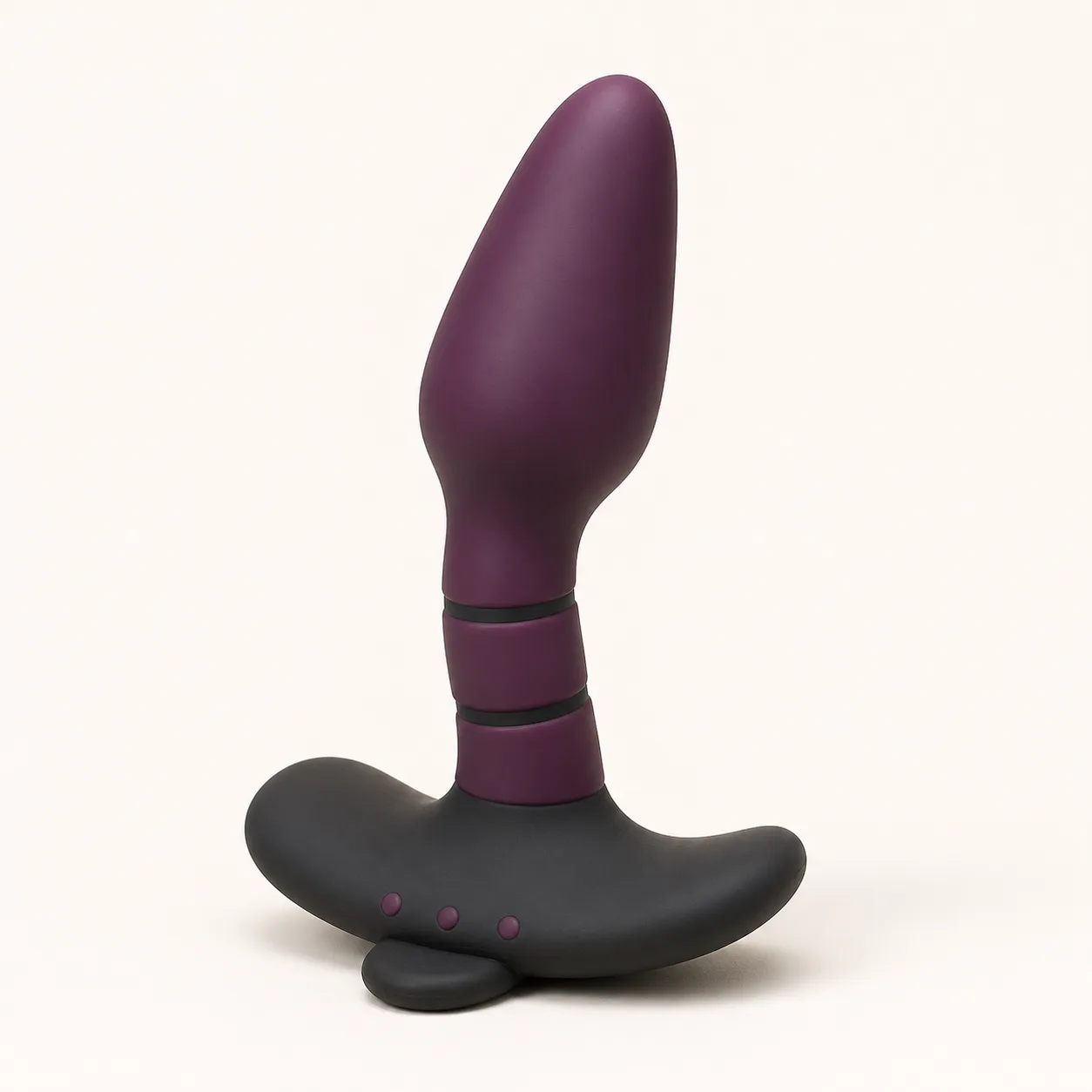
This three-pad differential-stroke tapping wand concept places exactly three raised plum oval pads across a shallow crescent head. Captive charcoal bellows surround the left, center and right pads, while a marked three-stop timing collar and a separate lock tab are intended to coordinate their stroke relationship.

The visualization does not prove independent tapping, stroke length, phase control, force, dimensions, materials, sealing, charging safety, sound level or production availability.
Inventory every pad drive and enclosure part
Request an exploded bill of materials for pad faces P1 through P3, plungers, captive bellows, retainers, guides, drive links, cams or solenoids, shallow crescent shell, short neck, handle shells, timing collar, three detents, lock tab, two buttons, indicators, control board, cell, charging contacts, vent membrane, fasteners, pigments, lubricants and adhesives.
Link each part to a drawing revision, tolerance, supplier batch and approved physical sample.
Measure the external geometry before endurance work
Record overall length, head span, crescent depth, head thickness, neck diameter, handle axes, pad center spacing, pad projection, bellows outer diameter, collar position, control reach, charging recess, mass and center of gravity.
Measure head flatness, neck alignment and pad coplanarity at ambient condition and after defined temperature and humidity exposure.
Characterize pads P1 P2 and P3 separately
For every oval face, measure major and minor axes, crown, edge blend, face hardness, compression curve, recovery, friction and surface texture. Inspect seams, flash, voids, thin regions, hard inclusions and pigment transfer under magnification.
Do not assume identical response from matching color; retain individual pad data throughout testing.
Inspect the captive bellows and moving clearances
Measure each bellows fold, wall thickness, compression limit and full-circumference clearance at rest, peak stroke, centered preload and edge preload. Use articulated gauges around pad retainers, collar, lock tab, controls, contacts and vent.
Reject a gap that admits the approved probe, exposes a hard guide, rubs through a fold or traps residue beyond the validated cleaning method.
Quantify individual stroke speed and tapping force
Track P1, P2 and P3 with high-speed displacement sensing to record stroke length, rise time, dwell, impact velocity, repetition rate, force, startup delay and coast-down. Repeat under several controlled preloads and low-cell conditions.
A differential-stroke claim needs measured separation between the three pad traces, not merely three visible faces.
Calibrate all three timing-collar stops
Measure collar angle, detent torque, hysteresis, repeatability and command mapping at every engraved mark. Approach each stop from both directions while logging the three displacement traces and relative timing.
The collar must not produce an ambiguous intermediate command, unexpected burst or uncontrolled drive transition.
Verify the timing-collar lock tab
Record tab travel, engagement depth, actuation force and resistance to accidental brushing. Apply bounded head vibration, handle torsion and collar torque while locked, then confirm that the selected stop has not shifted.
The locked state should be visible and distinguishable by touch without blocking either button.
Map phase order and beat behavior
Synchronize high-speed pad tracking with tri-axial accelerometers to identify whether strokes run together, alternate, travel across the head or create a repeating beat. Measure relative phase at startup, steady operation, mode change and shutdown.
Document timing drift across preload, temperature and battery state and define the allowed phase tolerance for each collar stop.
Map contact pressure across the crescent head
Use an instrumented compliant surface to measure contact area, peak pressure and load sharing for each pad under centered, offset and tilted preload. Compare static loading with every operating and timing selection.
Reject early contact from a bellows rim or shell edge, excessive center-pad dominance, unstable rocking or a hard point outside the intended oval faces.
Separate head rigidity from handle vibration
Measure crescent-shell deflection, neck bending, joint play and handle acceleration at several fixture positions. Compare pad displacement at no load and controlled load while monitoring vibration transmitted to both buttons, collar and charging area.
Inspect the neck for whitening, looseness, cracks, fastener migration and seal distortion after the test sequence.
Verify controls charging and predictable shutdown
Document every button action, indicator pattern, lock sequence, charging polarity, specified lead, charger limit, cell protection, low-voltage behavior and charge-time claim. Interrupt power in every mode and collar position and confirm a predictable off state.
Moisture and washability claims remain pending until the bellows, pad guides, neck joint, collar, controls, contacts and vent pass an appropriate ingress program.
Log current runtime sound and temperature
Measure operating current, runtime, accessible temperature, internal hot spots and A-weighted sound at a stated distance for every mode and representative timing stop. Repeat with one protected pad restrained, maximum approved preload and low cell voltage.
Investigate current spikes, audible gear impact, bellows chatter, pad drift, shell resonance, asymmetric heat or intermittent indicators.
Challenge a stalled pad then cycle and clean
In a protected fault specimen, restrain P1, P2 and P3 one at a time while monitoring the remaining drives, timing logic, current, temperature, force and shutdown. Stop before damage and quarantine units showing guide migration, torn bellows or uncontrolled pad motion.
Cycle operation, collar selection, locking, controlled preload, charging, defined cleaning, measured drying and storage. Recheck geometry, stroke, force, timing, clearances, pressure, neck play, controls, contacts, sound, heat and surface condition.
Build landed price after three-pad proof
An Alibaba wand-massager page currently shows a 2-in-1 rechargeable category example at USD 7.50-8.61 with MOQ five. It is a benchmark only and does not confirm this three-pad drive, bellows system, timing collar or an approved supplier.
The procurement reference supports an EUR 61.99 planning price after allowing for China-origin freight, exact-model sourcing, geometry and surface inspection, three-channel stroke and force measurement, timing calibration, gap and pressure mapping, electrical review, current, sound and heat tests, fault and cycle work, protective packing and discreet fulfillment. Exact quotation, MOQ, materials, battery, packed size, weight, freight, duty, tax, insurance, payment fees, certifications and delivery terms remain pending.
Frequently asked questions
Do the three pads tap at different depths?
The concept intends differential stroke, but P1, P2 and P3 need independent displacement and force measurements under controlled preload.
What does the timing collar change?
It is intended to select three timing relationships; actual phase order, repeatability and drift require synchronized traces.
Can the bellows create a pinch point?
Every fold, pad retainer and moving clearance needs articulated-gauge checks throughout stroke, preload, tilt and wear.
Will the handle stay relatively quiet?
Handle isolation, shell resonance and A-weighted sound require measurements at defined fixtures, modes and loads.
Is this wand waterproof?
No sealing claim is confirmed; pad guides, bellows, neck, collar, buttons, contacts and vent need test evidence.
Which faults mean the wand should be retired?
Torn bellows, loose pads, guide migration, head or neck cracks, collar drift, failed locking, exposed contacts, abnormal heat, erratic timing or persistent residue.
Reviews
There are no reviews yet.