



Bear-Muzzle Pocket Air-Pulse Massager
August 14, 2026
Transparent Dual-Paddle Glans Stimulation Cup
August 14, 2026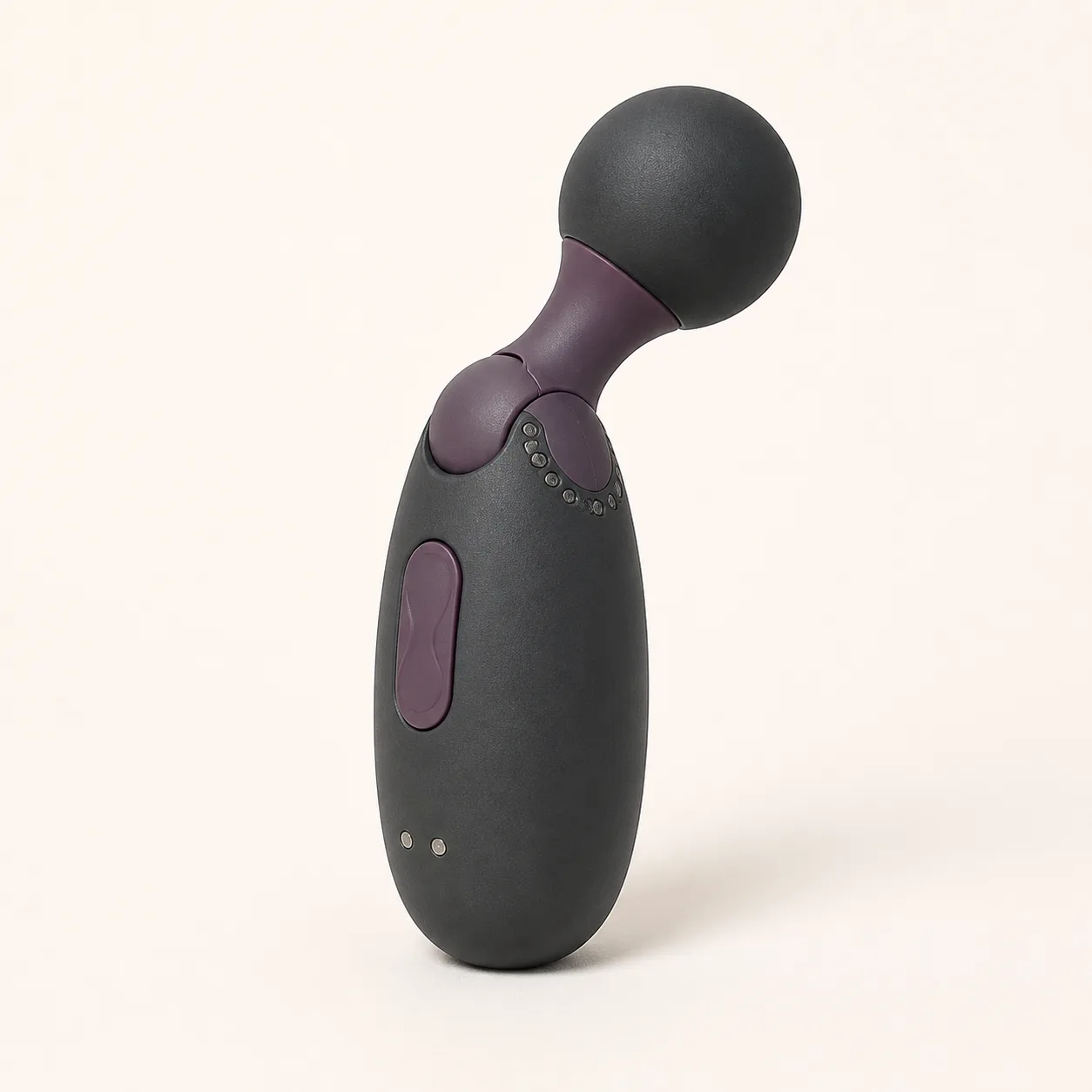
Detent-Hinge Articulating Mini Wand with Spherical Head
A compact rechargeable mini wand concept with a multi-position detent hinge, slim neck, small spherical external-contact head and palm-ready rocker control.
29,99 $
200 in stock
An articulating head changes reach without bending the neck
This articulating mini wand vibrator concept combines a short oval palm handle, mechanical detent hinge, slim angled neck and compact spherical contact head. The hinge is intended to hold several discrete working angles while the broad handle keeps power and mode control close to the thumb.

The image defines appearance only and does not verify hinge strength, electrical performance, materials, ingress or external-use limits.
Count and measure every stable hinge position
Move a sample through its complete arc without power and record each position that produces a clear tactile stop. Measure head angle relative to the handle at every detent and verify that both travel endpoints prevent hard-part collision.
Decorative marks around the pivot cannot be advertised as settings unless they align with repeatable mechanical positions.
Test holding torque under controlled load
Apply a small documented force to the spherical head at each angle and record whether the hinge stays fixed, slips gradually or releases suddenly. Repeat after extended cycling to reveal wear in the detent surfaces.
The hinge must not be used as a high-force lever, and any slipping position should be excluded from the approved range.
Inspect the pivot for pinch and debris gaps
Examine both sides of the hinge throughout its arc with gauges and raking light. Check for closing gaps that could catch skin, exposed springs, sharp edges, lubricant leakage or recesses that cannot be cleaned.
Adjust the angle only while the head is away from the body and the motor is off.
Measure the spherical head as a contact system
Record diameter, roundness, surface finish and the transition radius into the neck. A small sphere may concentrate vibration and pressure, so qualification needs a conservative contact-force envelope.
The head is planned for external contact only; no insertable dimensions are assigned.
Check neck alignment at every angle
Measure lateral play, twisting movement and the distance from the head center to the pivot. Inspect the neck-to-head and neck-to-hinge joints after repeated position changes for cracks, seam opening or permanent lean.
A stable angle is useful only when the head remains aligned and its joints stay intact.
Evaluate balance in multiple grips
Record total mass and center of gravity with the head straight, partly angled and at both endpoints. Test dry and lightly damp handling without covering the rocker control or resting fingers in the hinge path.
The oval shell should resist rolling when placed on a flat surface with power off.
Confirm every surface and internal material
Obtain evidence for the head skin, neck, hinge covers, handle shell, rocker, pigments, seals, internal frame and charge contacts. Match production lots to retained samples and independent screening.
No silicone, body-safe, hypoallergenic, waterproof or medical claim is confirmed by appearance.
Map the rocker control and power sequence
Document short press, long press and directional actions from off, active and locked states. Verify whether the rocker changes intensity, pattern or both, and check behavior after charging and full battery depletion.
The off command must remain simple, reachable and independent of any app or remote.
Verify lockout and unintended activation resistance. Place the powered-down sample in its planned storage pouch and apply light pressure from several directions. Record any activation, mode change or hinge movement, then confirm the exact lock and unlock sequence.
A lock icon or control sequence belongs on the page only after successful repeat testing.
Measure output at the head, neck and handle
Mount the product on a repeatable soft fixture and log vibration at each setting. Compare the spherical head with the hinge cover and palm shell to identify unwanted transfer, rattling or resonance.
Mode count, frequency, amplitude and noise require instruments and cannot be inferred from the control design.
Qualify the magnetic charging interface
Confirm connector polarity, input rating, cable retention and charging state indication on a dry nonflammable surface. Inspect the two contacts for recessed debris traps and test misalignment without forcing the connector.
Disconnect power before operation or cleaning and keep the contacts away from loose metal items.
Track battery behavior and surface heat
Record charge time, runtime, low-battery indication and shutdown across repeated cycles. Measure temperature at the head, neck, pivot, rocker, battery area and charge contacts at fixed intervals.
Stop evaluation after abnormal odor, swelling, unstable output, delayed controls or heat beyond the documented limit.
Treat ingress as unverified until tested
A moving hinge, rocker perimeter and magnetic contacts create separate sealing challenges. Review the exact model’s laboratory evidence and inspect seals after angle cycling before assigning any water-resistance boundary.
No immersion, shower use or charging near water is planned without matching proof.
Clean with the hinge open to visible positions
Power off, disconnect charging equipment and wipe the head, neck and handle using the confirmed mild method. Move the dry hinge through its approved positions so exposed shoulders can be inspected and cleaned without flooding the pivot.
Dry seams, rocker edges and contacts completely before storage; boiling, bleach, alcohol, abrasives and dishwashers need explicit approval.
Price articulation as a tested mechanism
An Alibaba mini-vibrator listing from Dongguan Style-Vibes Tech Co., Ltd. shows a rechargeable finger wand at USD 3.72-6.00 with MOQ 50. It does not establish an articulating hinge, so the exact supplier, model match, detent mechanism and full quotation remain pending.
The procurement reference supports an EUR 29.99 plan after allowing for China-origin freight, angle and torque mapping, hinge cycling, pinch-gap and joint inspection, control and lockout tests, vibration, battery, charging, temperature and ingress review, cleaning trials, protective packing and discreet fulfillment. Packed size, weight, freight, duty, tax, insurance, payment fees and destination terms require confirmation.
Frequently asked questions
How many head angles are available?
The exact number must be counted on a production sample; decorative pivot marks are not accepted as proof.
Can the angle be changed while running?
No; power off and move the head away from the body before adjusting the hinge.
Is the spherical head insertable?
No insertable use is planned; the concept is described for controlled external contact only.
Does the hinge stay fixed under pressure?
Holding torque and slip behavior require testing at every verified detent.
Can the wand be immersed for cleaning?
Not unless exact-model ingress evidence covers the hinge, rocker and charge contacts.
Which faults disqualify the sample?
Hinge slip, pinch gaps, cracked joints, abnormal play, accidental activation, unstable charging, battery swelling, excessive heat, surface damage or residue inside the pivot.
Reviews
There are no reviews yet.