


Twin-Ridge S-Curve Couples Vibrator
August 14, 2026
Square-Neck Long-Sleeve Lace Bodysuit with Three-Arch Waist Yoke and Scalloped Bell Cuffs
August 14, 2026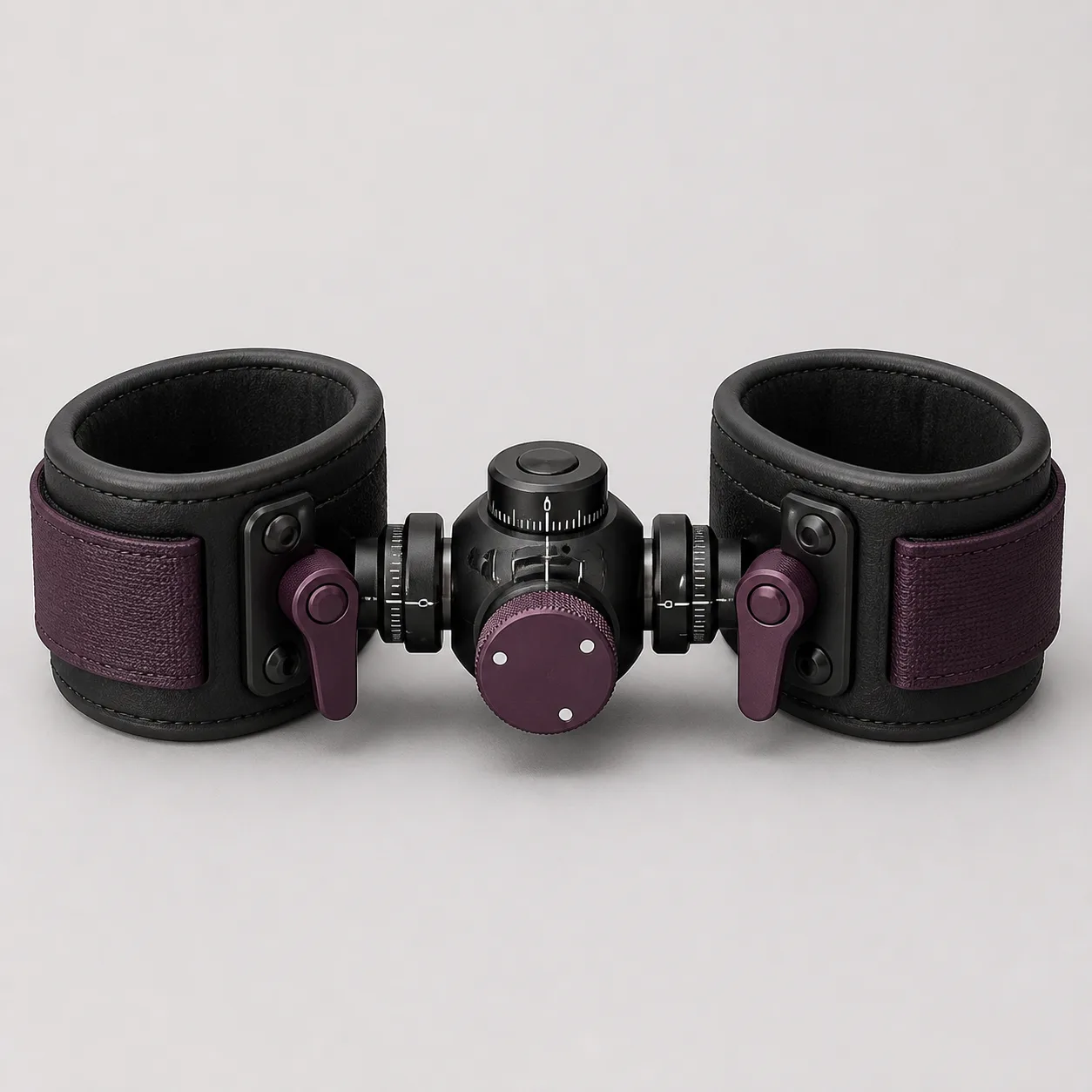
Twin-Cuff Three-Axis Gimbal Restraint with Torque-Limit Dial
A twin-cuff restraint concept with a three-axis indexed gimbal, three torque-limit states and two mirrored quick-release paddles.
44,99 $
200 in stock
Separate cuff fit from connector movement
This twin-cuff three-axis gimbal restraint concept connects exactly two broad padded oval cuffs through one compact indexed gimbal. Three perpendicular pivot rings surround a central body, while a smoky-plum three-dot torque dial and two mirrored quick-release paddles provide separate adjustment and release controls.

The image proposes mechanics only; it does not prove fit, strength, torque, materials or production readiness.
Inventory both cuffs and the complete gimbal
Require records for cuffs C1/C2, shells, padding, linings, closure tabs, reinforcement plates, gimbal body G0, pivot rings X/Y/Z, shafts, bushings, stops, torque dial, detents, clutch, release paddles, latches, fasteners, stitching, coatings, pigments and packaging.
Trace load and release paths without treating the outer shell as structural evidence.
Measure cuff range and connector envelope
Record cuff inner range, width, padding, closure overlap, center distance, gimbal size, pivot offsets, total span, mass and movement envelope at torque states T1-T3.
Repeat after loading, articulation, cleaning and storage cycles.
Evaluate cuff C1 independently
Map circumference adjustment, edge radius, compression, closure peel, stitching, reinforcement stiffness and rotation at its attachment plate.
Reject hard exposure, torn seams, uneven pressure, tab slip or permanent padding set.
Evaluate cuff C2 independently
Repeat the complete range, pressure, closure and attachment assessment for the second cuff. Compare tolerances directly rather than averaging them.
Reject mirrored parts that differ beyond documented limits.
Calibrate the X-axis pivot
Measure angular range, breakaway torque, running torque, lateral play, stop contact and residual movement at T1-T3. Inspect the guarded gap through full travel.
Keep X-axis data separate from Y and Z.
Calibrate the Y-axis pivot
Repeat rotation, torque, play and stop tests while X and Z are held neutral, then under combined angles. Inspect bushing wear and index accuracy.
Reject binding, false stops or exposed pinch edges.
Calibrate the Z-axis pivot
Measure twist range, clutch response, index alignment and attachment-plate loading at every confirmed torque state.
Reject uncontrolled rotation, shaft lift, rattle or load paths that bypass the limit mechanism.
Verify torque states T1 T2 and T3
Measure dial angle, detent force, clutch threshold and actual resistance on all axes from both adjustment directions. Repeat under centered and asymmetric cuff loads.
No numerical torque claim is accepted without calibrated fixtures and uncertainty reporting.
Map combined three-axis articulation
Build a bounded X/Y/Z movement matrix and record gimbal clearance, cuff collision, connector offset, torque coupling and stop sequence.
Identify forbidden combinations that trap a gap, overload a pivot or block a release paddle.
Validate both quick-release paddles
Measure reach, force, travel, latch disengagement and cuff separation for left and right paddles independently and together at T1-T3.
Release must remain accessible under uneven loading and must not require increasing torque first.
Screen pressure pinch abrasion and snag hazards
Probe cuff edges, closures, plate corners, pivot gaps, shafts, index rings, dial, paddles, latches, stitching and fasteners throughout the approved movement matrix.
Reject sharpness, exposed hardware, trapping gaps, abrasive flash or loose parts.
Validate cleaning drying and storage
Identify absorbent layers, seams, overlaps, pivot cavities and lubricant-sensitive surfaces. Confirm only exact-sample cleaning agents, wipe exposure and drying time.
Store fully dry with cuffs open and gimbal unloaded in a verified neutral state.
Cycle closure articulation torque and release
Cycle both cuffs, X/Y/Z pivots, T1-T3 dial changes, releases, bounded loads, cleaning, drying and storage. Remeasure play, torque, detents, closure strength and release force.
Retire for torn cuffs, stitch failure, plate lift, pivot play, dial drift, binding, delayed release, corrosion or persistent residue.
Build landed price after gimbal proof
An Alibaba adjustable-cuff page showed one padded cuff example at USD 0.67-0.69 with MOQ one. It is a category benchmark only and does not confirm this gimbal connector or an approved supplier.
The procurement reference supports an EUR 44.99 planning price after provisional allowance for China-origin freight, exact samples, cuff and gimbal teardown, three-axis and torque calibration, combined movement, release, hazard, cleaning and fatigue tests, protective packing and discreet fulfilment. Exact quote, MOQ, dimensions, materials, packed weight, freight, duty, tax, certification, payment terms and lead time remain pending.
Frequently asked questions
How far can each axis move?
Exact X/Y/Z ranges and safe combinations require sample measurement.
What does the torque dial change?
Actual clutch thresholds at T1-T3 need calibrated testing.
Can either paddle release a cuff?
Latch allocation and loaded release sequence require teardown and verification.
Are both cuffs the same size?
Inner ranges and manufacturing tolerances must be measured separately.
Which materials are used?
Padding, lining, shell, hardware and coatings require documentary confirmation.
When should it be retired?
Tears, stitch failure, plate lift, pivot play, binding, dial drift or delayed release.
Reviews
There are no reviews yet.