


Three-Arm Clover Mini Vibrator with Rounded Domes, Rotary Selector Dial and Oval Thumb Loop
August 14, 2026
Purple Twin-Arm Rechargeable Rabbit Vibrator
August 14, 2026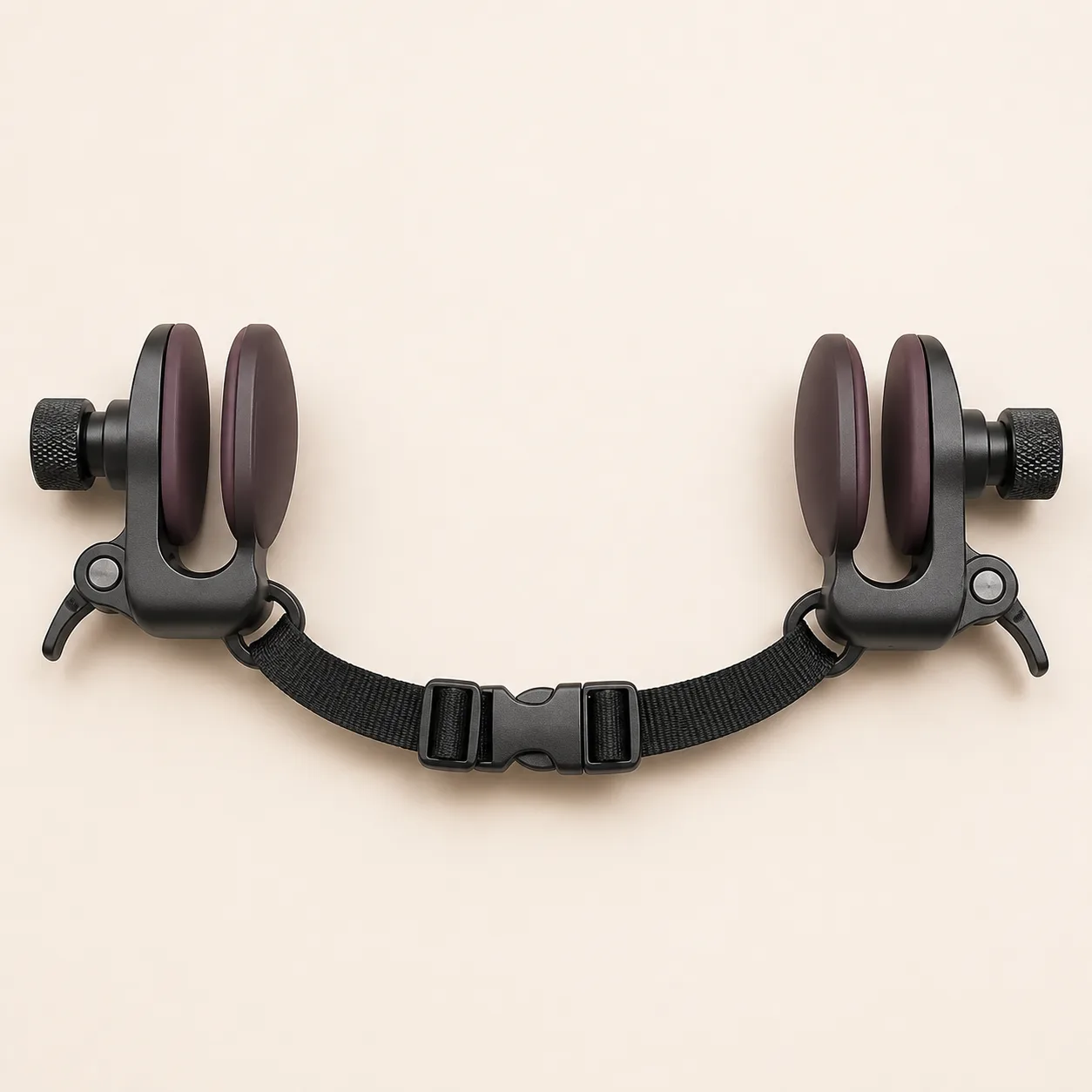
Twin-Dial Parallel Soft-Pad Sensory Clamps with Quick-Release Center Tether
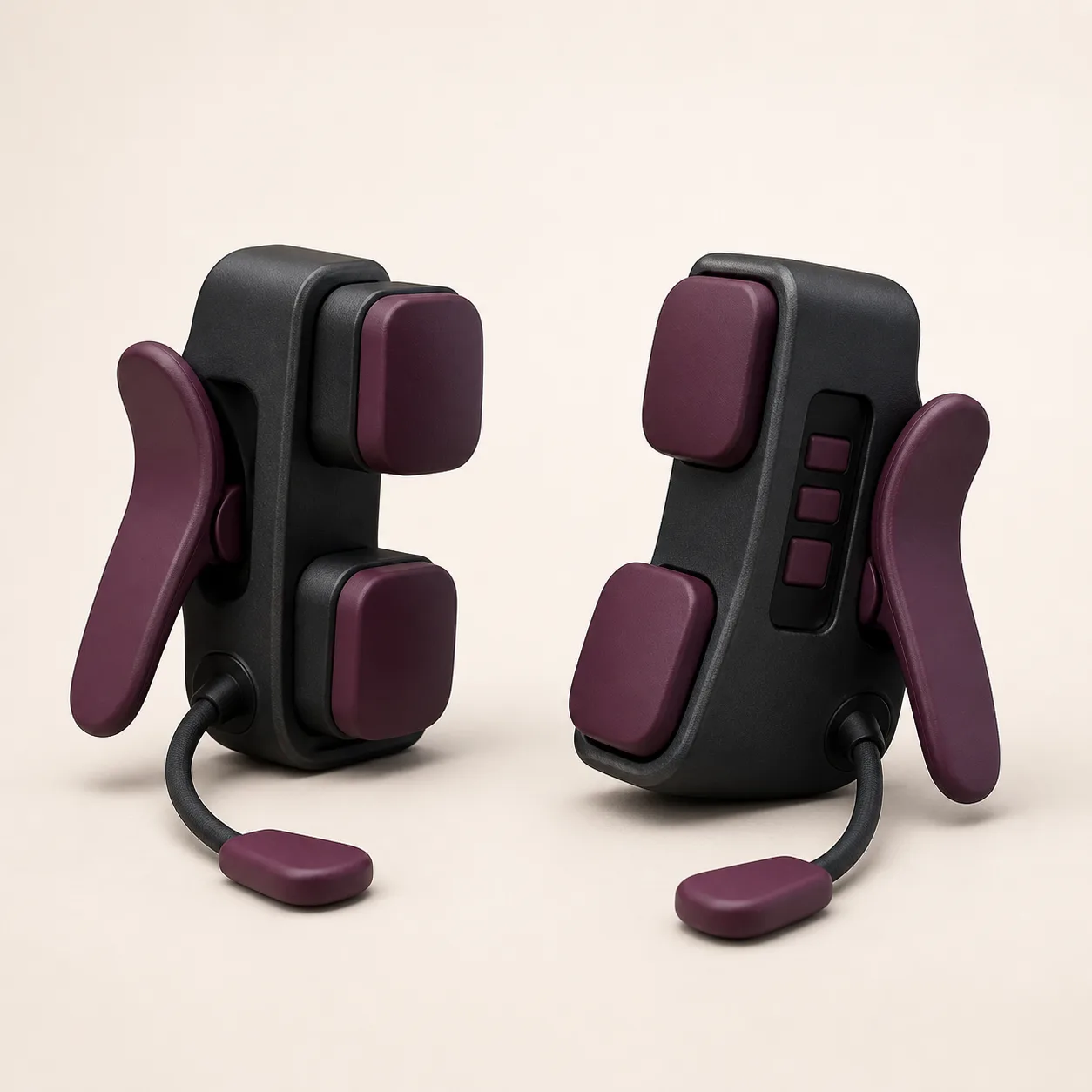
A mirrored sensory-clamp concept with exactly two charcoal parallel-jaw clamps, four broad smoky-plum pads, two independent rear thumbwheels, two release levers and one adjustable center tether with a side-release buckle.
39,99 $
200 in stock
Mirror two padded clamps across a releasable tether
This twin-dial parallel soft-pad sensory clamp set with quick-release center tether concept contains exactly two matching clamps connected by one short adjustable strap. Each clamp presents two broad smoky-plum pads, one rear thumbwheel and one small release lever; the center tether presents one side-release buckle.

The image establishes visible geometry only. It does not confirm dimensions, materials, clamping force, dial pitch, release performance, tether range, care or production readiness.
Audit the exact connected set
The planned inventory is two clamps joined by one adjustable center tether. Chain, bells, weights, collar, cuffs, remote, electrical lead, storage bag and other accessories are excluded.
Count two clamp bodies, four pads, two thumbwheels, two levers and one tether buckle before packing. Record hardware finish, strap lot and production traceability.
Measure the left parallel-jaw clamp
Record body length, width, jaw opening, arm thickness, pivot diameter, pad alignment and mass for the left clamp. Cycle the jaws through their full approved travel without side loading.
Reject bent arms, loose pivots, pad offset, rough edges, interference between lever and tether ring, or a dial that binds.
Measure the right parallel-jaw clamp
Repeat the same map for the right clamp and compare every dimension with the left reference. Confirm mirrored rather than duplicated hardware orientation so both controls remain accessible.
Pair tolerance for jaw spacing, pad angle, dial position and lever operation must be defined before release.
Inspect all four broad soft pads
Number pads LP1, LP2, RP1 and RP2. Measure face length, width, thickness, hardness, compression set, edge radius and attachment method for each.
Soft, cushioning, skin-safe and hypoallergenic claims remain pending exact pad composition and applicable tests. Reject tears, tackiness, contamination, detachment and hard inclusions.
Calibrate both rear thumbwheels
Record thread pitch, usable turns, end stop, force change per marked interval and resistance to unintended movement. Compare the left and right dial curves on a calibrated fixture.
No pressure range or beginner setting is claimed until force is measured across jaw openings, pad compression and sample tolerances.
Cycle the two release levers
Measure lever travel, actuation force, clearance, reset behaviour and release time under every approved adjustment. Confirm that each lever can be found and operated without contacting a sharp edge.
The visible levers are proposed as rapid jaw-release features; actual performance and one-hand accessibility remain pending validated samples.
Size the adjustable center tether
Measure total strap length, minimum and maximum clamp-to-clamp span, webbing width, thickness, slider travel, ring attachment and remaining tail at maximum extension.
The tether coordinates the pair but is not a leash, restraint line, suspension element or body-weight support. Do not pull, swing or anchor the set by the strap.
Test the centered side-release buckle
Cycle the buckle through engagement and release at stated strap loads. Record alignment, tactile confirmation, pull-apart resistance, tab access, accidental partial closure and low-temperature behaviour.
The center buckle separates the tether only; it does not replace operating the clamp levers. Keep both release methods visible and reachable.
Identify metals, polymers, coatings and webbing
Obtain traceable declarations for clamp bodies, pivots, springs, dials, levers, rings, pad material, buckle, strap, thread and colourants. Document coating thickness and corrosion protocol.
Stainless steel, nickel-free, latex-free, body-safe, hypoallergenic and certification claims remain pending exact composition and laboratory evidence.
Map force across the jaw-opening range
Use a calibrated compression fixture to measure force at defined dial positions and openings for both clamps. Repeat after cycling, cleaning conditioning and temperature exposure.
Reject irregular jumps, asymmetric force, pad slip, dial creep and lever release outside the approved window. Never estimate pressure by thumbwheel position alone.
Set short-session monitoring and release rules
Use only between informed sober adults with explicit consent, an agreed stop signal and continuous access to both release levers and the center buckle. Begin with the lowest verified force and short intervals.
Remove immediately for numbness, coldness, colour change, swelling, sharp pain, bleeding or loss of sensation. Check skin and hardware frequently and never leave the clamps unattended.
Exclude electrical and load-bearing use
This planned set contains no electrical function. Do not connect it to stimulation controllers, power sources, conductive leads, improvised wiring or medical equipment.
Do not attach weights, chains, cords or anchors to the clamps, rings, tether or buckle. The assembly is not designed for restraint, suspension or pulling.
Clean, dry and store with jaws relaxed
Use only the validated mild cleaning method for the approved pads, metals, coatings, webbing and buckle. Prevent liquid from remaining inside pivots, threads, lever joints, pad bonds and strap folds.
Dry fully, back both dials to the documented storage position and store the jaws relaxed in a ventilated pouch away from salt, solvents, sharp objects and heavy loads. Boiling and abrasive cleaning are excluded.
Build landed price from adjustable-clamp benchmarks
An Alibaba adjustable-clamp category page displayed a spring-adjustable pair at USD 2.00 to 2.99 with MOQ 10 and a separate adjustable clamp example at USD 0.49 to 0.99 with MOQ 10. Another category page displayed a new-style clamp at USD 1.99 to 2.19 with MOQ 1. These are broad references, not this exact twin-dial padded tethered design or an approved supplier.
The public procurement benchmark supports an EUR 39.99 planning price after provisional allowance for China-origin freight, two parallel-jaw mechanisms, four pads, two force dials, two release levers, adjustable tether, buckle, calibration, coating and corrosion checks, discreet fulfilment and handling loss. Exact supplier, quote, MOQ, dimensions, materials, force range, packed weight, freight, duty, tax, certification, payment terms and lead time remain pending.
Frequently asked questions
How many clamps are included?
Exactly two matching clamps connected by one adjustable center tether are planned.
How is each clamp adjusted?
Each clamp has one rear thumbwheel, but the verified force range and dial calibration remain pending.
What does the center buckle do?
It quickly separates the tether while each clamp retains its own release lever.
Are the pads removable?
The attachment method and serviceability remain pending the approved production specification.
Can the clamps connect to an electrical controller?
No. The planned set has no electrical function and must not be wired to power or stimulation equipment.
How should the set be stored?
Clean and dry it fully, relax the jaws to the documented storage position and protect the pads and hardware from compression and corrosion.
Reviews
There are no reviews yet.