


Opaque Multi-Pocket Bedside Care-Supply Caddy
August 14, 2026
Counter-Oscillating Twin-Pad Palm Vibrator with Central Pinch-Guard Spine
August 14, 2026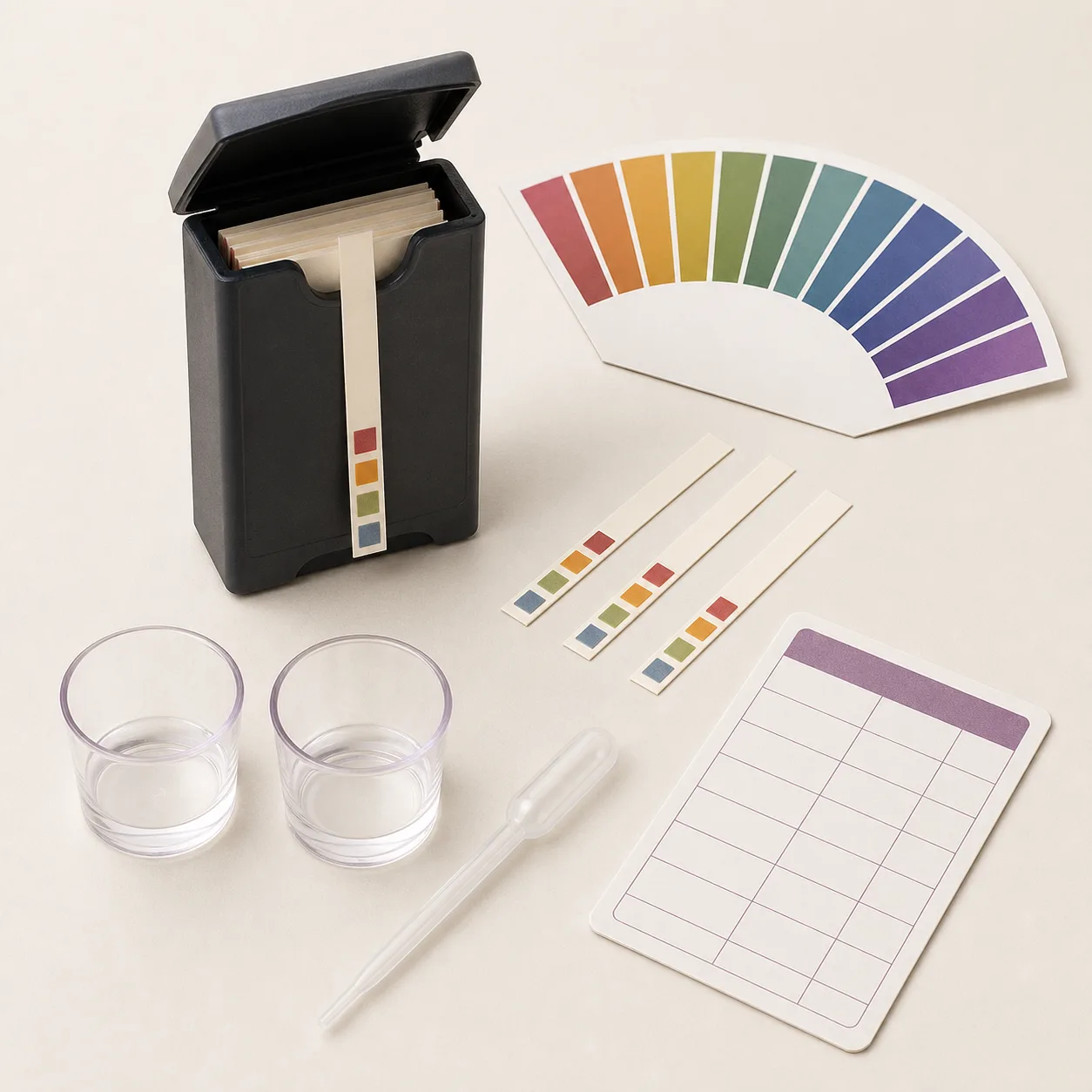
Wide-Range Liquid pH Indicator Strip Kit
A wide-range pH indicator strip concept with multi-pad paper, flip-top dispenser, comparator, sample tools and a controlled liquid-testing workflow.
12,99 $
200 in stock
A pH strip reports acidity or alkalinity, not overall safety
The liquid pH indicator strip kit concept combines multi-pad paper strips, a flip-top dispenser, color comparator, sample cups, transfer pipette and blank log card. It is intended for checking a clear liquid sample only when a cleaner or rinse procedure already has a documented pH target.

A pH reading cannot establish purity, concentration, disinfection, material compatibility or skin suitability.
Begin with a written target from the product or formula maker
Do not invent an acceptable range for a cleaning solution, rinse water or stored material. Use a strip only when the manufacturer provides the sample method, target range, temperature and action to take when the reading falls outside it.
Without that context, the color result has no reliable decision rule.
Take a separate sample instead of dipping into the source container
Pour or transfer the minimum specified volume into a clean dedicated cup. Direct dipping can introduce reagent, residue or moisture into the cleaner bottle and compromise later measurements.
Discard the tested sample according to the formula instructions rather than pouring it back.
Only compatible clear liquids suit a color strip method
Oils, gels, opaque cleaners, strongly colored liquids and emulsions may not wet the pads evenly or may hide the reagent colors. Volatile, corrosive or solvent-rich formulas can also attack the substrate or create unsafe exposure.
Use an instrumented laboratory method when the strip maker excludes the sample type.
Dilution accuracy comes before measurement
If a concentrate requires mixing, use verified measuring tools and follow the stated order, water quality and temperature. A pH check cannot correct an unknown dilution ratio or prove that every active ingredient is present at the intended concentration.
Record the batch and preparation time before opening a strip.
Wet the pads evenly without touching them
Handle the dry end, expose all reagent areas for the specified contact period and remove excess sample exactly as instructed. Fingers, splashes and partial immersion can create inconsistent patterns across the pads.
Use a new strip after any handling error.
Reading time is part of the result
Colors can continue developing, fade or bleed after the approved window. Start a timer at the defined step and compare promptly; do not save a dried strip as if it preserved the original measurement.
Reading time and permitted tolerance remain pending for the production lot.
Compare under neutral light with the exact lot chart
Warm bulbs, colored surroundings and phone image processing can alter perceived hue. Hold the strip beside its supplied comparator under the verified light source and record the closest complete pad pattern.
The non-numeric fan in the product image is a visual prop, not an interpretation chart.
A wide range usually trades detail for coverage
Universal strips can survey a broad span but may not distinguish small differences near a narrow target. Confirm increment, tolerance and adjacent-color separability before using the kit for a critical release decision.
A narrower-range method may be necessary when the acceptable window is tight.
Temperature and water composition can shift the comparison
Measure at the documented sample temperature and allow freshly mixed liquids to stabilize. Minerals, buffers and dissolved ingredients can affect color response or make a simple strip disagree with an electrode measurement.
Investigate disagreement rather than choosing the preferred value.
Sampling tools need single-purpose control
Reserve cups and pipettes for the defined test liquid, label them neutrally and rinse or discard them according to the verified procedure. Cross-contact from a previous cleaner can change a small sample enough to mislead the strip.
Cup and pipette inclusion remain pending.
Protect unused strips from air, moisture and chemicals
Open the dispenser briefly with dry hands, remove one strip and close it immediately. Store the pack within its confirmed temperature and humidity limits, away from cleaner fumes and direct sun.
Do not mix lots or transfer strips into an unverified decorative container.
Reagent paper requires deliberate handling and disposal
Keep strips and test liquids away from children, pets, food and drink. Do not use this kit on body fluids, directly on the body or as a medical diagnostic.
Final disposal instructions must reflect the verified reagent chemistry and tested formula.
Incoming inspection should test known buffer solutions
Check strip dimensions, pad placement, dispenser seal, comparator print and lot code. Challenge samples with traceable buffers across the intended range at the specified temperature and time, then record bias and color agreement.
Quarantine faded charts, loose pads, moisture-damaged strips, mixed lots or results outside the approved tolerance.
The source listing does not validate a cleaning protocol
An Alibaba entry from Guangzhou Sinosource Scientific Company Limited displays universal pH 0-14 indicator strips at USD 0.58-1.25 per box with MOQ 100 boxes. Exact range, resolution, chemistry, accuracy, chart and strip count remain pending.
The procurement reference supports sample inquiry only. The EUR 12.99 plan provisionally includes China-origin freight, buffer checks, lot review and sampling accessories; packed mass, freight, duty, tax, insurance, payment fees and destination terms remain pending.
Frequently asked questions
Can the strips prove a cleaner is safe?
No. They indicate pH within their limits and cannot establish formula identity, purity, concentration or material compatibility.
Can a strip be dipped into the cleaner bottle?
Use a separate clean sample cup to avoid contaminating the original container.
Will the kit work with colored or opaque liquids?
Such samples may mask pad colors or wet them unevenly, so follow the strip maker’s exclusions.
How precise is a wide-range strip?
Resolution and tolerance remain pending, and a narrower method may be needed near a tight target.
Are the sample cups and pipette included?
Their inclusion and materials remain pending until the production kit is approved.
When should a strip lot be discarded?
Remove expired, damp, faded, delaminated, mixed-lot or improperly stored strips according to the verified procedure.
Reviews
There are no reviews yet.