



Wide-Range Liquid pH Indicator Strip Kit
August 14, 2026
Three-Pad T-Bridge Wearable Couples Vibrator with Compact Remote
August 14, 2026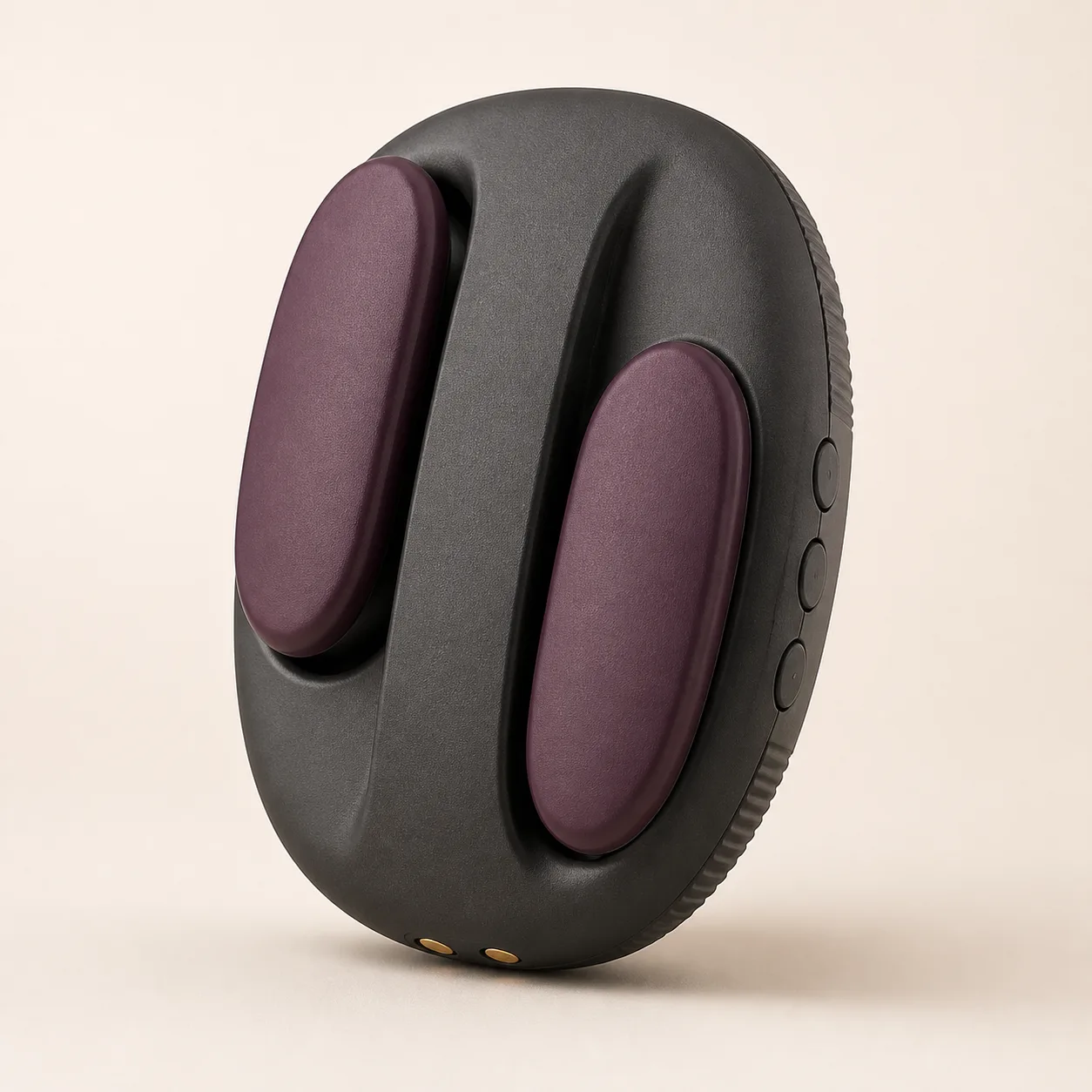
Counter-Oscillating Twin-Pad Palm Vibrator with Central Pinch-Guard Spine
A compact rechargeable external palm vibrator concept with two opposite-phase contact pads separated by a broad central pinch-guard spine.
38,99 $
200 in stock
Opposite pad travel creates a balanced external pulse
This counter-oscillating palm vibrator concept places two elongated deep-plum contact pads on separate concealed flexures. One pad moves upward as the other moves downward, while a broad central charcoal spine separates their paths and the oval rear shell provides a stable hand grip.

The two pads are intended for external contact only. Their counter-motion must be measured rather than inferred from appearance.
Identify both drive trains and the protective shell
Confirm the left pad, right pad, central spine, flexures, drive links, motors, bearings or bushings, shell, controls, battery and charging contacts. Request disclosure of hidden counterweights, stops, dampers, seals, fasteners and adhesives.
A single-motor linkage and two independently driven pads require different fault testing.
Measure the pad field and the protected gaps
Record overall length, width, thickness, mass, rear grip area, each pad’s length, width, projection and edge radius, spine width and distance from every moving edge. Measure minimum gaps at neutral and both motion extremes.
No skin, hair or fabric path should narrow into a closing trap.
Trace each motion path on a high-speed fixture
Mark pad centers with removable test dots and record displacement, direction, speed and dwell through every verified setting. Compare the left and right travel envelopes and confirm that neither pad contacts the spine or shell.
Visible offset in a photograph is not proof of controlled oscillation.
Quantify phase balance and handle cancellation
Measure the time difference between pad reversals, peak acceleration and vibration transmitted to the rear grip. Repeat after warm-up and partial battery depletion to see whether phase drift increases handle movement.
Counter-motion may reduce grip vibration only when amplitude and timing remain matched.
Challenge the pinch-guard spine under compression
Apply low controlled pressure to both pads using a compliant fixture while mapping gaps along the entire spine. Check whether the guard bends, sinks below a pad edge or exposes a hinge pocket at any angle.
A soft-looking ridge is not a reliable guard unless its loaded geometry is verified.
Cycle the concealed flexures and side stops
Run a documented motion cycle at low, middle and high settings, inspecting pad alignment, lateral play, surface creasing, stop noise and fastener movement at planned intervals. Add a controlled off-axis contact test below supplier limits.
Wobble, pad rotation, cracking or a newly exposed edge requires retirement.
Map output across both pad surfaces
Use the same soft instrumented fixture to measure amplitude, frequency and contact distribution at the top, center and bottom of each pad. Compare isolated left, isolated right and simultaneous contact if the controls allow those states.
Two moving surfaces can feel uneven even when their motor labels match.
Avoid stalling the counter-motion with pressure
Increase fixture pressure only within documented limits while monitoring displacement, motor current, sound and surface temperature. Confirm whether the controller reduces power or stops safely when a pad cannot complete its path.
Hard pressing can defeat the motion, increase heat and turn a safe gap into a pinch point.
Confirm local controls and a true full stop
Identify power, intensity and pattern functions by test. Measure long-press timing, setting order, memory, accidental activation force and the time for both pads to stop after the command.
A stopped display or indicator is not sufficient if either pad continues to coast or pulse.
Use externally with the moving gaps visible
Begin at the lowest verified setting while holding the rear grip and keeping the spine and pad edges in view. Use light contact, keep hair and loose fabric away and stop before repositioning the device.
Discontinue for pain, numbness, irritation, trapped skin, pad asymmetry, unusual noise, odor, heat or loss of control.
Validate dual-drive battery and thermal demand
Request cell chemistry, capacity, charge input, cable specification, runtime method, current limits and protection circuitry. Log temperature at both motors, flexure pockets, spine, battery, controls and charging contacts during the longest approved program.
Do not operate while charging unless exact instructions expressly allow it.
Verify materials on moving and fixed surfaces
Obtain composition for both pad skins and cores, flexures, spine, shell, grip ribs, pigments, seals, lubricants and adhesives. Review hardness, fatigue, porosity, restricted-substance and skin-contact evidence for the exact revision.
Ingress, cleaner compatibility and any material-grade claim remain pending until documented and tested.
Clean along the guard without flexing the pads
Power off and wait for both pads to stop completely. Follow confirmed mild-cleaning instructions, wiping each pad separately and using a soft swab along the spine and outer motion gaps without lifting or twisting a flexure.
Dry all recessed edges and charging contacts before storage; soaking, boiling, bleach, alcohol and abrasive tools are not approved without exact evidence.
Price the twin-drive mechanism above a simple palm toy
An Alibaba palm-vibrator showroom lists a two-in-one swinging vibrator at USD 6.00-7.50 with a one-piece minimum. It is a category benchmark only and does not establish this opposite-phase twin-pad and pinch-guard design, a legal supplier or a production quotation.
The procurement reference supports an EUR 38.99 planning price after allowing for China-origin freight, exact-model quotation, component disclosure, motion-path and phase mapping, grip cancellation, loaded pinch-gap tests, flexure cycles, output and stall behavior, controls, battery and thermal validation, materials, cleaning tests, protective packing and discreet fulfillment. Packed size, weight, freight, duty, tax, insurance, payment fees and destination terms require confirmation.
Frequently asked questions
Do both pads move in the same direction?
No. The concept proposes opposite-phase travel, which needs high-speed measurement on a sample.
Can the central spine be pressed as a third pad?
No. It is a fixed guard intended to separate the two moving paths.
May one pad be used while the other is blocked?
No. Blocking a pad can alter current, heat, synchronization and gap safety.
Is the device intended for insertion?
No. The twin contact pads are described for external use only.
What proves the guard is effective?
Minimum loaded-gap measurements across every setting and contact angle, not appearance alone.
Which faults require retirement?
Phase drift, pad wobble, flexure cracking, guard deformation, contact between moving parts, failed shutdown, swelling, abnormal heat or trapped residue.
Reviews
There are no reviews yet.