


Three-Stop Lateral-Bias Prostate Trainer with Twin Cantilever Rails
August 14, 2026
Low-Profile Manual Care Inspection Turntable with Grip Mat
August 14, 2026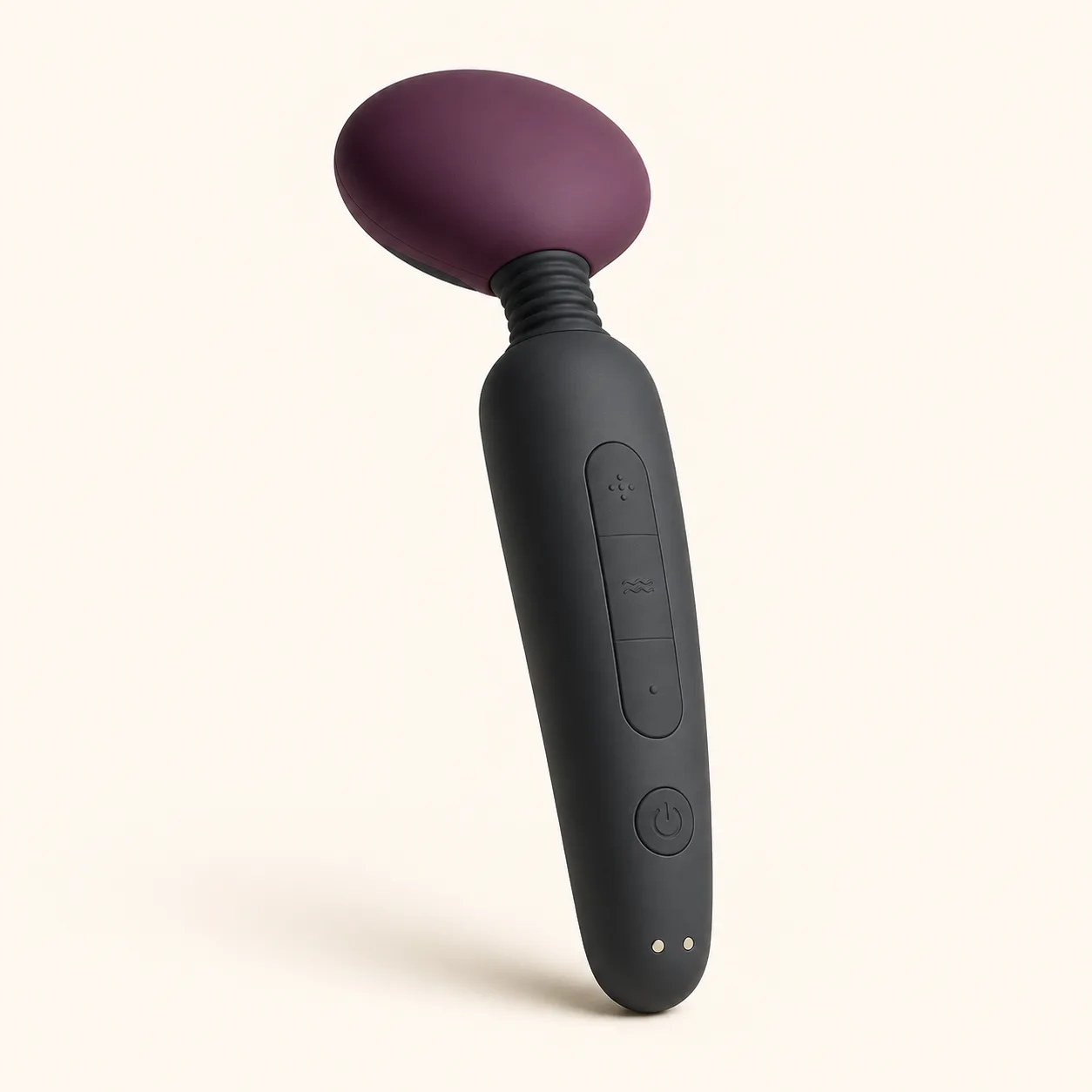
Pressure-Responsive Flat-Head Wand with Segmented Grip Strip
A broad flat-head wand concept with flexible neck, three-zone pressure grip, separate power button and magnetic charging for documented response testing.
34,99 $
200 in stock
A squeeze-responsive grip makes hand force part of the control system
This pressure responsive wand vibrator concept combines a broad plum oval head, short flexible neck, charcoal handle, three-zone grip strip, separate power button and magnetic charging contacts. The main evaluation is whether a controlled squeeze changes output predictably without turning an ordinary stabilizing grip into an accidental command.

The illustration does not prove that the strip senses pressure, that three zones act independently, or that the device is waterproof.
Measure head area, handle fit and neck geometry
Record total length, head length, width and thickness, neck diameter and free angle, handle circumference at each sensor zone, power-button position, charging-contact spacing and complete mass. Compare the grip with hand span before testing any squeeze input.
A handle that is too large may require constant high force and distort the intended control range.
Inspect the flat head for edge pressure and seam lift
Check the entire contact face, perimeter, underside, head-to-neck junction and any molding seam for flash, gaps, tack, discoloration, thin spots or abrupt hardness changes. Press it lightly against a calibrated soft pad to map the contact footprint.
A head that rocks onto one edge or separates from its core is not suitable for further trials.
Flex the neck only within a measured bending envelope
Use a padded fixture to record bending force, angle and recovery in several directions at conservative loads. Repeat approved cycles while watching for whitening, creaks, heat, seam movement or permanent lean.
Do not twist the head around the handle, fold the neck sharply or use it as a lever under body weight.
Identify whether the segmented strip is truly pressure-sensitive
With the motor off, apply measured forces to each visual zone and record any indicator or state change. Then repeat at the lowest manual mode to establish threshold, deadband and whether separate zones have separate functions.
Tactile markings alone do not prove sensor areas or a continuous response curve.
Calibrate output against grip force on a bench
Secure the head on a folded towel and use an instrumented padded clamp on the handle. Increase force in small steps while logging vibration level, delay, maximum response and the force needed to reduce output again.
Stop if output jumps abruptly, continues rising after force stabilizes or remains high after the grip is relaxed.
Test hysteresis and repeated-squeeze consistency
Run several identical low-force ramps from different starting modes and compare the response. A safe control plan needs predictable release behavior, not only predictable activation.
Large variation, lag, missed release or a sensor that drifts as the handle warms must be documented and corrected.
Challenge the strip with accidental inputs
Test a normal carry grip, a startle squeeze, setting the device on its side, towel pressure and minor handle flex. Confirm that lockout and the separate power button prevent unwanted operation during storage.
Do not carry the wand powered or place the pressure strip under a pillow, strap or clamp.
Keep the physical power button immediately reachable
Practice shutdown from each intended hand position before body contact. The off action must work even if the pressure strip is still compressed or the motor is at its highest verified response.
A sensor-only stop, delayed shutdown or sequence that requires both hands is not accepted for reactive control.
Charge on a dry surface with the matched lead
Clean and dry the contacts, align the confirmed cable and use the approved power source on a non-combustible surface. Observe polarity, attachment, indicators, charge time and temperature.
Do not charge under bedding, near water, while running or when contacts show debris, corrosion, heat or pitting.
Begin external contact with pressure response disabled
If the sample offers a fixed manual mode, start there at the lowest output and rest the broad head lightly on an external area. Hold the handle outside the sensor strip or at its verified neutral force.
This catalog concept is for external contact only; neither the head nor handle is planned for insertion.
Introduce squeeze control through a limited range
After the fixed mode is understood, select a low ceiling and use only small deliberate grip changes. Keep the head pressure constant so the effect of hand input can be distinguished from added contact force.
Stop after numbness, pain, redness, swelling, pinching, loss of sensation or any intensity that cannot be lowered immediately.
Partnered use needs one controller and spoken limits
Agree on contact area, initial setting, permitted squeeze range, check-in interval and immediate stop word. The receiving partner decides pressure and duration while the operator keeps the power button accessible.
Do not use while either person is asleep, impaired or unable to communicate changing sensation.
Log head, neck and grip-strip temperature
During fixed bench intervals, measure the contact face, perimeter, neck, sensor zones, power button and charging area. Compare steady manual operation with repeated pressure inputs for extra heat, pitch changes or output drift.
Power off after unusual heat, odor, swelling, rattling, seam change, intermittent control or a strip that becomes more sensitive as it warms.
Sourcing must prove the sensor rather than infer it from styling
An Alibaba wand-massager results page lists a general handheld wand from Hebei Niusida International Trading Co., Ltd. at USD 2.00-2.30 with MOQ 2 pieces. The source does not prove pressure response; legal supplier identity, exact model, current quote, sensor, materials and every performance claim remain pending.
The procurement reference supports inquiry only. The EUR 34.99 plan allows for China-origin freight, exact measurement, head and neck inspection, pressure-force calibration, hysteresis and false-input mapping, motor and control testing, charge and battery review, heat and sound logging, material verification, cleaning trials, protective packing and discreet fulfillment; packed size, weight, freight, duty, tax, insurance, payment fees and destination terms remain pending.
Frequently asked questions
Does squeezing always increase vibration?
Not until the exact response curve is measured; the zones may be decorative or use discrete commands instead.
Can pressure control be disabled?
A fixed manual mode is preferred, but its availability and behavior must be verified on the sample.
Is the broad head insertable?
No. This concept is planned for external contact only.
Can it run while charging?
No. Disconnect the charging lead before operation or body contact.
Will a tighter grip make it easier to hold?
It may also change output, so fit the handle and learn the neutral force before enabling reactive control.
When should the wand be withdrawn from service?
After cracks, seam lift, neck deformation, response drift, delayed shutdown, unusual heat or odor, battery swelling, charge faults or intermittent motor operation.
Reviews
There are no reviews yet.