



Write-On Care-Storage Label Clips, 12-Pack
August 14, 2026
Six-Spoke Floating-Core Pocket Vibrator with Preload Dial
August 14, 2026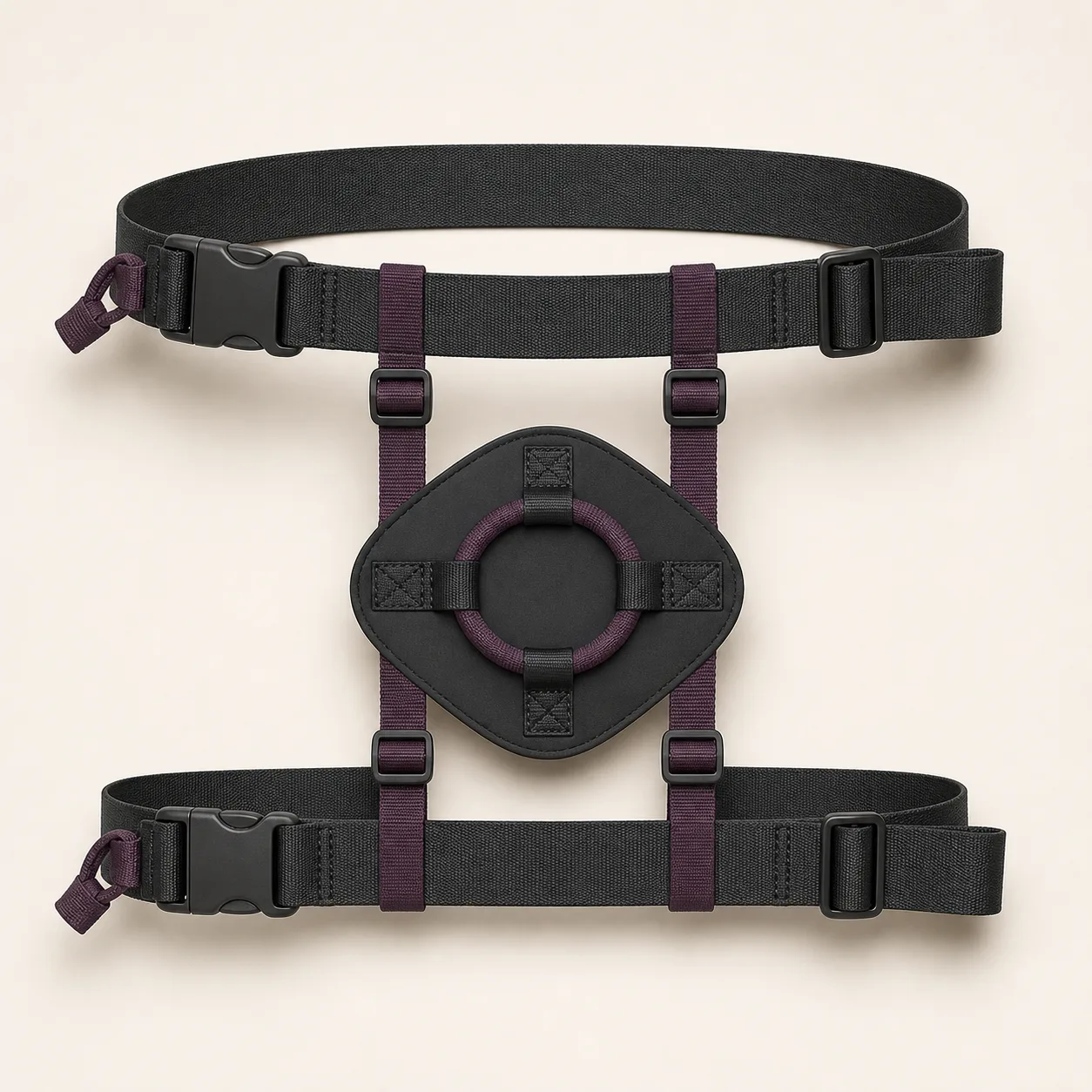
Twin-Belt Floating-Plate Strap-On Harness with Four-Point Height Adjustment
An adjustable strap-on harness concept with two independent horizontal belts, four-point plate-height control and one reinforced removable retention ring.
36,99 $
200 in stock
Two horizontal belts stabilize one independently positioned plate
This floating-plate strap-on harness concept uses separate upper and lower charcoal belts connected by four short plum height adjusters. A rounded diamond-shaped front plate hangs between them, carrying one broad retention ring held by four reinforced tabs.

The layout separates belt tension from plate height, but both systems must be fitted and tested together.
Inventory every strap path before fitting
Confirm upper belt, lower belt, two side-release buckles, two release tabs, four vertical adjusters, four sliders, floating plate, retention ring and four ring tabs. Request disclosure of hidden stiffeners, backing layers, rivets, adhesives and reinforcement tapes.
Each strap end should have a documented stop or fold that prevents pull-through.
Measure the two belt ranges independently
Record webbing width, thickness, shortest usable circumference, longest usable circumference, remaining tail and buckle overlap for each belt. Measure the vertical spacing between belts at the shortest and longest four-point settings.
The upper and lower loops may need different ranges and must not share one generic size claim.
Map all four height adjusters as a coordinate system
Mark left-upper, right-upper, left-lower and right-lower straps, then record usable travel and slider holding force for each. Adjust in small equal increments to move the plate vertically without introducing diagonal twist.
Unequal settings can rotate the plate even when both belts appear level.
Keep the floating plate centered under movement
Fit the empty harness to a padded form and record plate position at standing, sitting and controlled hip movement. Measure lateral shift, vertical rise, edge lift and rotation relative to the belt centerlines.
The plate should remain supported without a corner digging in or a vertical strap sawing across the form.
Prove both buckles release locally
Test the upper and lower side-release buckles separately with dry and damp gloved hands. Record squeeze force, opening time, strap rebound and whether the plum pull tab helps locate the buckle without carrying load.
A buckle that jams under normal belt tension or needs a tool fails qualification.
Inspect strap routing for folds and abrasion
Cycle every slider through its approved range and check whether webbing doubles over, crosses a plate edge or rubs a buckle gate. Inspect stitching, bar tacks, folded ends and surface fuzz after repeated fitting on the form.
A routed strap should lie flat and keep all adjustment hardware away from pressure points.
Test plate torque before attaching a compatible product
Mount the empty ring plate on a fixture and apply controlled forward, lateral and twisting loads below written supplier limits. Measure plate deformation, ring-tab stretch, strap slip, buckle rotation and permanent set.
The harness has no suspension, lifting or body-weight rating.
Measure the supplied retention ring as a separate component
Record relaxed inner diameter, cross-section, outer diameter, hardness, mass and maximum verified stretch. Inspect the four holding tabs for equal overlap and check whether the ring remains centered after repeated removal and installation.
A ring opening cannot be selected from appearance or a universal label.
Validate compatibility with the exact separate attachment
No insertable product is included. For any separately sourced compatible item, measure the shaft where it crosses the ring and confirm that its flange stays broader than the loaded opening under controlled push, pull and twist tests.
Ring stretch, flange shape, plate thickness and movement all affect retention.
Fit the empty harness before mounting anything
Adjust both belts over thin clothing, center the unloaded plate and set the four height straps evenly. Walk, sit and change position on a safe surface while checking buckle access and plate stability.
Only after the empty assembly remains comfortable should exact attachment compatibility be evaluated.
Use numbness, chafing and buckle movement as stops
Loosen or remove the harness for pain, numbness, tingling, coldness, marked color change, swelling, chafing, folded webbing, plate-edge pressure, slider creep or buckle rotation. Both local releases must remain reachable throughout partnered use.
Never sleep in the harness or use it to restrain, lift or support a person.
Verify textiles, plate layers and hardware
Request composition for webbing, thread, plate face, backing, padding, ring, buckles, sliders, tabs, pigments, rivets and adhesives. Review abrasion, colorfastness, corrosion, restricted-substance and skin-contact evidence for the exact production revision.
Leather content, textile fiber, load rating and cleaner compatibility remain pending until documented.
Clean the ring apart from the layered plate
Remove any separate attachment first, then detach the retention ring only if the instructions allow it. Follow confirmed mild-cleaning guidance for ring, plate and webbing, paying attention to tab undersides, slider folds and buckle gates.
Dry layered seams and folded strap ends fully before storage; soaking, machine washing, bleach, alcohol and heat drying are not approved without exact evidence.
Price the reinforced geometry above a basic belt
An Alibaba showroom lists an adjustable strap-on harness belt with a retention ring at USD 1.49-1.79 with a three-piece minimum. It is a category benchmark only and does not establish this twin-belt floating-plate design, a legal supplier or a production quotation.
The procurement reference supports an EUR 36.99 planning price after allowing for China-origin freight, exact-model quotation, complete component inspection, independent belt and four-point range mapping, padded-form plate stability, buckle release, abrasion cycles, plate and tab loading, ring dimensions and compatibility tests, material review, cleaning validation, protective packing and discreet fulfillment. Packed size, weight, freight, duty, tax, insurance, payment fees and destination terms require confirmation.
Frequently asked questions
Is an insertable product included?
No. This listing describes the harness and retention ring only; exact separate-item compatibility requires testing.
Why are there two horizontal belts?
They are intended to distribute load and let four short straps position the plate independently.
Can all four height straps be set differently?
They can be adjusted, but unequal lengths may twist the plate and should be mapped carefully on a padded form.
Does one ring fit every attachment?
No. Ring diameter, stretch, shaft size, flange geometry and loaded retention must match the exact item.
Can the harness be used for restraint?
No. It has no restraint, suspension, lifting or body-weight support function.
Which faults require retirement?
A cracked buckle, slipping slider, torn bar tack, stretched ring tab, warped plate, sharp edge, color transfer, delamination or odor that persists after approved cleaning.
Reviews
There are no reviews yet.