



Palm-Squeeze Pebble Vibrator with Offset Contact Ridge
August 14, 2026
Twin-Dial Compression Manual Stroker with Removable Liner
August 14, 2026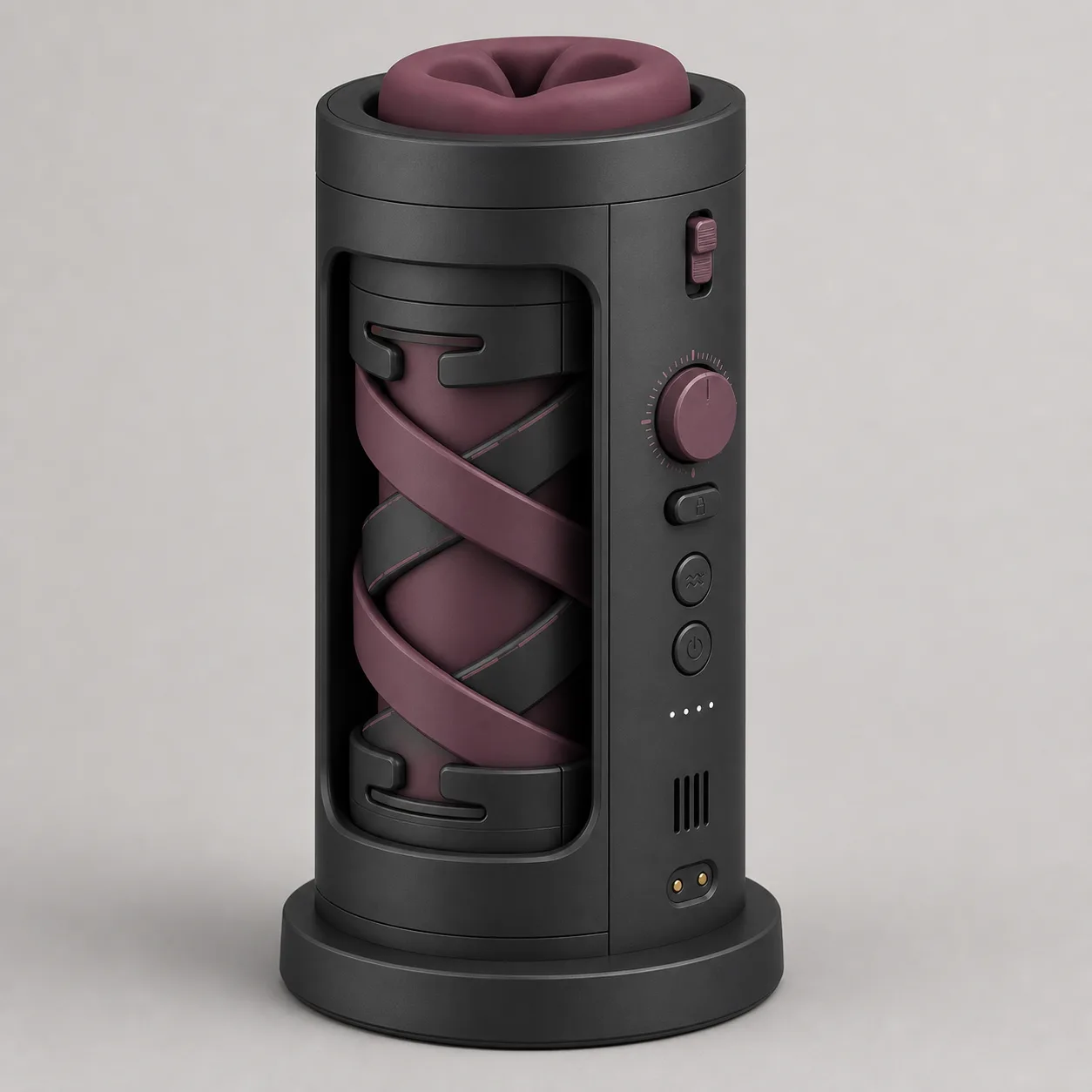
Counter-Rotating Twin-Helix Automatic Stroker with Split Drive Collars
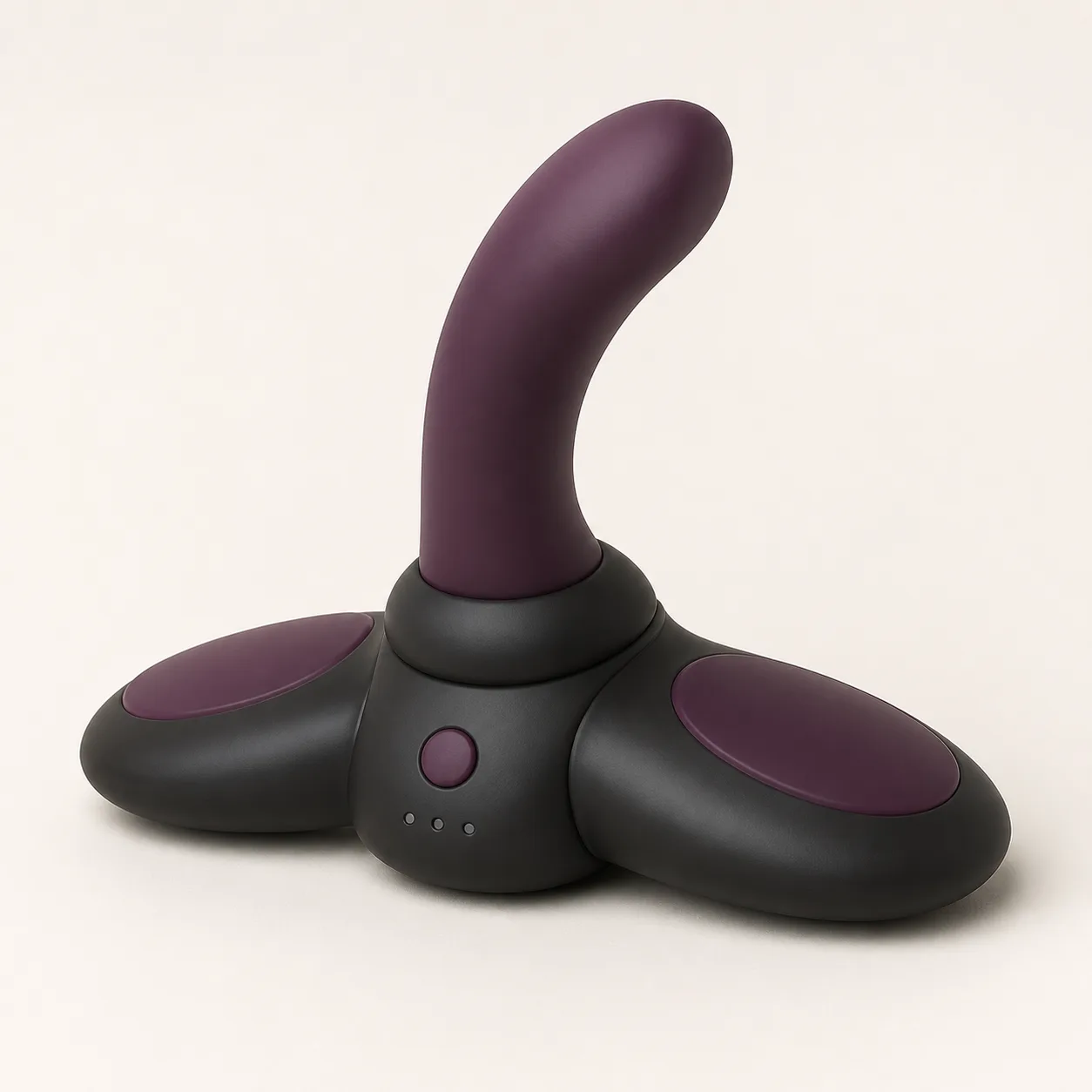
An upright automatic stroker concept with two opposite-hand helical drive bands, captured split collars and a lockable direction-and-phase dial.
89,99 $
200 in stock
Drive one liner with two opposite-hand helices
This counter-rotating twin-helix automatic stroker concept wraps exactly two continuous drive bands around the outside of an abstract removable liner. The plum and charcoal bands follow opposite helical paths between captured upper and lower split collars, while a three-stop direction-and-phase dial is intended to coordinate their motion.

The image does not prove band movement, counter-rotation, phase control, liner travel, pressure, dimensions, materials, interlocking, sealing, charging safety or production availability.
Inventory both helix drive paths
Request an exploded bill of materials for liner, rim, upper and lower liner keys, plum helix H1, charcoal helix H2, edge markers, band carriers, guided crossing bridges, upper and lower split collars, bearings, gears or belt drives, actuators, sensors, frame, service shell, latches, interlocks, phase dial, three detents, lock tab, buttons, indicators, controller, cell, contacts, vent membrane, conductors, seals, pigments, lubricants and adhesives.
Link every part to drawing revision, tolerance, batch and approved sample.
Measure enclosure base and service window geometry
Record overall height, shell diameter, base axes, base flatness, window dimensions, frame depth, latch positions, rim projection, dial location, control reach, contact recess, vent area, mass and center of gravity.
Check shell roundness, frame alignment, window-guard stiffness, collar coaxiality and base stability before and after conditioning.
Characterize the removable liner independently
Measure opening axes, wall thickness by station, tunnel depth, external collar keys, internal profile, mass, hardness, compression recovery, tear behavior, friction and surface finish. Inspect seams, voids, thin regions, hard inclusions, tack change and pigment transfer.
Verify orientation, seating force, axial retention, anti-rotation and removal without dragging the liner across a band edge or bridge slot.
Measure both helical bands by station
For H1 and H2, record width, thickness, pitch, handedness, turn count, neutral radius, surface crown, edge blend, stiffness and continuity. Map every carrier, anchor and change in section from upper to lower collar.
Compare the two bands for length, tension, runout, surface friction and fatigue rather than assuming that opposite paths are mechanically matched.
Inspect crossing bridges and moving clearances
Measure band-to-band, band-to-bridge, band-to-liner, band-to-frame and carrier-to-collar gaps at rest, peak travel, centered preload, offset preload and operation. Use articulated probes and soft-film screening.
Reject edge rubbing, exposed carriers, crossing contact, a sharp bridge slot, hair or film traps, or a recess that cannot be cleaned and dried by the validated method.
Characterize upper and lower split collars
Measure collar concentricity, engagement depth, segment closure, runout, axial play, bearing drag, hard stops and band-anchor capture. Track upper and lower angular position under no load and controlled liner load.
Confirm that segment seams remain guarded and that a partly closed collar cannot release a band, distort the liner or falsely satisfy an interlock.
Calibrate direction and phase dial states
Measure dial angle, detent torque, backlash, hysteresis and command mapping at all three marks. Approach every stop from both directions while logging H1, H2 and both collar positions.
Engage the separate lock tab and apply bounded vibration and torque; a locked dial must not drift or create an undefined transition between direction and phase states.
Map band motion speed and relative phase
Use high-speed optical markers to record band direction, linear travel, angular progression, velocity, acceleration, dwell, reversal, slip and coast-down. Synchronize H1 and H2 to measure phase offset, drift and startup skew.
Repeat across preload, battery and temperature conditions and identify any program that bunches, pauses or reverses one band unexpectedly.
Measure liner twist translation and deformation
Track liner markers by depth to separate angular twist, axial translation, radial compression, wall folding and delayed movement. Compare each dial state under centered and offset compliant loads.
Reject collar creep, rim migration, helical buckling, permanent wall thinning, band imprint, hard bridge exposure or liner movement beyond the verified retention envelope.
Map pressure shear and airflow
Use an instrumented compliant sleeve to measure normal pressure, tangential shear, contact duration and progression beneath both helices and crossing sectors. Monitor entry force, sustained movement, release force, airflow and any tendency toward occlusion.
A passive pressure-relief path and prompt powered shutdown need evidence under blocked vent, jammed band, low battery and power-loss conditions.
Verify service latches interlocks controls and charging
Measure latch engagement, false-close resistance, hinge or panel play and every service interlock state. Document button functions, indicators, local stop, charging polarity, specified lead, input limit, cell protection, low-voltage behavior and operation-during-charge interlock.
The drive must remain disabled when the window or either split collar is not fully secured, and power interruption must produce a predictable low-force state.
Log current runtime sound and temperature
Measure operating current, runtime, accessible temperature, motor, collar, band, controller and cell hot spots and A-weighted sound at a stated distance for every program and representative dial state. Repeat under maximum approved preload, one protected band restrained and low battery.
Investigate current spikes, bridge chatter, collar runout, liner slip, shell resonance, dial drift, asymmetric heat or intermittent indicators.
Challenge jams then cycle clean and inspect
In protected specimens, obstruct H1 and H2 separately, increase one collar drag, misseat a liner key, partly close one collar and block the vent while monitoring pressure, motion, current, heat, sound and shutdown. Stop before damage and quarantine unsafe samples.
Cycle liner seating, collar capture, dial selection, locking, band motion, controlled loading, stopping, charging, defined cleaning, measured drying and storage. Recheck geometry, two-band motion, crossings, collars, phase, liner deformation, pressure, interlocks, controls, contacts, heat and surfaces.
Build landed price after twin-helix proof
An Alibaba automatic-stroker page currently shows a motorized suction-category example at USD 30.00-32.00 with MOQ one. It is a benchmark only and does not confirm this counter-rotating twin-helix drive, split collars, phase control or an approved supplier.
The procurement reference supports an EUR 89.99 planning price after allowing for China-origin freight, exact-model sourcing, liner, helix and collar metrology, band-motion and phase testing, liner deformation, pressure and airflow mapping, gap and interlock review, electrical, current, sound and heat tests, protected fault and cycle work, protective packing and discreet fulfillment. Exact quotation, MOQ, materials, battery, packed size, weight, freight, duty, tax, insurance, payment fees, certifications and delivery terms remain pending.
Frequently asked questions
Do both helical bands rotate continuously?
The motion type is unknown until optical tracking measures direction, travel, reversal and relative phase for H1 and H2.
What does the three-stop dial change?
It is intended to select direction and phase relationships, subject to command mapping, drift and load stability.
Can the crossing bands pinch the liner?
Every crossing bridge, carrier and band gap needs probe, soft-film and pressure tests across travel, offset load and wear.
How is pressure released after a jam?
Passive relief, stop time, neutral force and reset behavior require fault tests with blocked vent, low battery and power loss.
Is the device waterproof?
No ingress claim is confirmed; liner rim, window, collars, dial, buttons, contacts and vent require evidence.
Which faults require retirement?
Frayed bands, carrier migration, crossing contact, collar runout, false latching, torn liner, failed interlock, exposed wiring, abnormal heat, cell swelling or persistent residue.
Reviews
There are no reviews yet.