


Twin-Rail Sliding-Pod Strapless Couples Vibrator with Squeeze Locks
August 14, 2026
Seven-Node Hex-Ring Pocket Vibrator with Three-Zone Phase Dial
August 14, 2026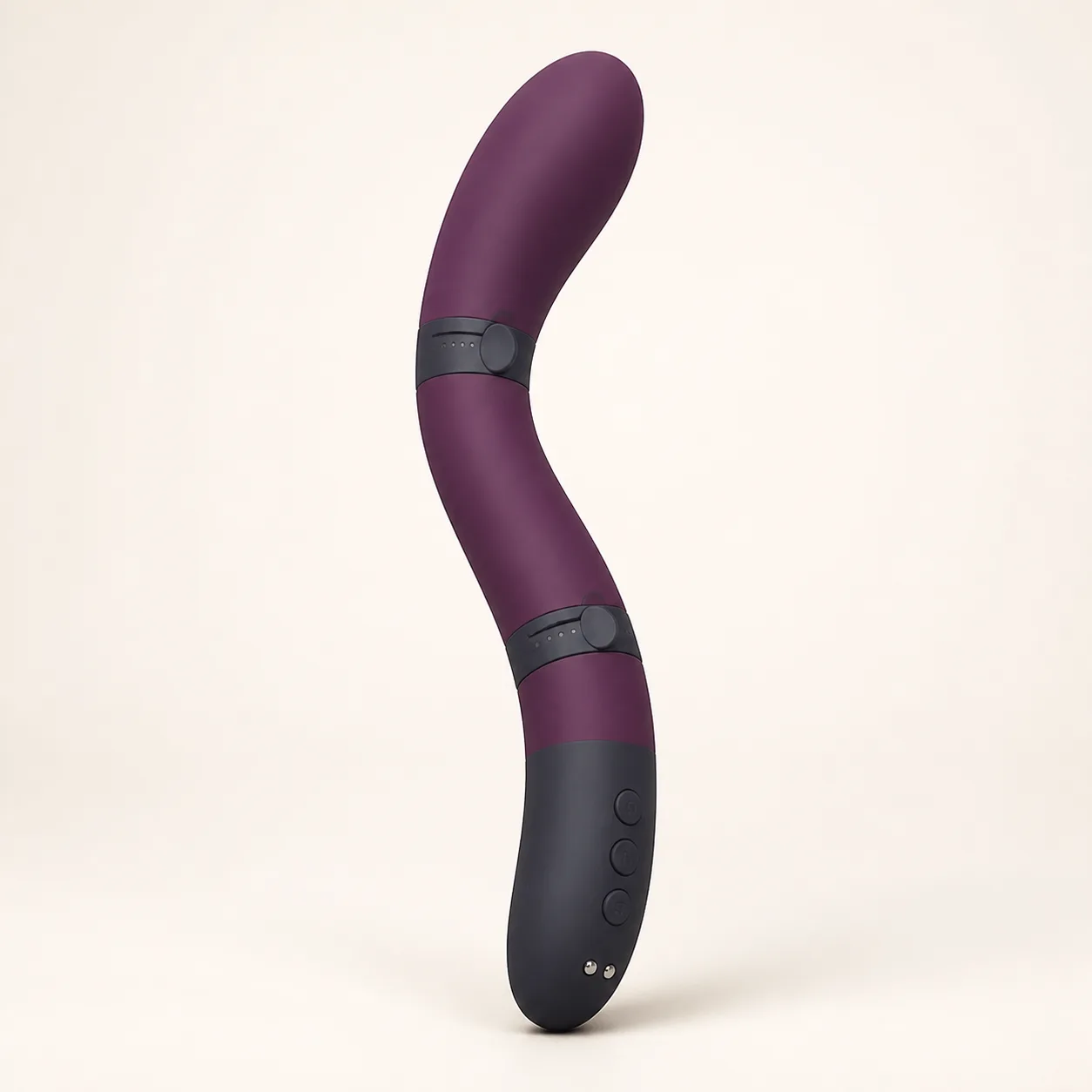
Dual-Pivot Angle-Lock Curved Vibrator with Tapered Oval Head
A slim rechargeable curved vibrator concept with two independently indexed angle-lock pivots, a tapered oval head and three local grip controls.
33,99 $
200 in stock
Two indexed pivots shape one slim curved vibrator
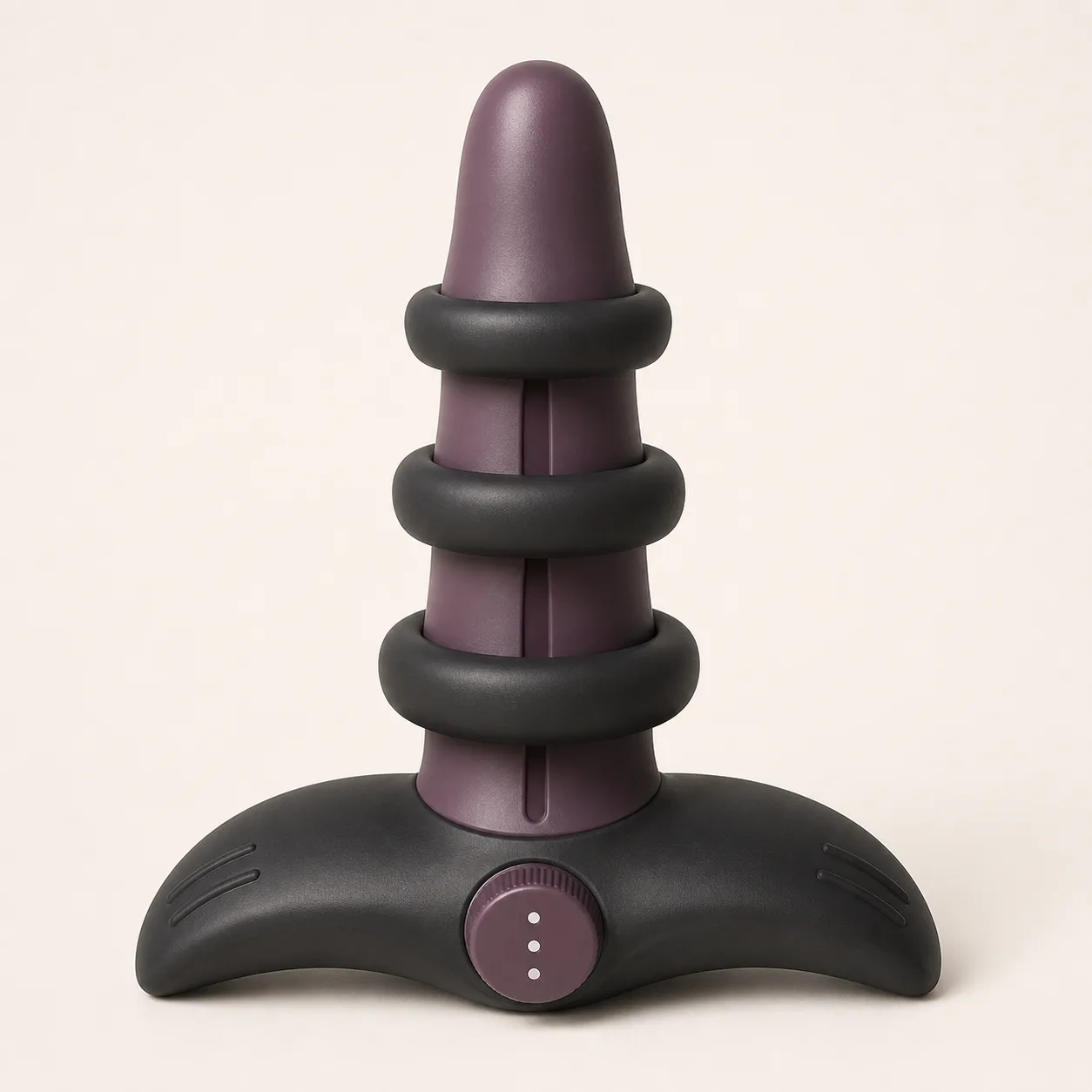
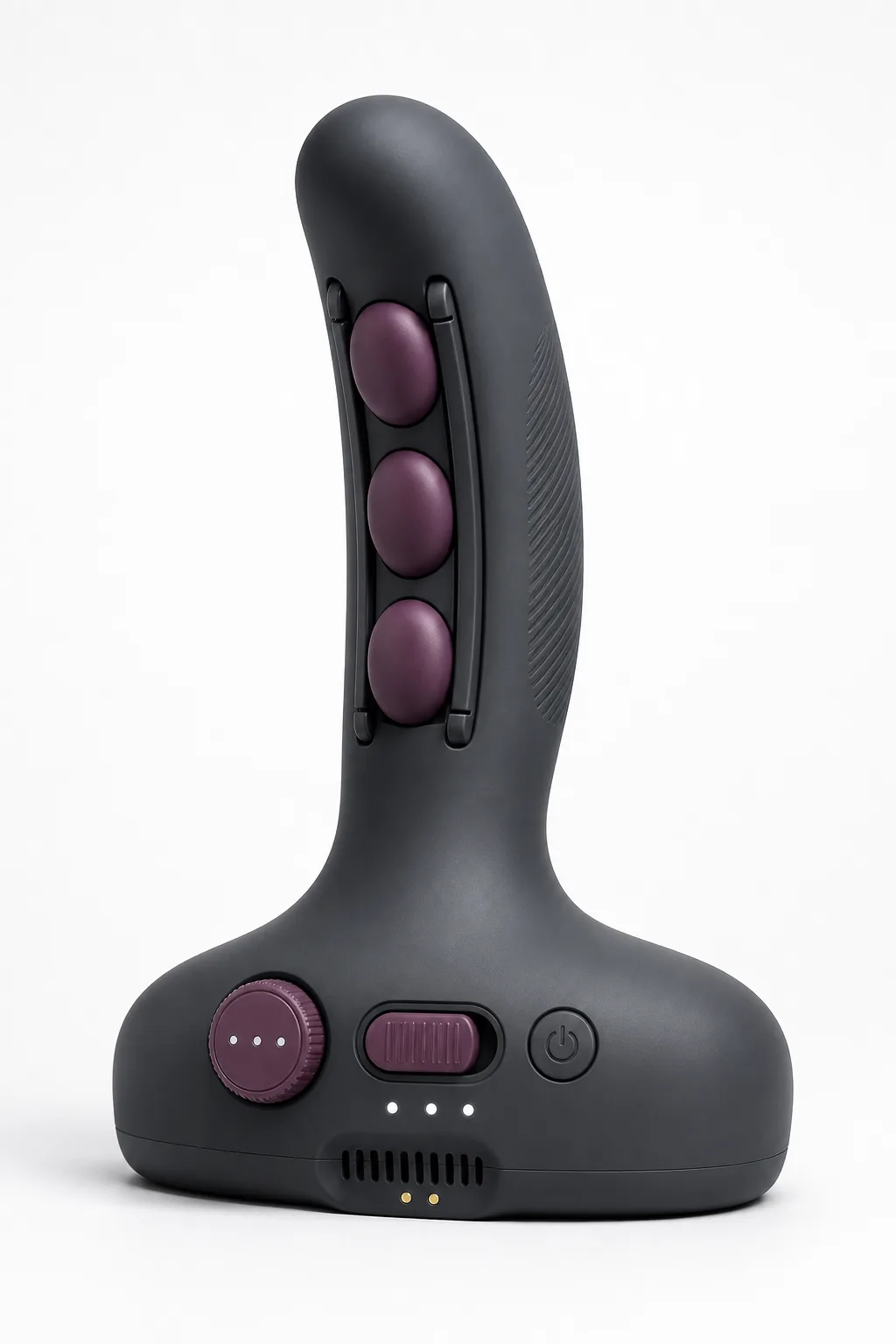
This dual-pivot curved vibrator concept places two low-profile charcoal angle-lock collars between a deep-plum tapered oval head and a three-button grip. Each joint has a broad release tab and visible position dots so the upper and lower arcs can be evaluated independently.

The mechanical geometry adds fit options, but every locked angle introduces load, pinch and cleaning questions that a fixed-shape vibrator does not have.
Identify every rigid segment and hidden joint part
Map the oval head, upper body segment, upper collar, center segment, lower collar, grip, controls and charge contacts. Ask the supplier to disclose internal pins, teeth, springs, bushings, seals, motor mounts, wires, adhesives and strain relief.
External position dots do not establish the mechanism inside.
Measure the straight and articulated envelopes
Record total length, maximum head width, segment diameters, collar diameters, grip length, mass and center of gravity with both joints neutral. Repeat overall reach, lateral offset and profile height at every allowed upper and lower setting.
The insertable boundary, usable dimensions and minimum safe bend geometry remain pending.
Chart each pivot without combining assumptions
Operate one release tab at a time while the other joint stays locked. Measure every positive angle, direction of movement, stop position, actuation force and whether the collar can rotate beyond its marked arc.
Create a two-joint matrix rather than treating both pivots as identical.
Test lock strength, wobble and creep on a fixture
At every permitted position, apply controlled bending and torsional loads below written supplier limits. Record angular play, collar movement, tab lift, segment twist and permanent offset before and after a timed hold.
A joint that creeps, skips a tooth or releases without deliberate tab pressure fails qualification.
Probe pinch gaps throughout the full movement path
With power off, use a standardized soft gauge around collar edges, release tabs and segment transitions while slowly articulating each joint. Repeat with the neighboring joint at its extreme approved positions.
No skin-contact area should enter a closing gap, expose a hard ridge or trap residue.
Cycle articulation before trusting repeated adjustment
Run a defined unlock, move, lock and load sequence across the complete angle matrix. At planned intervals, remeasure tab force, play, stop position, surface seams and electrical continuity.
Rising friction, cracking, looseness, intermittent power or loss of a positive stop requires retirement.
Map vibration transfer at every locked profile
Secure the grip on an instrumented fixture and measure output at the head, both collars and center segment for every available power setting. Compare neutral, single-bend and compound-bend profiles.
Amplitude, frequency, pattern count, noise, resonance and battery draw require production-sample testing.
Document local controls and full shutdown
Identify the three buttons by physical position, then record startup hold, intensity and pattern order, last-setting memory, indicator behavior and complete power-off sequence. Repeat after charging and after articulation cycles.
No app or remote is planned, so essential control must remain reachable at the grip.
Adjust the pivots only while fully removed
Power off, separate the product from the body, support both sides of one collar and press its release tab before changing angle. Confirm a positive lock with a light external check, then repeat for the other joint.
Never force a bend, unlock a collar during insertion or use the head as leverage against a jammed mechanism.
Use comfort and control as stop conditions
Begin with a conservative verified shape, abundant compatible lubricant and the lowest tested vibration setting. Keep the grip and shutdown buttons under direct control.
Stop for pain, numbness, unusual pressure, bleeding, loss of grip, a moving collar, unexpected noise or a shape that cannot be removed comfortably.
Validate battery, wiring and joint strain relief
Request cell chemistry, rated capacity, charge voltage and current, cable specification, charge time, runtime method, cycle life, transport paperwork and thermal protection. Inspect how conductors cross both moving joints and test continuity through the angle matrix.
Do not charge while worn, wet, hot, damaged or unattended, and do not claim an ingress rating without exact evidence.
Confirm materials, seams and compatibility
Obtain composition for all contact surfaces, collars, tabs, rigid segments, pigments, seals, bushings, wire jackets and adhesives. Review hardness, porosity, restricted-substance and skin-contact evidence for the exact revision.
Lubricant, cleaner and barrier compatibility must be verified rather than inferred from appearance.
Clean joint recesses and dry before articulation
Switch off and follow confirmed mild-cleaning instructions. Hold each joint only at approved external angles while using a soft swab around collar seams and release-tab recesses; never force liquid through a moving gap.
Dry the head, segments, both collars, controls and contacts completely before cycling the locks or charging.
Price the two-joint mechanism above a fixed curve
An Alibaba showroom lists a conventional rechargeable ergonomic curved vibrator at USD 5.67-6.41 with a one-piece minimum. It is a category benchmark only and does not establish this dual-pivot angle-lock design, a legal supplier or a production quotation.
The procurement reference supports an EUR 33.99 planning price after allowing for China-origin freight, exact-model quotation, full angle and dimension mapping, lock-load and creep tests, pinch-gap probing, articulation cycles, output transfer, wiring and battery review, materials, lubricant and cleaning validation, protective packing and discreet fulfillment. Packed size, weight, freight, duty, tax, insurance, payment fees and destination terms require confirmation.
Frequently asked questions
Can both pivots be adjusted during use?
No. Power off and fully remove the product before changing either angle.
Do the position dots guarantee a secure lock?
No. Positive stops, holding loads, play and creep require fixture testing for every joint setting.
Can the device form any curve?
Only supplier-defined indexed positions should be used; forcing past a stop can damage the collar or internal wiring.
Does the vibrator need an app?
No app or remote is planned. Three local grip buttons are intended to manage essential functions.
How should the pivot seams be cleaned?
Use only confirmed mild methods and a soft swab around accessible recesses, then dry fully without flooding the joint.
Which faults require retirement?
A slipping collar, lifted tab, cracked seam, sharp gap, intermittent power, swelling surface, corroded contact, damaged cable or unusual heat.
Reviews
There are no reviews yet.