


Tri-Lobe Squeeze-Puck Manual Stroker with Three Finger Windows and Open-End Ripple Liner
August 14, 2026
Six-Fall Adjustable-Spread Sensory Flogger with Sliding Guard Collar
August 14, 2026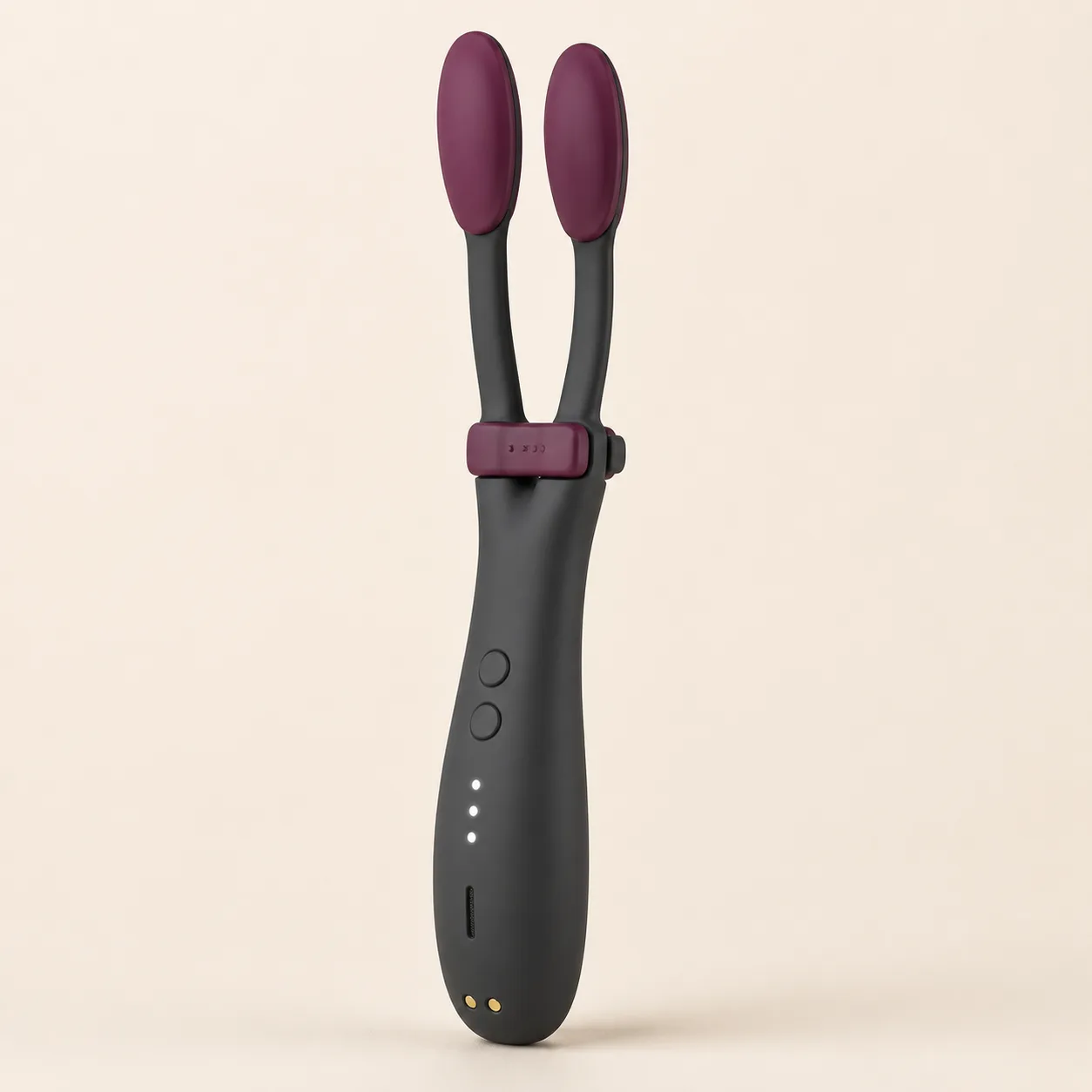
Three-Stop Spacing Twin-Fork Counter-Phase Vibrator
A slim rechargeable vibrator concept with two parallel flexible fork arms, two oval contact tips and a proposed three-stop spacing slider.
43,99 $
200 in stock
Drive two fork tips in proposed counter-phase
This twin fork vibrator concept divides a slim handle into two parallel flexible arms, each ending in one shallow oval contact tip. A guarded three-stop slider is proposed to change the gap while a counter-phase program would move or vibrate the two tips with opposite timing.

The image does not prove spacing range, tip parallelism, counter-phase behavior, independent motors, output, materials, ingress protection, runtime or supplier approval.
Inventory both fork channels
Request an exploded drawing and bill of materials for both tip skins, tip cores, carriers, fork arms, flexure zones, slider, crossbar, tracks, detents, lock tab, guards, hard stops, actuators, counterweights, sensors, frame, shell, controls, indicators, vent, cell, contacts, conductors, seals, pigments, lubricants and adhesives.
Identify shared drives and every part that transmits spacing force into the fork roots.
Measure the neutral geometry
Record overall length, handle width, fork length and thickness, root fillets, tip dimensions, face angle, neutral gap, axial offset, slider travel, guard clearance, control positions, vent area, contact spacing, mass and center of gravity.
Repeat after a standardized rest period at each verified spacing state.
Characterize both flexible arms
Measure inward, outward, lateral and torsional load-deflection, stiffness, hysteresis, springback, neutral drift and permanent set for each arm. Compare the pair under identical tip forces.
Inspect flexure roots for molding lines, voids, reinforcement proximity, hard spots and strain concentration.
Calibrate the three spacing stops
Measure slider travel, tip gap, detent engagement, lock force, false seating, backlash and repeatability at every proposed stop. Approach each position from narrow and wide directions with no load and standardized arm deflection.
The three visible marks are references only until the gap and retention are proven.
Verify tip parallelism through adjustment
Track pitch, roll, yaw, face plane, height and lateral shift for both tips across spacing stops and compliant loads. Record whether one arm leads or twists as the slider moves.
Reject a state where faces converge unexpectedly, touch each other or expose a carrier edge.
Measure counter-phase timing
Record startup, peak, crossover, dwell, decay and neutral parking for both tips in every supported direction or program. Repeat across battery states, temperatures, spacing stops and compliant loads.
Log phase drift, skipped cycles, asymmetric amplitude and transitions that drive both tips toward the gap simultaneously.
Characterize output and handle transfer
Measure three-axis acceleration, dominant frequency, harmonics, rise, decay, sound and current at each tip, fork root and handle. Compare isolated, paired, synchronized and counter-phase operation where supported.
Shared structure can transfer output even when a nominal channel is inactive.
Map contact pressure at both tips
Use instrumented compliant fixtures to record contact footprint, peak and edge pressure, shear, rocking and migration at every spacing state. Repeat with centered and slightly offset contact on one or both tips.
Set limits from the highest local peak, arm strain and tip misalignment rather than average combined force.
Probe the center gap and slider track
Inspect tip-to-tip, arm-to-arm, slider-to-root, crossbar, track, detent, lock and guard clearances throughout adjustment, vibration and loading. Use articulated probes from all directions.
Reject a gap that pinches hair, film or loose material, closes under load, traps residue or blocks visual inspection.
Test grip and controls at all widths
Record grip friction, wrist moment, button force, accidental presses and indicator visibility with dry and damp hands. Confirm slider movement cannot distort the control panel or trigger a program.
Verify startup hold, level changes, channel or phase selection, pause, immediate stop, memory and lockout.
Verify battery and charging behavior
Confirm cell chemistry, capacity, protection, charger input, contact polarity, charge time, runtime method, low-charge indication, storage voltage, charging interlock and transport paperwork. Inspect conductors where they split into both fork arms.
Test contact contamination and cable-free charger misalignment without claiming waterproofing.
Test heat and asymmetric obstruction
Log temperature at both tips, arms, roots, slider, handle, controls, vent, contacts, actuator zones and cell. Obstruct one tip, then load both tips unequally using protected fixtures.
Verify current limiting, shutdown, neutral release, cool-down and restart behavior without forcing a flexed arm by hand.
Cycle spacing, flex, phase and cleaning
Run repeated width changes, lock seating, individual and paired arm deflection, supported programs, immediate stops, charging, cleaning, measured drying and storage. At checkpoints repeat geometry, stiffness, gap, parallelism, timing, output, pressure, current, sound and heat tests.
Validate cleaning beneath tip edges, along both arms and roots, inside the central gap, through the slider track, around guards, controls, vent and contacts.
Price after paired-arm validation
An Alibaba mini-vibrator showroom currently displays an app-controlled mini-vibrator category example at USD 2.55-3.15 with MOQ one hundred. It is a category benchmark only and does not confirm this twin-fork geometry, three-stop spacing slider or counter-phase drive.
The procurement reference supports an EUR 43.99 planning price after allowing for China-origin freight, exact-model sourcing, teardown, fork metrology, dual-arm load curves, spacing calibration, loaded parallelism, phase analysis, tip output, pressure maps, gap inspection, controls, battery, heat and obstruction review, combined fatigue, material evidence, cleaning validation, protective packing and discreet fulfillment. Exact quotation, MOQ, packed size, weight, freight, duty, tax, insurance, payment fees and delivery terms remain pending.
Frequently asked questions
Are the two tips independently powered?
Motor count, channel assignment and shared-structure transfer remain pending teardown.
Do the three marks guarantee three widths?
No. Tip gap, detent engagement and repeatability must be measured at every stop.
What does counter-phase mean?
The proposed timing alternates the two tip outputs, but actual phase requires instrumentation.
Can the arms be bent by hand?
Only within verified load and deflection limits; forced bending can damage the roots.
Is the center gap easy to clean?
That requires validated access beneath tips, along roots and through the full slider track.
Which faults require retirement?
A cracked root, permanent arm bend, loose tip, closing gap, false slider lock, exposed conductor, swollen cell, erratic phase or abnormal heat.
Reviews
There are no reviews yet.