



Blue Rabbit BR-HB2505 Red App and Remote 9-Mode Wearable Panty Vibrator
August 14, 2026
Three-Pad Differential-Stroke Tapping Wand with Timing Collar
August 14, 2026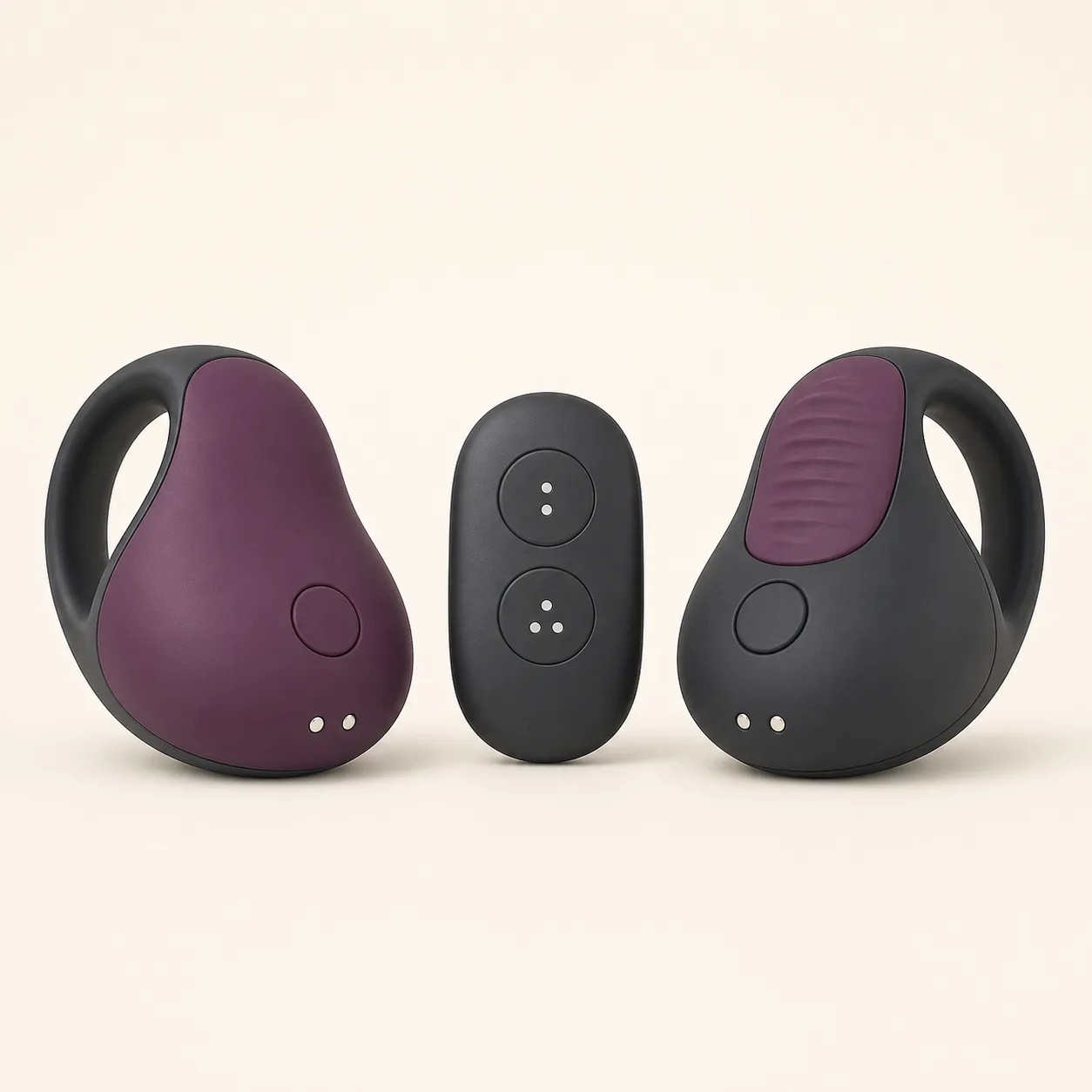
Paired Finger-Loop Couples Vibrator Set with Dual-Channel Remote
A paired couples vibrator concept with two differentiated finger-loop pebble pods, independent local controls and one dual-channel handheld remote.
44,99 $
200 in stock
A pair is more than two identical devices
This paired couples vibrator set concept contains two separate finger-loop pebble pods and one handheld remote with two control zones. The plum pod uses a broad smooth face, while the charcoal pod adds a raised plum ridge; both are planned for controlled external contact only.

The image does not prove materials, motor specifications, radio pairing, waterproofing, charging accessories or simultaneous operation.
Verify the complete set before assigning users
Open one sealed production sample and inventory pod A, pod B, the remote, charging equipment, instructions, identifiers and any storage item. Record serial numbers or other durable marks that distinguish each electronic unit.
A color difference alone is insufficient if future production colors or replacement components may vary.
Measure each pod instead of copying one data row
Record length, width, thickness, mass, loop opening, contact-face area, button position and charge-contact location for both pods separately. Note balance and the distance from the loop to the active contact surface.
The raised ridge on one concept pod creates a different geometry, so the two units must not inherit the same fit description.
Check finger-loop fit with a graduated gauge
Measure relaxed opening and low-force expansion across a set of smooth finger-size cylinders. Inspect the inner edge for pinching, excessive compression, seam ridges or a loop that rolls toward the knuckle.
The loop is a handhold, not a body restraint, and must be removed promptly after numbness, tingling, color change or swelling.
Label remote channels with a durable physical system
Assign one remote zone to each pod and verify the mapping after power cycling, full charging and battery depletion. The production design needs tactile or visual differentiation that remains understandable without relying on a phone.
Document the channel labels in the quick-start instructions and on the storage layout.
Prove that commands cannot cross between channels
Run a matrix covering every button, press length and pod state. A command for pod A must not start, stop or alter pod B unless a clearly labeled synchronized mode has been intentionally selected.
Repeat the matrix near other wireless devices and with several identical sets operating in the same room.
Test pairing recovery after common interruptions
Switch one pod off, move it beyond range, deplete its battery and interrupt the remote during operation. Record the state of both pods after the link resumes and confirm that neither restarts at an unexpected intensity.
A safe recovery state is off or a documented low state that requires deliberate confirmation.
Keep independent local shutdown on both pods
Each pod must have a reachable physical control that powers it down without the remote. Verify the hold time with dry and lightly damp fingers while the product rests in a representative external position.
If local shutdown depends on a working wireless link, the set does not pass this evaluation.
Measure range as a reliability envelope
Test line-of-sight distance, one-room separation, body blocking, pocketed remote use and nearby radio interference. Log latency, missed commands, repeated commands and the exact behavior when the connection fails.
Advertised maximum distance cannot substitute for a conservative tested operating range.
Compare output without assuming perfect matching
Mount both pods on the same soft fixture and log output, sound and pattern timing at every setting. Swap channels and repeat to separate motor differences from remote-command differences.
A paired set may intentionally provide two contact profiles, but both must still respond predictably to their assigned controls.
Track two batteries as separate wear items
Record charge time, runtime, low-battery indication, current draw and shutdown behavior for pod A and pod B across repeated cycles. Note whether the remote has its own rechargeable cell or a replaceable battery and document it independently.
Partners should not assume equal remaining runtime just because both pods started together.
Charge in a layout that prevents cable confusion
Confirm connector polarity, input rating and stable contact on a dry nonflammable surface. If one lead serves two pods, test simultaneous charging and verify that heat, charge completion and cable strain stay within documented limits.
Disconnect all power before operation or cleaning and keep magnetic contacts free of metal debris.
Log heat on each contact face and shell
Measure temperature at the motor area, loop junction, battery region and charging contacts of both pods at fixed intervals. Repeat at matched settings after fresh charging and later battery cycles.
Stop after abnormal odor, swelling, unexpected output change, control delay or any temperature beyond the supplier’s documented limit.
Separate hygiene records for shared equipment
Assign each pod to one user during a session, clean it before reassignment and avoid moving a device between people or body areas without a new barrier and compatible cleaning step. The remote also needs cleaning because both partners may handle it.
No immersion is planned until model-specific ingress evidence is verified; wipe seams, buttons, loops and charge contacts according to confirmed material instructions.
Price the pair, remote and validation as one package
An Alibaba vibrator-couples showroom lists a wireless couples vibrator with app control at USD 2.85-3.56 and MOQ 1. That may be a single device rather than this two-pod set, so the legal supplier, paired-set quote, handheld remote, materials, batteries, wireless protocol and all performance claims remain pending.
The procurement reference is a component benchmark only. The EUR 44.99 plan allows for China-origin freight, complete-set and identifier checks, geometry inspection, loop-fit testing, channel-isolation and pairing trials, radio range and dropout testing, independent shutdown, dual-output and battery comparison, charging and temperature review, cleaning trials, protective packing and discreet fulfillment; packed size, weight, freight, duty, tax, insurance, payment fees and destination terms require confirmation.
Frequently asked questions
Can one remote control both pods at once?
Simultaneous control is not assumed. Channel mapping and any synchronized mode must be verified and clearly labeled.
What happens if the remote disconnects?
Testing must confirm an off or documented low recovery state with no unexpected restart.
Can each pod be stopped without the remote?
That is a required qualification point; both pods need an accessible independent local shutdown.
Are the two finger loops the same size?
They must be measured separately because pod geometry and production tolerances may differ.
Can partners exchange pods during use?
Not without a fresh barrier and compatible cleaning step; assigning one pod per person is the clearer plan.
Which faults disqualify the set?
Cross-channel commands, unsafe dropout behavior, failed local shutdown, unstable charging, excessive heat, loop pinching, battery swelling, surface damage or inconsistent pairing.
Reviews
There are no reviews yet.