



Fuchsia U-Shape Wearable Couples Vibrator with Fan-Groove and Triple-Groove Paddles
August 14, 2026
Red Rose-Head LCD 9-Mode Rechargeable Wand Vibrator
August 14, 2026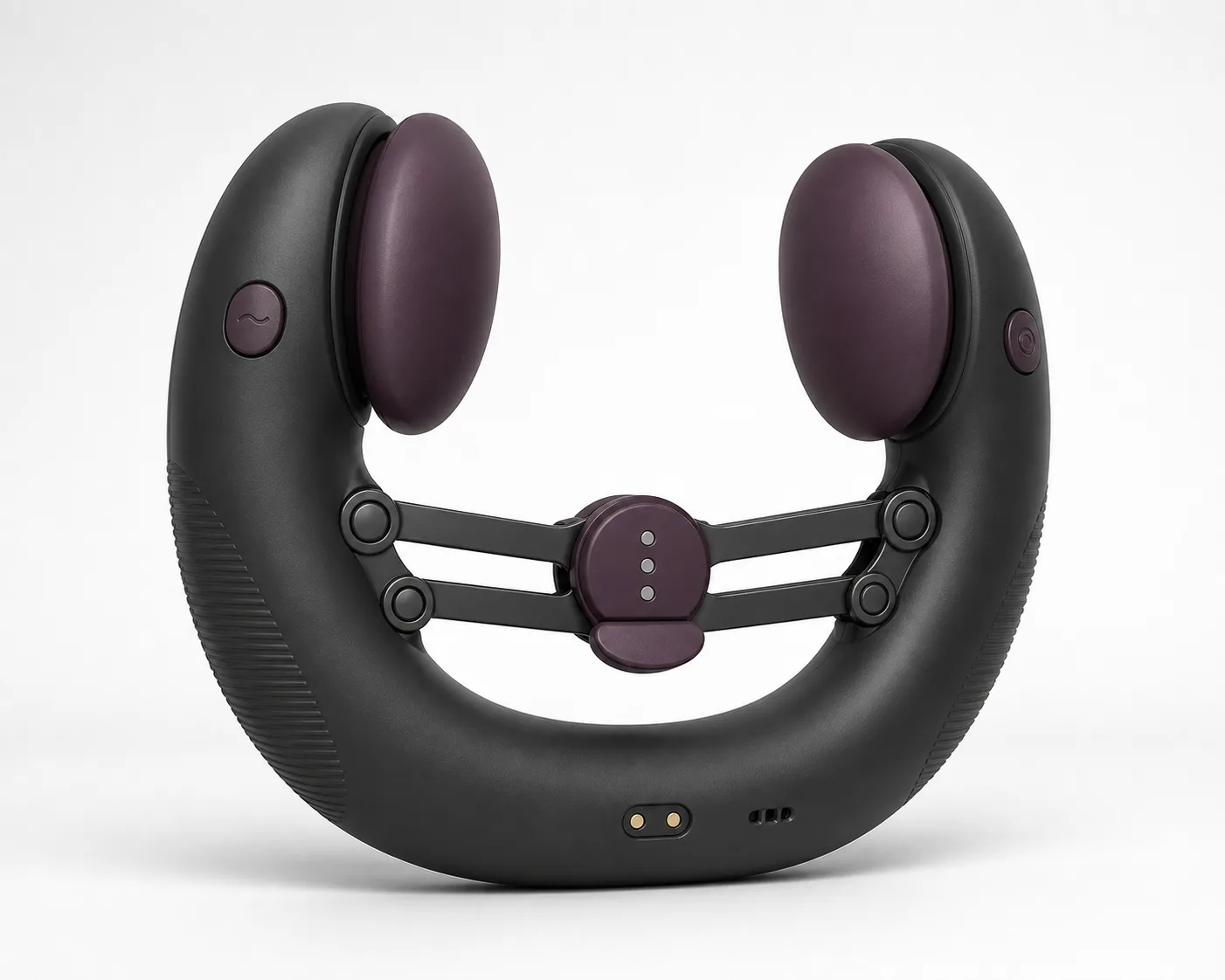
Twin-Pad Parallel-Link Couples Vibrator with Three-Stop Span Cam
An adjustable couples vibrator concept with two oval contact pads, a paired parallel-link bridge, three indexed span states and a broad quick-release tab.
72,99 $
200 in stock
Compare two contact pads through one parallel-link bridge
This twin-pad parallel-link couples vibrator concept places exactly two smoky-plum oval pads on short charcoal arms around an open U-shaped yoke. Two slim bridge links and guarded pivots are intended to keep the pads parallel while a three-stop span cam changes their spacing.

The render does not prove span range, pad parallelism, clamp force, vibration output, fit, materials, ingress or manufacturing availability.
Inventory both arms bridge and electrical path
Require a bill of materials for pads A and B, pad carriers, arm shells, output modules, eccentric masses or other actuators, bearings, bridge links L1 and L2, pivot pins, bushings, guards, travel stops, span cam, detents, release tab, opening bias, controller, cell, buttons, indicators, conductors, strain reliefs, contacts, vent, yoke shell, grip zones, seals, coatings, pigments, lubricants and adhesives.
Trace shared and independent mechanical and electrical dependencies before assigning dual-channel behavior.
Measure neutral geometry span and balance
Record yoke height and width, opening area, pad center spacing at each cam stop, pad angles, arm lengths, link lengths, pivot axes, clearances, stop locations, base curvature, grip thickness, mass and center of gravity.
Measure while unloaded and on calibrated fixtures, then repeat after output, flex, charging, cleaning and storage cycles.
Profile pads A and B independently
Map each pad face, edge radius, crown, compliant layer thickness, carrier boundary, local hardness, friction, deformation and attachment. Compare left-to-right symmetry without assuming the plum surfaces are identical.
Reject delamination, hard carrier exposure, thin edges, tack, pigment transfer, surface tearing or a pad that rotates unintentionally.
Verify parallel-link kinematics across travel
Track both pad centers and normals through the full mechanism path. Measure parallelism error, link angle, pivot play, side drift, backlash, binding, over-center behavior and load-dependent skew at every cam stop.
Guarded pivots and paired links must be confirmed by teardown; the image alone cannot establish true parallelogram motion.
Calibrate the three-stop span cam
Measure cam angle, detent force, indication, pad spacing and holding force at all three states approached from both directions. Repeat with symmetric and offset loads and after wear cycles.
Reject false seating, spontaneous state changes, excessive release force or a stop that drives contact pressure outside the approved envelope.
Test the broad quick-release tab
Measure tab force, travel, recognition, cam disengagement, arm opening and reset from every span state, output program, battery condition and permitted load. Confirm access without reaching between moving links.
The fastest opening path must not require cycling through a tighter setting or waiting for software.
Map contact pressure and holding force
Use instrumented compliant fixtures to record contact area, normal pressure, edge peaks, holding force, slip onset and pressure relaxation at pads A and B. State fixture shape, compliance, lubrication state and span stop.
Reject hard carrier contact, local edge peaks, progressive tightening, unstable asymmetry or force that remains high after release.
Characterize differential vibration output
Record acceleration, dominant frequency, harmonics, startup, coast-down and phase at each pad, arm, bridge link and yoke for every confirmed program. Test unloaded and under standardized symmetric and offset compression.
Quantify cross-coupling, cancellation, link resonance and any program in which one pad exceeds its accepted output band.
Check motion fit and yoke stability
Measure housing migration, arm twist, bridge rocking, grip torque and pad alignment while fixtures move through bounded translation and rotation. Compare all three span states and synchronized versus differential outputs.
No hands-free or anatomy-fit claim is accepted without exact geometry, controlled fit trials and documented load limits.
Screen pivots links seams and pinch gaps
Probe pad rims, carrier joints, arm gaps, four pivot caps, link edges, cam perimeter, release tab, yoke seam, buttons, contacts and vent while adjusting and vibrating. Record minimum gaps and relative motion.
Reject accessible pinch or shear zones, exposed pin ends, link collision, sharp stops, loose guards or lubricant migration onto contact surfaces.
Verify controls battery charging and ingress
Document each arm button, startup, program selection, differential rules, pause, stop, memory and travel lock. Confirm cell chemistry, capacity, input limits, charge time, runtime, polarity, protection circuits, indication and charging interlock.
Map pad joints, arm seams, pivots, controls, yoke split line, contacts and vent. No ingress rating is assumed without exact-model evidence.
Log current sound heat faults and shutdown
Measure current, A-weighted sound and temperatures at pads, actuators, arms, pivots, links, cam, controller, battery, contacts and vent. Challenge restrained pads, jammed pivots, blocked release, link obstruction, low voltage and power interruption in protected fixtures.
Confirm stop timing, release priority, overcurrent behavior and safe cooling without accepting an undocumented automatic recovery.
Validate cleaning access and cycle durability
Define wiping, washing, rinsing and measured drying for verified removable or sealed parts. Inspect pad rims, pivots, links, cam, release tab, grip texture, seams, controls, contacts and vent for residue and moisture traps.
Cycle span changes, release actions, output, compression, yoke flex, charging, cleaning, drying and storage. Retire for torn pads, carrier lift, rising pivot play, pin migration, link cracks, cam drift, delayed release, intermittent output, abnormal heat, cell swelling or persistent residue.
Build landed price after bridge verification
An Alibaba wearable-vibrator page showed a remote wearable couples category example at USD 7.99-9.99 with MOQ one. It is a benchmark only and does not confirm this twin-pad parallel-link architecture or an approved supplier.
The procurement reference supports an EUR 72.99 planning price after allowing for China-origin freight, exact-sample sourcing, pad and bridge teardown, span and parallelism metrology, cam and release calibration, contact pressure, output transfer, movement, pinch, controls, charging, current, sound, heat, protected faults, cleaning and cycle testing, protective packing and discreet fulfillment. Exact quotation, MOQ, materials, battery, packed size, weight, freight, duty, tax, insurance, payment fees, certifications and delivery terms remain pending.
Frequently asked questions
Do the pads stay parallel at every span?
Pad-center tracking and angular error require instrumented testing under load.
What do the three cam stops change?
Actual pad spacing, holding force and contact pressure at each stop remain pending.
Can each pad run a different pattern?
Controller channels, actuator allocation and differential program behavior require exact-sample evidence.
How quickly does the release tab open the yoke?
Release force, arm travel and timing must be measured across span, output and battery states.
Is the device waterproof?
No ingress rating is claimed for pad joints, pivots, seams, controls, contacts or vent.
Which defects require retirement?
Torn pads, loose carriers, pivot play, pin migration, link cracks, cam drift, delayed release, heat, swelling or residue.
Reviews
There are no reviews yet.